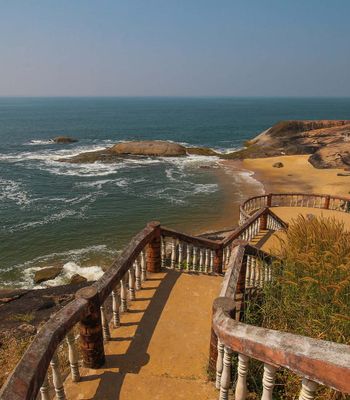
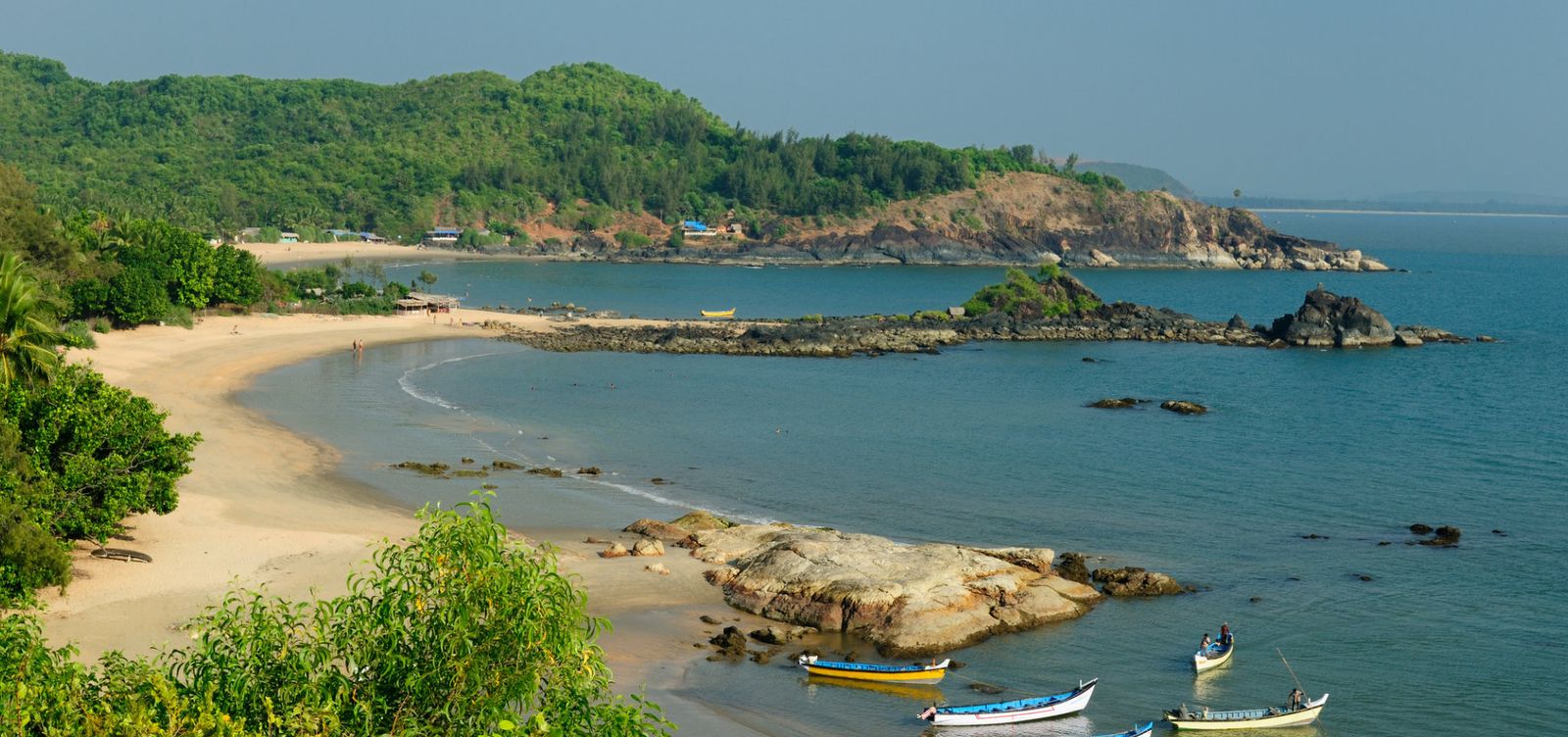
From the clifftop trail that links Gokarna's beaches like beads on a rough string, you see it before you arrive — two crescent coves meeting at a rocky headland, their silhouette tracing the Sanskrit character for "Om." In a country where the sacred and the geological constantly collapse into one another, the resemblance feels less like accident than inevitability. OM Beach lies on Karnataka's western coast, about 490 kilometers from Bangalore, in a town that served Hindu pilgrims for centuries before the first backpacker unrolled a sleeping bag on its shore. That dual identity persists, and it's remarkably unforced. Temple bells carry faintly across the water from Gokarna proper while travelers doze on the sand below. Neither constituency pays the other much mind.
A Shape That Earned Its Name
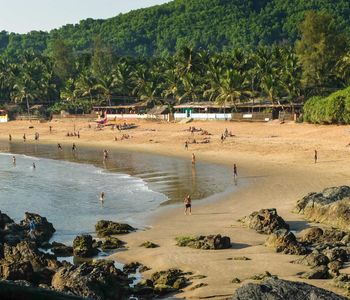
The two semicircular bays stretch roughly 1.5 kilometers end to end, divided by a jut of rock you can scramble across when the tide drops. The southern cove pulls the bigger crowd — shack restaurants cluster along its rim, and fishing boats rest keel-up on the sand, their painted hulls facing the Arabian Sea. Walk north and the mood shifts: rockier, emptier, scored with tide pools where small crabs explode sideways at the shadow of your hand.
But the shape, famous as it is, isn't really what sets this beach apart. It's the scale. Laterite cliffs rise sharply on both flanks, steep enough to create an enclosure you almost never feel on an open-ocean shore. You're held by the landscape rather than thrown against it. Late afternoon light hits those cliff faces and turns them a deep rust-orange — a color so particular to coastal Karnataka it functions as a kind of geological accent, unmistakable once you've seen it.
The Trail That Delivers You
Two routes lead here, and the one you pick reveals the trip you're having. Route one: a rattling auto-rickshaw from Gokarna town, roughly six kilometers on a road that narrows without warning. Drivers charge between 150 and 250 rupees, calibrated to your bargaining stamina.
Route two — and the one worth earning — is the cliff trail from Kudle Beach. Twenty minutes on foot, winding through scrubby brush and exposed rock. Nobody has marked it with any conviction, but steady foot traffic has beaten it obvious enough. Wear real shoes. Flip-flops and loose gravel on a cliff edge is a story that ends badly. At the trail's apex the entire Om shape unfolds beneath you, and you grasp instantly why someone reached for that name. From sea level, it's a beautiful beach. From above, it's a diagram — geometry that looks deliberate, drawn by a hand much older than yours.
What the Shacks Get Right
The restaurant shacks lining the southern cove exist in a state of cheerful impermanence. Bamboo and tarpaulin, they materialize each October as the monsoon retreats and disassemble by June when the rains return. Menus barely differ — fried fish, dal, banana pancakes, chai — but execution varies enough that regulars develop loyalties bordering on tribal.
Fresh catch is the only ordering principle that matters. If a boat came in that morning, eat whatever it landed. Kingfish grilled over coconut husks, served with a lime wedge and a hill of rice, runs around 200 rupees and quietly humiliates meals costing ten times as much in Goa. The chai arrives sweet, milky, and scalding in small glasses that will brand your fingertips. Don't hurry it. The shacks run on their own clock, and syncing to that tempo is half the reason you came.
Here's the thing nobody expects: those shacks actually make the beach better, not worse. Across much of India, beach commerce means poured concrete, thumping speakers, and permanent encroachment. Gokarna's seasonal economy keeps the coastline honest. When the monsoon arrives, everything washes away, and the sand belongs to the sea again. The impermanence is the point.
Staying Close to the Sand
At the simplest end, bamboo huts sit directly on the beach — some without electricity. You get a thin mattress, a mosquito net, and waves for an alarm clock. That's the transaction. Rates run between 500 and 1,500 rupees per night, depending on the season and your tolerance for spartan living.
For something with walls that don't flex in the wind, a handful of properties occupy the cliffs above the coves, offering air conditioning, hot water, and perspectives that earn the premium. SwaSwara, perched on the hill above the northern crescent, operates as an ayurvedic wellness retreat where silence during meals is encouraged. It inhabits a different cosmos from the backpacker shacks below, yet both share the same strip of coast without apparent friction.
Water, Rock, and the Art of Doing Little
Swim in the southern cove, where the gradient is gentler and the currents behave. The northern cove carries a stronger undertow, especially in the afternoon as the tide turns. Watch the locals. If fishermen aren't in the water, take the hint.
Boat rides to neighboring Half Moon and Paradise beaches leave from the southern end throughout the day. Fishermen moonlight as taxi operators, charging 300 to 400 rupees for a return trip. Paradise Beach, the most remote of Gokarna's five main stretches, is reachable only by boat or a punishing trail. The solitude there is absolute. No shacks, no power lines, just sand and a silence so thorough it becomes almost physical.
Back on OM Beach, kayaking has gained ground in recent seasons. Rental operators set up near the shacks during peak months, and paddling along the cliff base uncovers small caves and rock formations completely invisible from shore. Go early, before the wind rises and the sea surface trades its glass for chop.
When the Calendar Matters
October through March is the window — dry skies, manageable heat, water calm enough for swimming. December and January pull the thickest crowds: European backpackers and domestic visitors from Bangalore and Mumbai, often on the same patch of sand, often eyeing each other's lunch. February is the sweet spot. Weather holds. The holiday surge has passed.
June through September, stay away entirely. The monsoon doesn't merely dampen OM Beach — it erases it. Waves slam the cliff base, the shacks vanish, and the trails turn treacherous with wet laterite. The beach lives on borrowed time each year, rebuilt by human hands every autumn. That cycle of obliteration and return gives it a quality no permanent resort shore can touch — the feeling that nothing here is owed to you.
A Beach That Still Knows Its Own Name
OM Beach hasn't escaped change. Every season delivers more visitors, more guesthouses creeping up the hillside, more outboard motors splitting the morning quiet. But something in Gokarna's deeper identity — a temple town, serious, unhurried, fundamentally uninterested in performing for outsiders — keeps the beach tethered. The sand still smells of salt and coconut husk smoke. Fishermen still haul nets at first light. The cliff trail still demands your full attention. Come here not for polish or spectacle, but for a stretch of coastline that hasn't yet forgotten what it was before anyone thought to arrive.