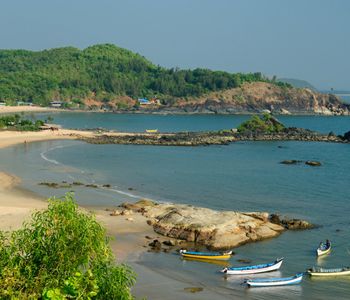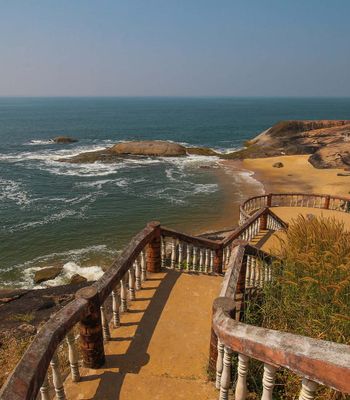
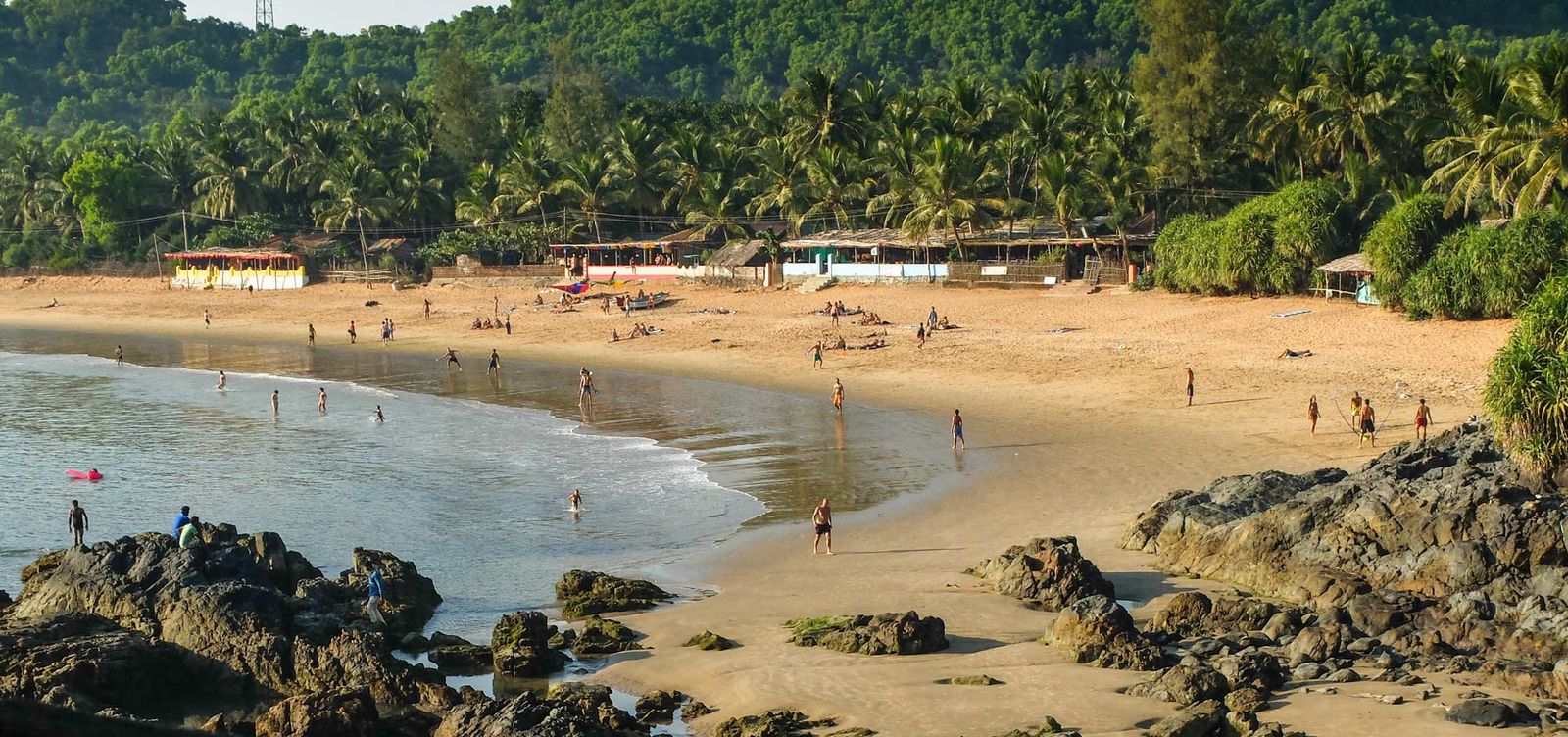
Gokarna's beaches don't announce themselves. There are no neon-lit shack strips, no touts waving laminated menus, no thumping bass at noon. Instead, you walk a red-dirt trail through scrubby coastal forest, the Arabian Sea flickering between the trees, and then the land simply falls away. Below, a crescent of sand meets water so clear it looks like someone forgot to add the ocean's usual murkiness. This is Gokarna Beach — the main town beach, where Hindu pilgrims in wet cotton walk past backpackers in board shorts, and neither group pays the other much attention. That indifference is the point. Gokarna has figured out something that Goa forgot decades ago: a beach town doesn't have to choose between spirituality and sand.
A Shoreline with a Second Life
For centuries, Gokarna was purely a temple town. Pilgrims came for the Mahabaleshwar Temple and its ancient Shiva lingam, not for sunbathing. The beach running along the town's western edge served a functional purpose — fishermen launched boats at dawn, cremation rituals took place near the waterline. Tourism arrived late, mostly in the 1990s, when travelers hunting a quieter alternative to Goa's party circuit drifted south along the Karnataka coast.
That late arrival preserved something essential. The town beach still carries its dual identity, unapologetically. On any given morning, you'll see a priest performing puja at the water's edge while a couple of French tourists unroll a yoga mat twenty meters away. Fishing boats still go out. Pyres still burn at the southern end. Gokarna Beach doesn't sanitize its purpose for visitors, and that rawness gives it a gravity that purely recreational shores never achieve.
Coarse Sand, Camphor Air
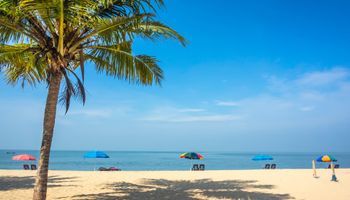
The main beach stretches roughly a kilometer, bookended by rocky headlands. The sand is coarse and tawny — nothing like the powder-fine white you'll find further south at OM Beach. Waves run moderate: strong enough to body-surf on a good day, gentle enough that local kids wade out unsupervised. The seabed drops off gradually, which makes it forgiving for swimmers who aren't confident in open water.
What separates this beach from its more photographed neighbors is the backdrop. The town presses right up against the sand. Temple gopurams rise above low-slung rooftops. The smell of burning camphor tangles with salt air. You're never more than a five-minute walk from a chai stall or a 1,400-year-old shrine, and that proximity between the sacred and the seaside creates an atmosphere no resort architect could ever draft.
Here's the thing about Gokarna Beach that nobody puts on a poster: it's the least scenic of the area's five main beaches, and by a comfortable margin the most interesting. Om Beach has the Instagram-ready shape. Half Moon Beach has the seclusion. Paradise Beach has the name. But none of them carry the human texture of the town beach, where daily life hasn't been displaced by tourism — it just shifted slightly to make room.
The Cliff Trail South
Most travelers use Gokarna Beach as a launchpad for the coastal trail connecting the area's beaches. From the southern end, a footpath climbs the headland and winds along the cliffs to Kudle Beach, then pushes on to Om Beach, Half Moon, and Paradise. The full walk takes about two and a half hours if you don't stop — but you will stop. Every headland reveals another cove, another jagged rock formation worth a long look.
Wear proper shoes, not flip-flops. The path gets steep in sections, with loose laterite gravel that turns treacherous after rain. Carry water — shade is intermittent and the Karnataka sun between October and March shows no mercy. Start early, before eight if you can manage it, and you'll share the trail with langurs and not much else.
Where Conch Shells Echo Through Granite
Turn your back to the ocean and Gokarna's narrow lanes pull you into a different century. The Mahabaleshwar Temple, one of the seven important Shiva pilgrimage sites in India, dominates the town's spiritual geography. Non-Hindus can't enter the inner sanctum, but standing in the temple's granite courtyard — listening to the rhythmic clang of brass bells reverberating off stone worn smooth by centuries of bare feet — you understand instantly why this town existed long before anyone thought to spread a towel on its beach.
The main street leading to the temple sells everything a pilgrim needs: coconuts, flower garlands, sacred thread, brass figurines. Street food here leans vegetarian, and the standout is goli baje — deep-fried gram-flour fritters, crispy on the outside, impossibly soft within. Eat them standing up at one of the stalls near the temple entrance. Wash them down with filter coffee served in a steel tumbler. You've spent about forty rupees on one of the best snacks in coastal Karnataka, and you haven't even sat down.
Timing Your Arrival
The sweet spot runs from October through February. Skies stay clear, humidity drops to bearable levels, the sea calms enough for comfortable swimming. December and January bring the thickest crowds — mostly domestic tourists and European backpackers — though "crowded" in Gokarna still means you can find an empty stretch of sand without much effort.
Avoid the monsoon months from June through September unless you have a genuine appetite for horizontal rain and shuttered beach shacks. The town doesn't close entirely, but the sea turns rough and the cliff trails become genuinely dangerous. March through May pushes past 35 degrees Celsius — punishing heat, though the ocean offers relief and accommodation prices drop noticeably.
Getting There, Checking In
Gokarna has its own railway station on the Konkan Railway line, connecting Mumbai to Mangalore. Trains from Goa take about three hours. From Bangalore, an overnight bus covers the 485-kilometer distance, arriving early enough for a sunrise walk on the beach. The nearest airport is Dabolim in Goa, roughly 150 kilometers north.
Accommodation near the town beach ranges from bare-bones guesthouses to mid-range hotels. Don't expect luxury — Gokarna isn't built for it, and that's a feature, not a flaw. A clean room with a ceiling fan and a sea-facing window runs between 800 and 2,000 rupees per night depending on the season. The budget places along the beach road are simple but adequate. Here, proximity to the sand matters more than thread count.
A Beach That Knows Its Own Name
Gokarna Beach doesn't compete with tropical postcard destinations, and it shouldn't try. Its power lies in the collision of the ordinary and the ancient — fishermen hauling nets beside temple processions, the drone of conch shells dissolving into breaking waves. You come here not to escape the world but to stand in a place where several worlds occupy the same narrow strip of coast without friction. Bring a book. Walk the cliff trail. Eat the fritters. Let the town's unhurried rhythm set your pace. Gokarna asks very little of you. In return, it offers something increasingly rare: a beach that hasn't forgotten its own story.