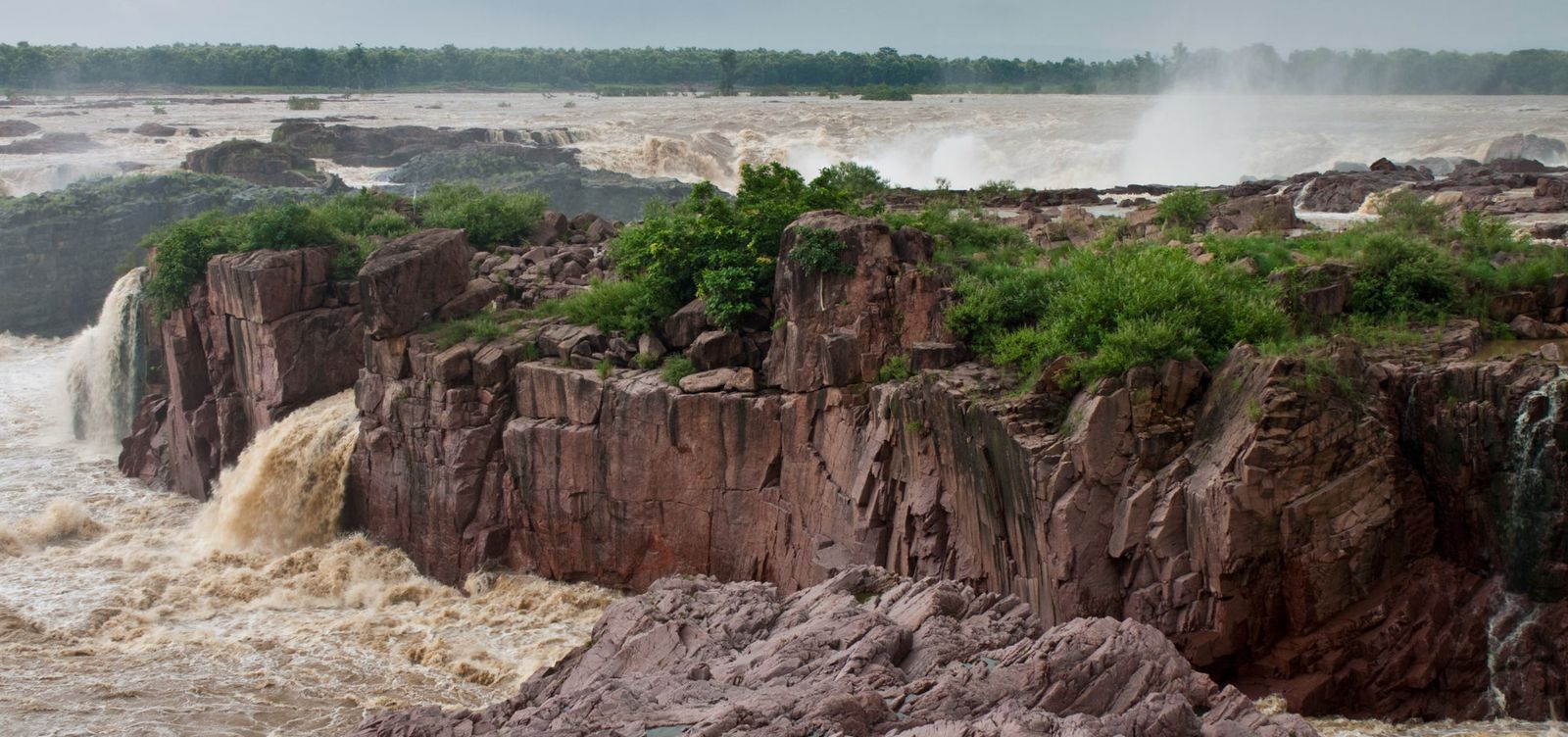
About twenty kilometers south of Khajuraho, far from the temple crowds and their erotic carvings, the Ken River drops into a canyon it has spent millions of years carving. Raneh Falls isn't a single dramatic plunge. It's a series of cascades tumbling over crystalline granite walls that rise nearly thirty meters on either side, their surfaces streaked in shades of pink, red, grey, and deep volcanic black. The canyon itself is the real spectacle — a geological wound exposing igneous rock formations so vivid they look almost artificial, as though someone painted the cliffs for a film set. Most travelers come to Khajuraho for the temples and never learn this place exists, which says more about guidebook laziness than it does about the falls.
Rock Older Than Memory
The rock here is primarily pure crystalline granite, born of volcanic activity long before human history had a starting line. What makes Raneh Falls geologically unusual is the sheer variety of igneous rock visible in a single glance — dolomite, granite, and jasper pressed side by side in the canyon walls, each layer a different era of the earth cooling and compressing.
During the monsoon months, the Ken River swells dramatically and the falls become a roaring, muddy force — powerful but not particularly photogenic. Come in the weeks just after the monsoon recedes, roughly October through December, and you'll find them at their most compelling. The water runs clearer, the volume remains substantial, and those multicolored rock faces catch the light without being submerged.
Here's the counterintuitive part: the dry season, when the water thins to a trickle, actually reveals the canyon's finest trick. Without the river obscuring the lower walls, you can see the full geological layering — five distinct colors of rock stacked like a cross-section from a textbook, except no textbook has ever looked this striking.
A River That Doesn't Advertise
The Ken doesn't get the reverence the Ganges or Yamuna commands, but it's one of the last free-flowing rivers in the Bundelkhand region. It feeds the Panna Tiger Reserve upstream before arriving at Raneh Falls, carrying with it the sediment and seasonal moods of Central India's interior. The Ken Gharial Sanctuary surrounds the falls, which means the canyon and its immediate environment remain under government protection.
Crocodiles inhabit the river below the falls. Not the saltwater monsters of coastal India — these are mugger crocodiles, freshwater residents who sun themselves on the granite ledges when the water level drops. You won't always spot them. But knowing they're there changes how you look at the river. It stops being scenery and becomes habitat.
Along the Rim
The falls sit within a fenced area managed by the Madhya Pradesh tourism department. A paved path runs along the canyon rim, offering several viewpoints where you can look straight down into the gorge. The walk takes no more than thirty to forty minutes at a comfortable pace, though you'll want to linger at certain overlooks where the rock striations are most pronounced.
There's no scrambling down to the water's edge — the drop is steep and the authorities don't allow it, which is probably wise given the crocodile population. You experience the falls from above, peering into the gorge as the sound of water echoes off granite walls. Late afternoon light hits the western face and turns the pink granite almost copper. Photographers, take note.
The surrounding landscape is flat scrubland, which makes the canyon feel even more startling when it suddenly opens at your feet. One moment you're walking through unremarkable terrain. The next, the earth drops away and reveals this ancient, layered wound. That contrast — the mundane giving way to the primordial — is what stays with you.
Getting There Without the Runaround
From Khajuraho town, Raneh Falls is roughly a thirty-minute drive. No public bus runs directly to the site, so you'll need to hire an auto rickshaw or taxi. Most drivers in Khajuraho know the route — it's on the road toward Panna National Park, making it a natural stop if you're combining both destinations in a single day.
The entrance requires a modest fee, typically around 25 to 30 rupees for Indian nationals and slightly more for international visitors. Vehicles pay a separate parking charge. These fees shift without much notice, so carry extra cash. There's no ATM at the site and no card machine. A small kiosk near the entrance sells water and packaged snacks, but don't expect a restaurant or a proper canteen.
The falls are open from sunrise to sunset. Morning visits mean fewer people and softer light on the eastern canyon wall. By midday, especially on weekends, school groups and domestic tour buses arrive, and the overlook points get crowded. If solitude matters to you — and at a place like this, it should — arrive before nine in the morning.
Follow the River to Panna
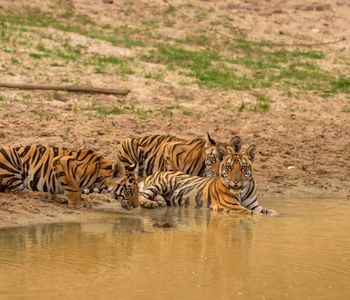
Because the Ken Gharial Sanctuary and Panna National Park share the same river system, combining Raneh Falls with a Panna safari makes logistical sense. The tiger reserve entrance at Madla Gate sits only about twenty-five kilometers further down the road. A morning at the falls followed by an afternoon safari is a full day, but it's the kind of full day that justifies the trip to Khajuraho beyond the temples alone.
Panna reintroduced tigers in 2009 after losing its entire population, and the recovery has been remarkable. The Ken River runs through both places, connecting the canyon's geological drama with the forest's biological one. You start your day staring into deep time and end it watching a landscape trying to heal in real time.
What the Temples Don't Tell You
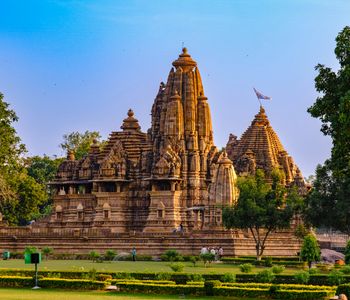
Khajuraho's sandstone temples deserve their fame. But they also create a gravitational pull that keeps most visitors within a tight radius of the town center. Raneh Falls sits just outside that orbit — close enough to reach easily, far enough to feel like a different world entirely. The canyon's silence, broken only by falling water and the occasional bird call ricocheting off granite, offers something the temple complex cannot: a reminder that this landscape was extraordinary long before anyone thought to build on it.
Bring good shoes, a full water bottle, and the willingness to stare at rocks for longer than you expected. The rocks reward it.