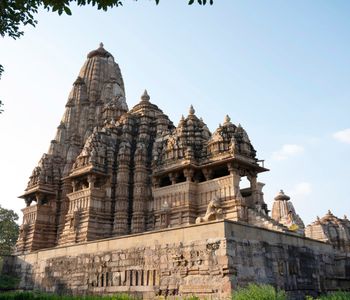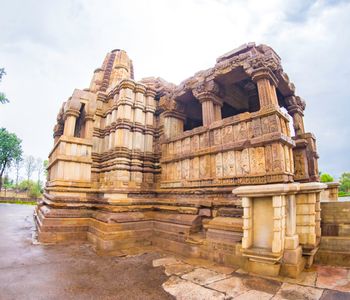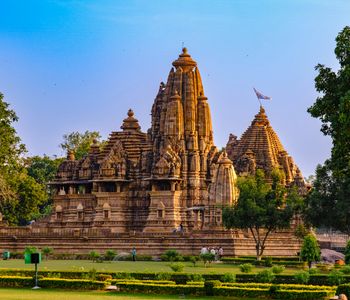
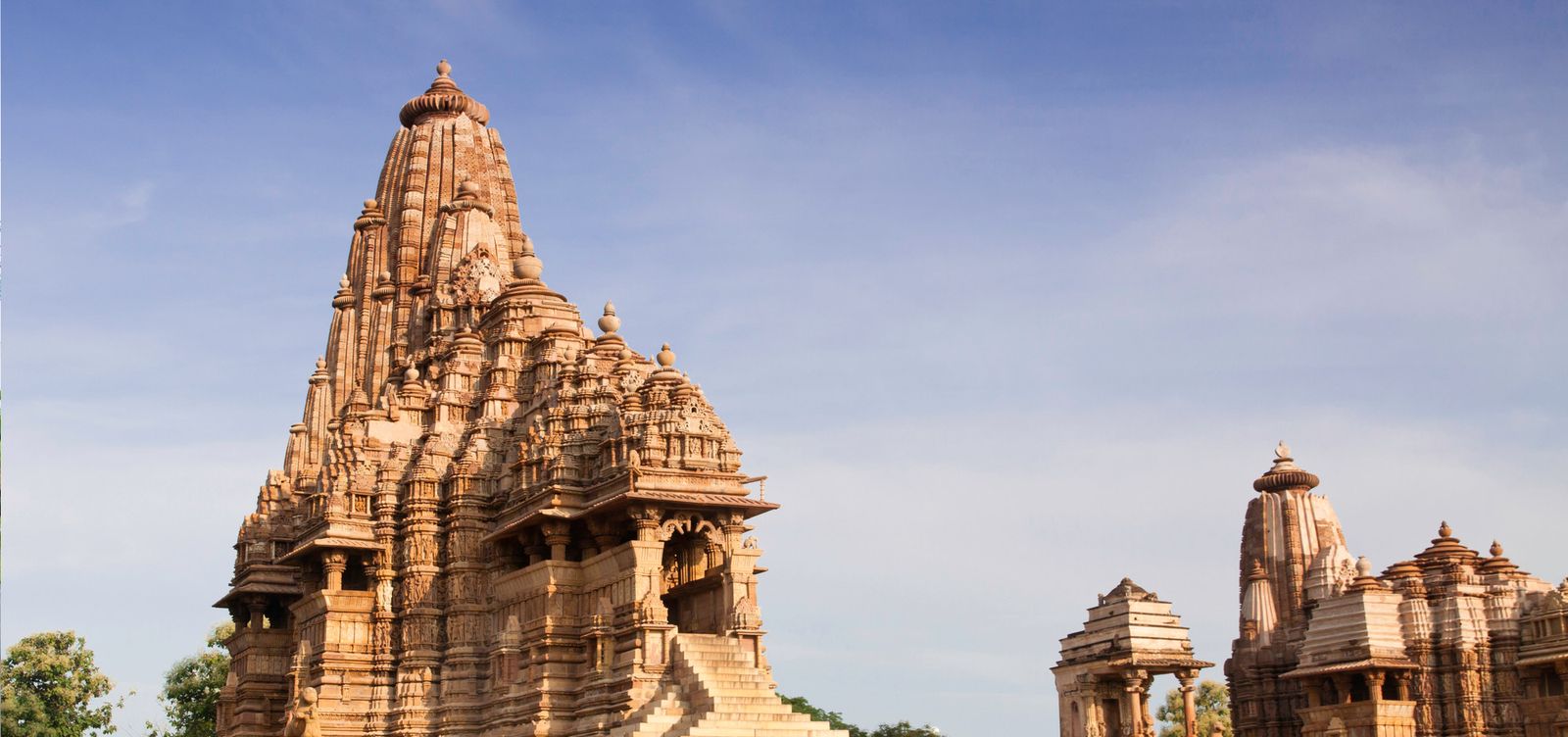
The first thing that strikes you about Kandariya Mahadev Temple isn't the erotic sculpture — though everyone warns you about that. It's the building's sheer upward hunger. Rising roughly 31 metres from its platform, the shikhara drags your gaze skyward through a cascade of subsidiary spires, each leaning into the next like a compressed mountain range rendered in sandstone. Built around 1030 CE under the Chandela king Vidyadhara, this is the largest and tallest temple in Khajuraho's Western Group, and quite possibly the most accomplished piece of medieval Indian architecture still standing. The 800-odd sculptures covering its walls aren't decoration. They're a philosophical argument — the case for the unity of the sacred and the sensual, carved into every available surface with an obsessive, nearly reckless precision.
An Empire's Devotion, Miles from Anywhere
The Chandela dynasty held sway over central India from the 9th to the 13th century, and their capital at Khajuraho was never a major political center. That's the strange part. These temples weren't built to intimidate rival courts or impress foreign ambassadors. They were built for the gods, in a place of relative obscurity, by kings whose military reach vastly exceeded their city's population.
Kandariya Mahadev went up during the dynasty's zenith, when Vidyadhara had successfully repelled Mahmud of Ghazni's advances. The temple honors Shiva. Its name comes from "kandara," meaning cave — an invocation of the mythical caverns of Mount Meru, the cosmic axis in Hindu cosmology. Every element of the structure, from the stepped platform to the ascending tower, translates that mythological mountain into physical stone.
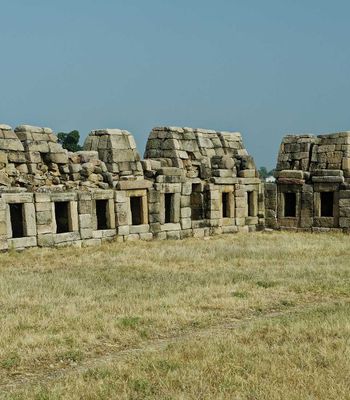
What the Chandelas built here outlived their kingdom by centuries. By the 1300s, the dynasty had dissolved. Forest crept over the temples, and that slow swallowing paradoxically saved them from the systematic destruction that erased so many medieval Hindu monuments across northern India. Neglect, it turns out, can be a form of preservation.
Where Architecture Becomes Theology
Walk the exterior before you enter. This isn't a suggestion — it's how the building was designed to be encountered. The architects organized the structure along a strict east-west axis, and the circumambulatory path moves you through a deliberately sequenced visual narrative. Base moldings depict processions of elephants and horses. Above them, the apsaras and mithuna figures begin their work.
Those erotic carvings occupy roughly ten percent of the total sculptural surface. Tour guides fixate on them. Guidebooks lead with them. But spend twenty minutes with the exterior and you'll notice the sensual figures sitting within a far larger cosmological framework — celestial musicians, guardian deities, composite beasts, abstract geometric patterns repeating with mathematical insistence. The erotic panels aren't the main event. They're one voice in a very crowded choir.
The sandstone itself has weathered to a tawny gold that shifts with the light. Early morning throws long shadows across the deeply carved surfaces, giving flat walls an almost sculptural depth. By midday everything flattens out, the detail retreating into glare. If you're choosing between a 7 a.m. visit and a noon visit, it's not even close.
Inside the Mountain
Step through the entrance porch and the temperature drops at once. The interior is deliberately dark — a compression after the sun-flooded exterior. You pass through a succession of halls — the ardhamandapa, the mandapa, the maha-mandapa — each slightly lower and narrower than the last, funneling you toward the garbhagriha, the innermost sanctum. At its center sits a marble lingam, the symbolic presence of Shiva.
Look up in the main hall. The ceiling is carved into concentric rings of figures and foliage, layered so densely your eye can't fix on any single element. The craftsmanship here surpasses even the exterior work, perhaps because these carvings were addressed to the gods rather than to passing admirers. The stone feels impossibly thin in places, cut so fine you wonder how it survived a thousand monsoons.
There's a stillness inside that the exterior doesn't prepare you for. Outside, the temple is spectacle. Inside, it's silence.
Reading the Walls Like a Book Written Upward
The sculptural program at Kandariya Mahadev follows a specific iconographic order that most people walk right past. The lowest band depicts everyday life — soldiers, dancers, farmers. The middle registers shift to celestial beings and mythological episodes. The highest figures, closest to the shikhara, represent transcendence. You're meant to read the temple vertically, from the earthly to the divine, and the erotic sculptures sit precisely at the transitional zone between human experience and spiritual aspiration.
Several individual carvings repay close attention. On the southern facade, a Surasundari figure wrings water from her hair in a pose so fluid it seems impossible in stone. Nearby, a couple embraces with a tenderness that goes beyond the merely erotic — her hand rests on his shoulder with a weight you can almost feel through your own skin. These weren't anonymous artisans reproducing templates. Someone was paying fierce attention to how human bodies actually move.
Getting There and Getting In
Khajuraho has its own airport with direct flights from Delhi and Varanasi, which makes the place more reachable than its small-town pace suggests. The temple sits within the Western Group complex, the most visited of Khajuraho's three temple clusters. Foreign nationals pay 600 rupees for entry; Indian citizens pay 40 rupees. A single ticket covers all temples in the complex.
Gates open at sunrise and close at sunset. Arrive when they open. By 10 a.m., tour buses begin disgorging large groups, and any contemplative atmosphere dissolves fast. An Archaeological Survey of India guide can be hired at the entrance, though quality varies sharply. The better ones connect iconography to theology rather than simply pointing at the obvious figures and grinning.
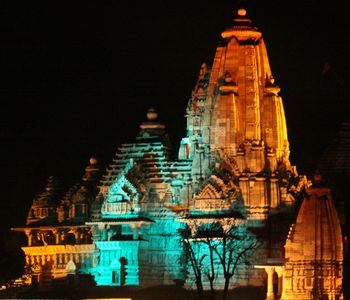
Khajuraho's town is small and walkable. Most hotels cluster within a kilometer of the Western Group, and auto rickshaws handle the rest. Evenings bring a light-and-sound show at the temple complex — heavy on dramatic narration, but it does illuminate architectural details you may have missed in daylight.
When Stone Outlasts Empires
Kandariya Mahadev has survived nearly a millennium not because anyone protected it, but because the jungle swallowed it whole. Rediscovered by a British engineer in the 1830s, it now carries UNESCO World Heritage status and the careful attention of conservators. The irony is hard to miss — a temple built for worship, forgotten for centuries, now visited primarily by people who will never pray inside it. Yet the building doesn't care about your intentions. Stand before it long enough, and the sculpture, the architecture, the sheer accumulated weight of human craft begins to work on you regardless. That's the real argument the Chandelas carved into this sandstone: beauty doesn't require your belief to be true.