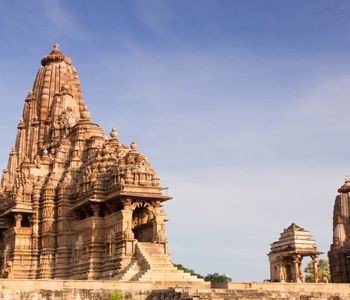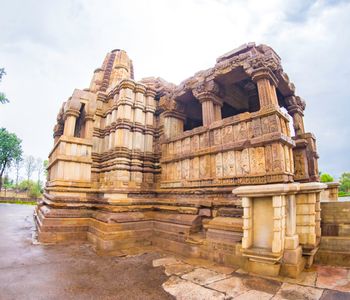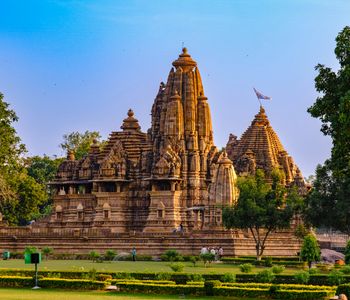
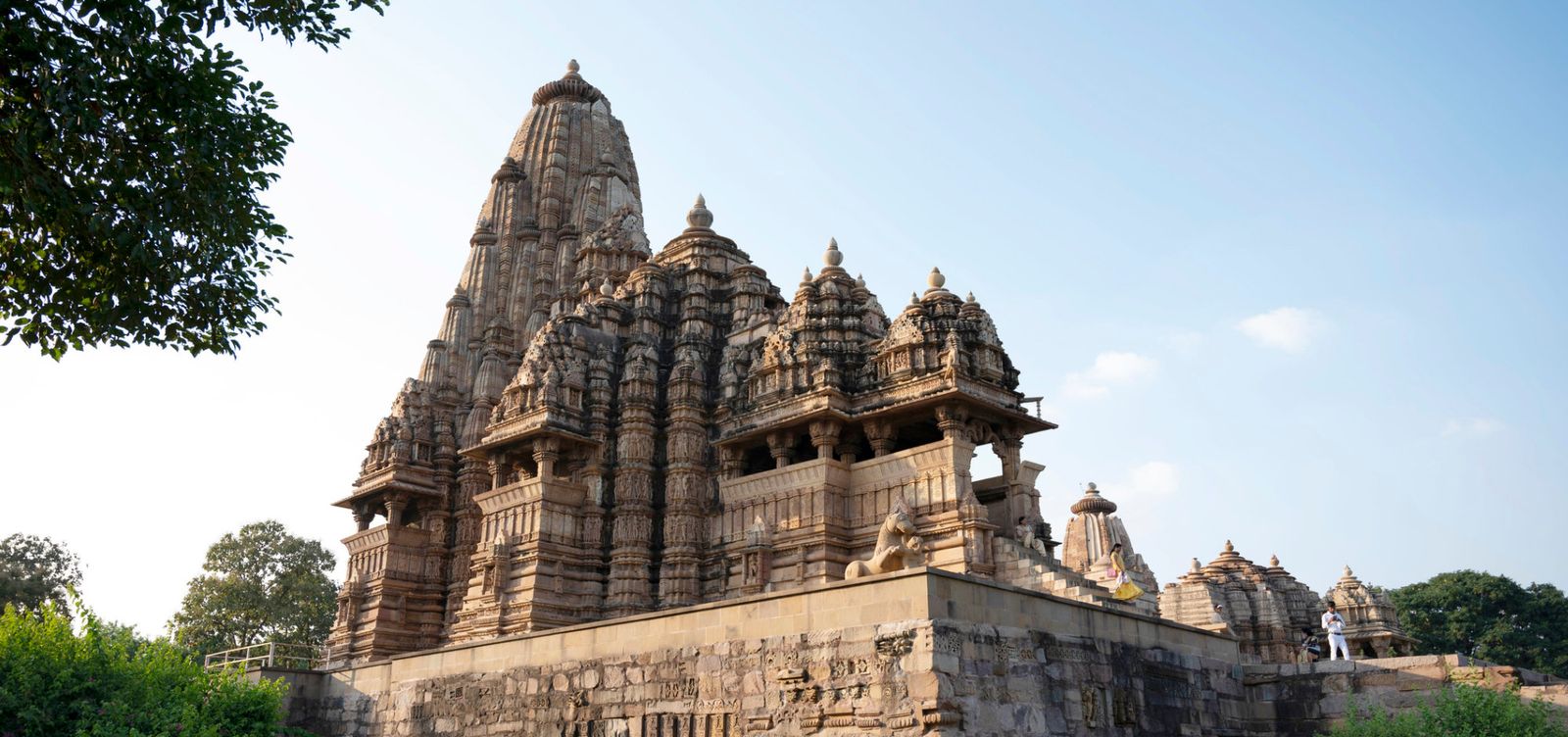
The first thing that strikes you about the Lakshman Temple isn't the erotic sculpture — though that's what brought you here, probably. It's the sandstone itself, warmed by centuries of Madhya Pradesh sun until it glows the color of raw honey. Built around 930–950 CE by the Chandela king Yashovarman, this is the oldest of Khajuraho's surviving temples and, by most accounts, the most architecturally complete. While the nearby Kandariya Mahadeva Temple gets the lion's share of attention for its sheer height, the Lakshman Temple rewards a different kind of looking. It demands slowness. Every panel, every frieze, every figure carved into its exterior walls tells a story — and the stories are far stranger and more varied than the reputation suggests.
Beyond the Postcards
Let's address it directly. The erotic panels exist, and they're extraordinary — frank, athletic, occasionally bewildering in their geometry. But they account for roughly ten percent of the temple's total sculptural program. The other ninety percent is a world unto itself: warfare, courtly intrigue, musicians mid-note, dancers mid-turn, mythological episodes unfolding frame by frame. Elephants march in solemn procession along the base platform. Warriors clash in frozen combat. Women apply kohl to their eyes, wring water from their hair, write letters.
What binds all of it is the sheer confidence of the carving. These weren't timid artisans copying templates. The figures twist, lean, and reach with a naturalism that feels almost modern — you'll catch individual expressions rendered in stone that's held its detail for over a thousand years. Amusement. Concentration. Tenderness. The fact that this particular sandstone was soft enough to carve with such precision and hard enough to survive a millennium is itself a small miracle of geology.
A Blueprint in Stone
The Lakshman Temple stands on a high platform known as an adhishthana, elevating the entire structure roughly three metres above the surrounding ground. This isn't decorative. The platform draws a line between the sacred space above and the earthly world below, and it forces you to climb a set of stairs before entering — a deliberate act of ascent, a physical negotiation between one realm and the next.
Architecturally, the temple follows the panchayatana plan: the main shrine at the center, four subsidiary shrines occupying the platform's corners. This five-temple arrangement was prestigious, reserved for the most important commissions. The central tower, or shikhara, rises in a curvilinear sweep made up of smaller, repeating tower motifs that create a texture like compressed mountain peaks. Catch it in the late afternoon, when shadows carve deep lines into the stone, and the shikhara looks less built than formed — something geological rather than constructed.
Inside, the sanctum houses a three-headed image of Vishnu — his primary form flanked by the boar-headed Varaha and the lion-headed Narasimha. The interior is comparatively plain, which makes the exterior's riot of sculpture feel deeply intentional, as though the building's skin is alive while its heart stays still.
The Chandelas and Their Calculated Devotion
King Yashovarman didn't build this temple casually. The Chandela dynasty, which ruled from roughly the 9th to the 13th century, poured extraordinary resources into Khajuraho as a religious capital. At its peak, the site held over eighty temples. Fewer than thirty survive today. The Lakshman Temple's dedication to Vishnu reflects the Chandelas' strategic religious patronage — they supported Shaiva, Vaishnava, and Jain temples simultaneously, hedging their spiritual bets with impressive pragmatism.
An inscription on the temple records Yashovarman's military campaigns and his devotion, providing one of the few direct historical accounts of the Chandela rulers. Here's what's counterintuitive: despite the erotic carvings that dominate modern discussion, many scholars believe the temples were never widely visited during their active period. Khajuraho sat far from major trade routes, deliberately isolated — a sacred city built for the gods rather than for crowds. It now receives hundreds of thousands of visitors annually, drawn precisely by the sculptural content its builders considered one element among many. The gods, you suspect, would find this amusing.
Reading the Temple's Skin
Take your time circling the exterior. Start from the south side where the light falls most generously in the morning, and work your way clockwise. The sculptural bands run in horizontal registers, and reading them from bottom to top reveals a loose hierarchy — earthly life at the base, celestial figures higher up, divine forms near the shikhara.
Pay close attention to the apsaras, the celestial women who appear throughout the middle registers. Each one holds a distinct pose. One removes a thorn from her foot. Another plays with a ball. A third looks over her shoulder with an expression that suggests she knows you're watching. These aren't interchangeable figures of idealized beauty — they carry personality, weight, and intention. The sculptors gave them individuality, and that generosity of detail is what lifts the temple above spectacle into something more lasting.
The platform's base frieze deserves your eyes, too. Running along the bottom, it includes a continuous procession of elephants, horses, soldiers, and scenes of daily life that function almost like a documentary film carved in stone. Most people look upward. Look down first.
The Practical Details
Khajuraho has its own airport with daily flights from Delhi and Varanasi, making access easier than you'd expect for a town this small. The temple sits within the Western Group of Temples — the main cluster, managed by the Archaeological Survey of India. Entry costs 40 rupees for Indian nationals and 600 rupees for international visitors, and a single ticket covers the entire Western Group.
The site opens at sunrise and closes at sunset. Go in the morning. Not just for the thinner crowds, but for the light — it rakes across the carvings at low angles and pulls out details that flatten into nothing under the midday glare. Winter months, October through February, are ideal, with temperatures hovering in the comfortable mid-twenties Celsius. Avoid May and June entirely unless you enjoy studying sculpture at 45 degrees.
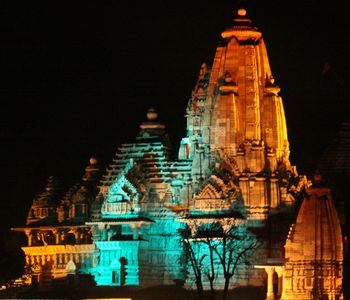
A sound-and-light show runs on the temple grounds each evening. It's earnest and somewhat dated, but it provides context that enriches a second-day visit. If you hire a local guide — and you should — verify their ASI accreditation. The good ones don't just recite dates. They'll point out sculptural details you'd walk past three times without noticing, the kind of quiet revelations that change how you see the whole building.
Why This One Stays With You
Khajuraho has grander temples and taller towers. The Lakshman Temple's hold on you is different. Its completeness — the unbroken sculptural program, the intact subsidiary shrines, the original platform — gives it a coherence the others can't match. You leave with the sense that you've seen something whole, a single artistic vision executed without compromise. In a country where monuments are so often magnificent fragments of their former selves, that wholeness feels rare. Quietly defiant. Come for the carvings. Stay for the stone that refuses to let go of its story.