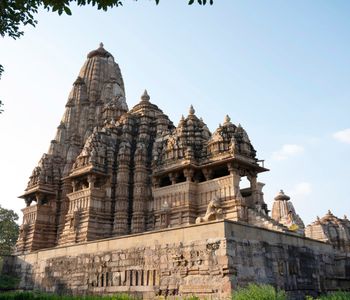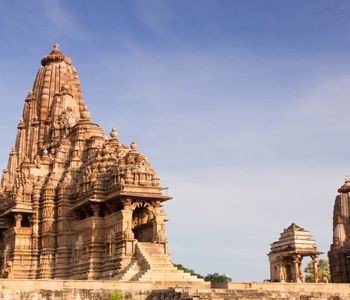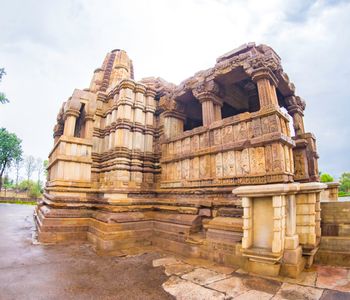
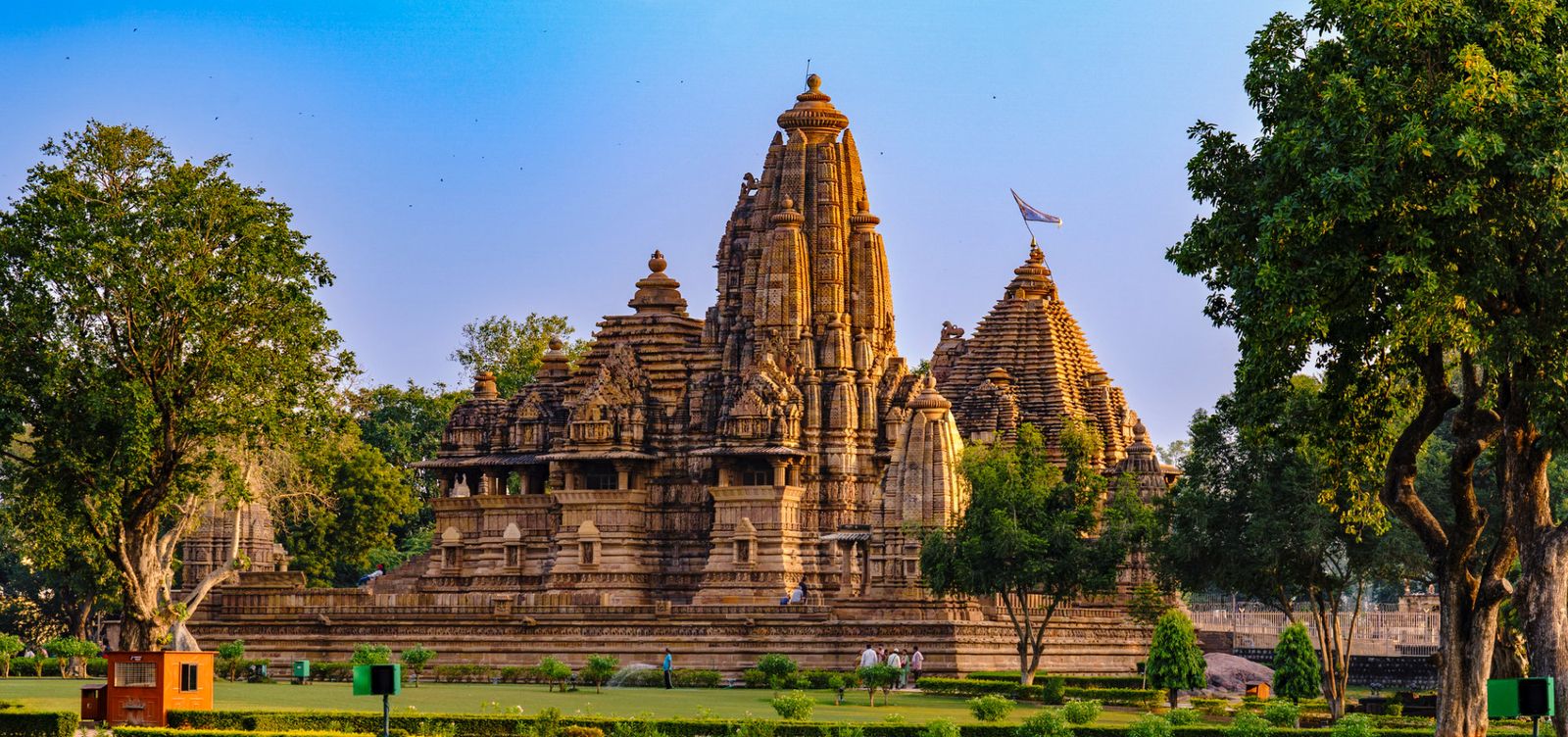
Most temples in India ask you to lower your gaze. Khajuraho asks you to look closer. Across the sandstone facades of these thousand-year-old temples, carved figures twist and embrace in positions that would make a yoga instructor reconsider their flexibility. Erotic sculptures account for roughly ten percent of the total carvings here, yet they've dominated the conversation about Khajuraho for centuries. That imbalance says more about us than it does about the temples. The remaining ninety percent depicts gods, warriors, musicians, animals, and the full sweep of medieval Indian life — a civilization rendered in stone with an honesty that still startles. Built by the Chandela dynasty between 950 and 1050 CE, these structures form one of India's most important UNESCO World Heritage sites. They also happen to be among its most misunderstood.
A Dynasty Carved in Sandstone
The Chandela Rajputs held central India for several centuries, and at the height of their ambition they commissioned over eighty temples across this region. Only about twenty-five survive today. War, weather, and indifference claimed the rest.
What remains is extraordinary — not because the temples endured, but because the jungle swallowed them whole for hundreds of years. British engineer T.S. Burt stumbled upon them in 1838, choked in vegetation and largely forgotten. A handful of local Brahmin priests still tended a few active shrines, but dense forest had consumed the majority of the complex. That long oblivion is almost certainly what saved them. Invaders who methodically demolished religious sites across northern India simply never found these.
Construction spanned roughly a hundred years under successive Chandela rulers. Dhanga, Yashovarman, and Vidyadhara each contributed temples, and their combined output represents the apex of Nagara-style architecture in northern India. The sandstone was quarried along the Ken River, hauled overland to this site, and fitted without mortar. Every block joins by a mortise-and-tenon method, locked with such precision that the seams are nearly invisible a millennium later. No adhesive. No forgiveness. Just geometry.
Where Desire Meets Devotion
Here's the counterintuitive truth about Khajuraho's famous erotic carvings: they aren't scandalous. They're theological. Hindu and Jain traditions both recognized kama — desire — as one of the four legitimate goals of human life, alongside dharma, artha, and moksha. The carvings on the outer walls represent worldly attachment. Step inside the sanctum, and the imagery shifts entirely to the divine. The architecture itself makes a spiritual argument: you must pass through desire to reach transcendence.
Stand before the Kandariya Mahadeva Temple — the largest and most elaborate of the group — and trace this progression yourself. The outer walls seethe with figures: lovers entwined, celestial nymphs adjusting anklets, warriors mounting horses. The sandstone surface carries so much detail that a single panel can hold you for twenty minutes. Move inward through the mandapa, and the carvings grow quieter, more inward-looking. By the time you reach the garbhagriha, the inner sanctum, the noise of the world drops away. Only the Shiva lingam remains.
That shift from chaos to stillness is deliberate. The architects understood something about human attention that modern designers still struggle with — you can't arrive at silence without first acknowledging the noise.
Three Groups, Three Temperaments
The surviving temples fall into western, eastern, and southern clusters, each with its own character. The western group draws the largest crowds, and rightly so. It contains the Kandariya Mahadeva, its soaring shikhara rising approximately thirty meters — the tallest spire in the complex. Nearby, the Lakshmana Temple displays some of the finest sculptural work anywhere on the site, its friezes depicting processions of elephants and horses with an almost eerie naturalism. The Varaha Temple shelters a monolithic boar carved from a single sandstone block, its entire body covered with miniature deity figures — an animal made into a map of the divine.
Walk east, and the air itself changes. The eastern group includes three Jain temples alongside Hindu ones, a reminder that the Chandelas were ecumenical patrons who saw no need to pick sides. The Parsvanatha Temple here contains carvings as refined as anything in the western group, though far fewer people stop to look at them. This is Khajuraho's quieter register — no tour buses idling, no guides jostling for your rupees. Just stone and birdsong.
The southern group sits further afield and draws fewer visitors still. The Duladeo Temple here is considered the last of the Chandela constructions, and scholars have noted a subtle decline in sculptural quality — competent rather than inspired, as though the dynasty's creative fire was already cooling.
Light, Shadow, and the Right Hour
Khajuraho's sandstone has a particular quality that photographs almost never capture. In early morning the temples glow a pale amber, and the carvings appear nearly flat against the surface — decorative, polite. Return in late afternoon, and everything transforms. Low-angle sunlight catches every curve, every fold of carved fabric, every expression on every face. Shadows deepen the relief, and figures that seemed ornamental at noon suddenly look alive, almost restless. If you visit only once during the day, make it the last two hours before sunset.
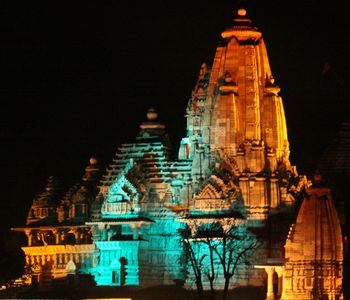
The Archaeological Survey of India hosts a sound-and-light show each evening in the western temple complex. These productions can feel overwrought at other Indian monuments, but the Khajuraho version benefits from its setting — the floodlit temples at night carry a gravity that narration can't diminish. Shows run in both Hindi and English on alternating evenings.
Getting There Without Losing Your Mind
Khajuraho has its own airport, with connections to Delhi and Varanasi through limited daily flights. This is the simplest route, though schedules shift with the seasons. The nearest major railway station is Jhansi, roughly 175 kilometers southwest. From there, taxis and buses make the four-to-five-hour journey through rural Madhya Pradesh — a flat, agricultural landscape that offers little in the way of scenery but plenty of time to read up on Chandela history before you arrive.
Entry to the western group costs 600 rupees for international visitors and 40 rupees for Indian nationals. The eastern and southern groups are free to access. Bring comfortable walking shoes — the temple platforms demand climbing, and the distances between groups add up fast if you explore all three. October through March offers the most tolerable weather; summer temperatures in this part of Madhya Pradesh regularly exceed 45 degrees Celsius, and the monuments offer no shade whatsoever. None.
Budget at least half a day for the western group alone. If the eastern temples interest you — and they should — a full day is more realistic. Guides cluster near the western entrance and charge negotiable rates. A knowledgeable one is worth the money; they'll decode iconographic details you'd otherwise walk past without a second glance.
What the Stone Still Teaches
Khajuraho survives because of an accident — centuries of jungle growth shielding it from the demolition that erased so many other temples across the subcontinent. That accident preserved something rare: a complete artistic vision of medieval Indian life, unedited and unapologetic. The temples don't moralize. They don't separate the sacred from the sensual. They hold both in the same frame, carved by hands that saw no contradiction between the two.
Walk through the western complex as the light fades, run your eyes along those crowded sandstone walls, and you'll feel it — the strange authority of a place that told the truth about being human. Empires crumble. Dynasties forget themselves. Honesty, carved deep enough, outlasts them all.