Every evening, as the last tour buses pull away and the daytime crowds thin to nothing, the Western Group of Temples at Khajuraho undergoes a transformation that the original Chandela builders could never have anticipated. Floodlights wash across thousand-year-old erotic carvings, and a disembodied voice begins narrating the rise and fall of a dynasty that left behind some of the most provocative stone sculpture on earth. The Light and Sound Show at Khajuraho isn't a spectacle in the Bollywood sense. It's quieter than that, more deliberate — a one-hour attempt to make medieval sandstone confess its own history. Whether it succeeds depends on what you bring to the experience and, frankly, on which night you attend.
Three Centuries in Sixty Minutes
The show's ambition is formidable: compress roughly three hundred years of Chandela dynasty history into a single hour using only light, narration, and the temples themselves as a stage. It opens with the legendary origins — the story of Hemvati, a Brahmin maiden, and the moon god Chandrama, whose union supposedly seeded the Chandela lineage. From there, the narration sweeps through the construction frenzy of the 10th and 11th centuries, when over 80 temples were raised across this plateau in central Madhya Pradesh. Only about 25 survive today.
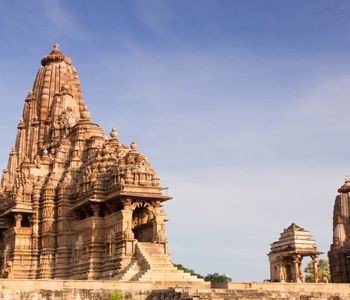
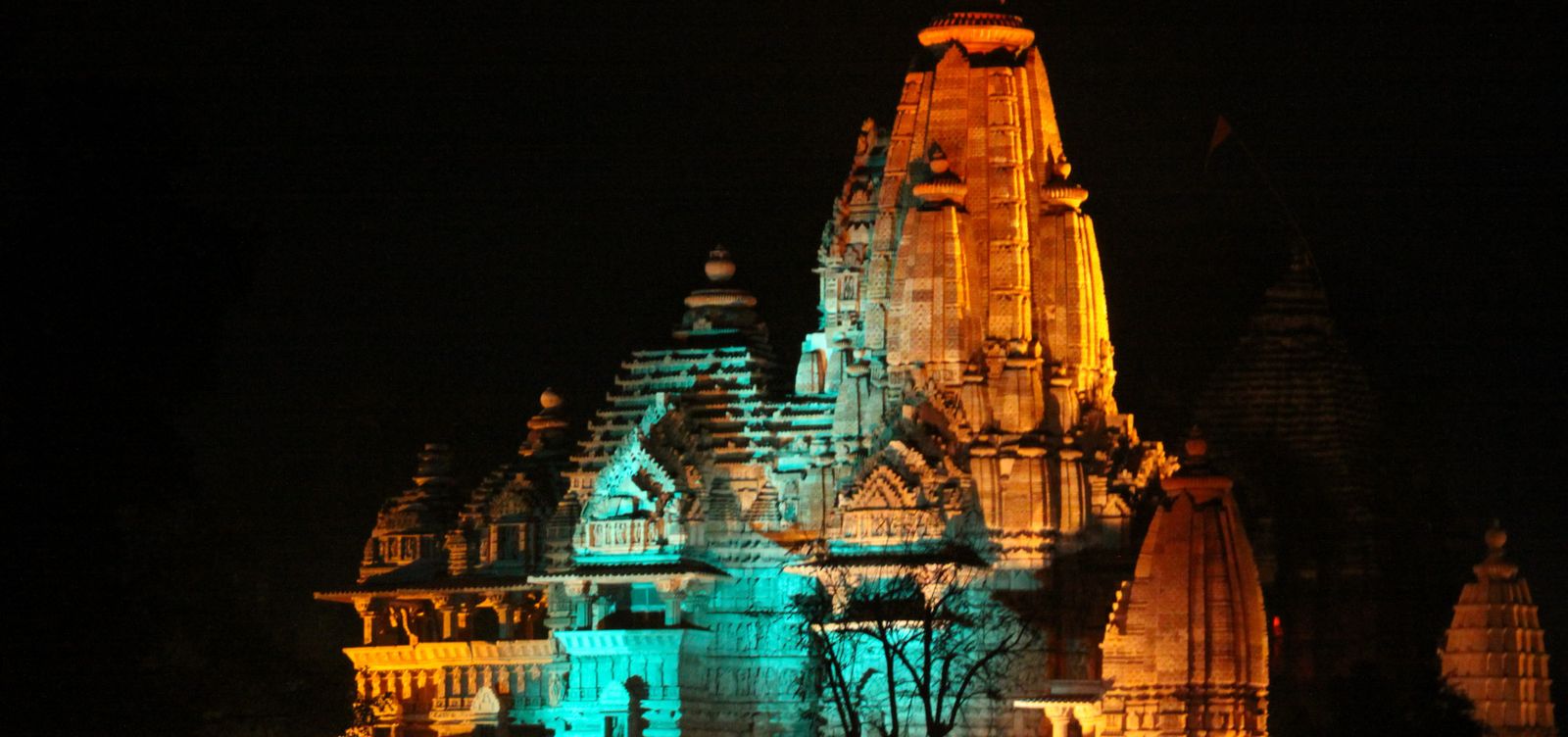
What makes it work is the discipline. No battle sound effects. No orchestral bombast. The production trusts the architecture to do the heavy lifting. When a beam of amber light isolates a particular frieze — say, a celestial nymph adjusting her anklet on the Kandariya Mahadeva Temple — the narration pauses just long enough for you to absorb the detail yourself. Those silences carry more weight than any script.
When Stone Starts Performing
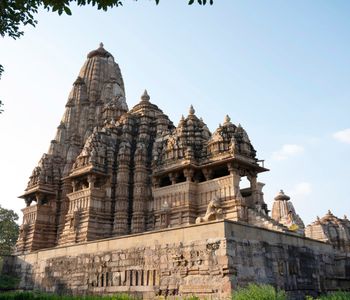
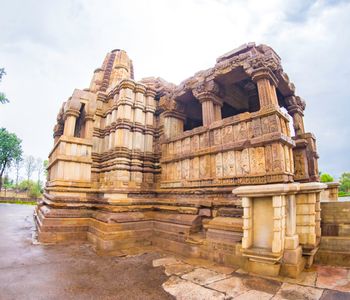
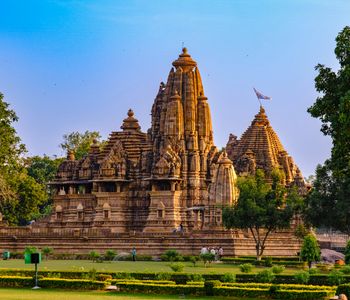
You sit on stone steps facing the Western Group, which holds the largest and most elaborately carved temples in the complex. The Kandariya Mahadeva dominates the sightline, its shikhara rising over 30 metres against the dark sky. Beside it, the Devi Jagadambi and Chitragupta temples receive their own moments under colored light — shifting in sequences timed to the narration, pulling your eye from one sculptural panel to the next.
Here's the thing nobody tells you: the famous erotic sculptures barely feature. The show is far more interested in cosmology, devotion, and architectural ambition than in the sensual carvings that fill every tourist brochure. Less than ten percent of the temple sculpture is erotic in nature, and the production seems determined to correct that popular misconception. It works. By the end, you start seeing these temples as philosophical statements rather than stone curiosities.
The Bachchan Effect
Two performances run each evening. The first is in English, typically starting around 6:30 p.m. during winter months and 7:30 p.m. in summer, though times shift with sunset. The second is in Hindi. Amitabh Bachchan's baritone anchors the Hindi narration, and his voice carries a gravitas that the English version, competent as it is, can't quite match. If you understand Hindi at even a conversational level, attend the later show. The language suits the subject matter — its cadences fit the rhythm of the temple carvings in a way English simply can't replicate.
Tickets for the English show cost around 700 rupees for international visitors and considerably less for Indian nationals. Buy them at the ticket counter near the Western Group entrance. There's no reserved seating, so arriving twenty minutes early secures a better vantage point on the stepped viewing area.
Cold Stone, Warm Jacket
An hour outdoors in Khajuraho means contending with the climate. During winter months between November and February, temperatures after sunset drop into the low teens Celsius. A jacket or shawl isn't optional — it's essential. The stone seating absorbs the cold and transfers it directly through your clothing. Bring a cushion or folded towel if you value comfort over packing light.
Attending during the monsoon months is a gamble. Shows get cancelled in rain, and there are no refunds for weather-related disruptions. The sweet spot is October or early November, when the air is dry, the temperature is bearable, and post-monsoon clarity sharpens the floodlit contours of temple towers against an ink-black sky. Mosquitoes patrol the grounds year-round. Repellent is non-negotiable.
Where the Lighting Outperforms the Script
Production quality has improved since the show's early years, though it still carries the aesthetic of an Indian government cultural project — earnest, educational, occasionally stiff. The soundtrack mixes traditional instruments with ambient tones, and the pacing drags slightly during the middle third when dynastic politics takes center stage. But then a single temple will flood with golden light, the narration will fall away, and you'll hear nothing but crickets and the faint rustle of neem trees behind you. Those unscripted moments rescue the entire performance.
The lighting design deserves genuine credit. Whoever calibrated the angles understood that sandstone changes character under artificial light. Carvings that look flat and weathered at noon acquire startling depth when lit from below. Shadows pool in the recesses between figures, and the temples seem to breathe — expanding and contracting as beams sweep across their surfaces. It's not a trick. It's closer to revelation.
Practical Matters, Plainly Stated
The Western Group of Temples sits in the heart of Khajuraho town, walkable from most hotels. Auto rickshaws charge modest fares from the outskirts, and the airport is only five kilometres away for those arriving the same day. The show venue falls within the same ticketed archaeological complex you may have visited during daylight hours, but evening entry requires a separate ticket specifically for the performance.
No food or drink vendors operate inside the venue during the show. Eat beforehand. A handful of restaurants along Jain Temple Road serve reliable North Indian fare and can have you fed and walking toward the entrance gate within thirty minutes. Carry water — the combination of dry air and an hour of sitting leaves most people parched by the finale.
What You Actually Leave With
The Light and Sound Show at Khajuraho won't redefine your understanding of Indian history, and it isn't trying to. What it does, with surprising effectiveness, is slow you down. After a day of walking the temple complex — craning your neck, squinting at inscriptions, dodging tour groups — the show forces you to sit still and let the architecture come to you. The temples look different at night. Older, somehow. More deliberate.
You leave with the strange impression that the Chandela builders anticipated this moment: their stone figures performing for an audience a thousand years in the future, illuminated by a technology they could never have imagined but would certainly have appreciated.