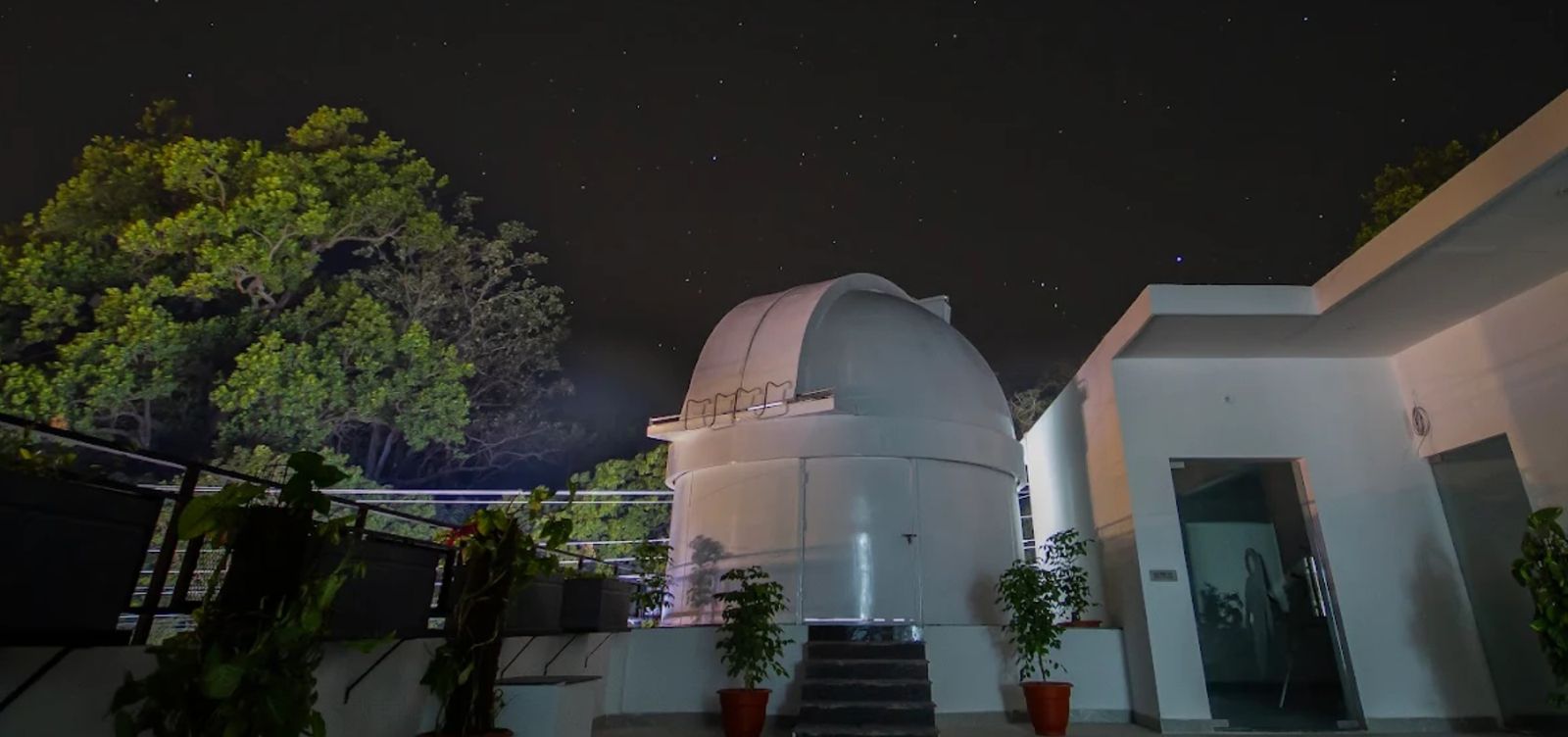
Most people come to Jim Corbett for the tigers. You come for the sky. After dark, when the jungle settles into its low chorus of insects and distant calls, the Starscapes Observatory at the edge of the park opens its roof to one of the cleanest night skies you'll find within driving distance of Delhi. No light pollution. No glow on the horizon. No haze of city sodium washing out the stars. Just the Milky Way, draped across the black like spilled salt on cloth.
This isn't a research facility. It's something rarer in India — a place built specifically to let ordinary people look up properly, through serious telescopes, guided by astronomers who actually know what they're pointing at.
What the Kumaon Foothills Do to the Dark
The foothills do something strange to the night. You'd think a place this close to the Gangetic plain would suffer from atmospheric haze, but the elevation and the surrounding forest act as a kind of filter. The air sits still. The temperature drops fast after sunset. And the absence of nearby towns means darkness arrives complete, not gradual.
On a moonless night between October and March, you can see Andromeda with the naked eye — a faint smudge two and a half million light years away. Try doing that from Connaught Place.
The observatory sits inside the Corbett zone, far enough from the main resorts that you feel the silence before you see the sky. Step outside the dome, let your eyes adjust for ten minutes, and the constellations start arriving one by one. Then in groups. Then everywhere.
An Hour and a Half with the Universe
The session usually begins with a green laser pointer and a guide who treats the sky like a familiar neighbourhood. They trace Orion's belt, swing across to Sirius, then take you north to Cassiopeia's lazy W. The talk is informal — part mythology, part hard science, part wonder.
Then comes the telescope time. The observatory operates Dobsonian and computerized telescopes, the kind that let you actually see Saturn's rings as rings, not as a description in a book. The first time you press your eye to the eyepiece and a planet appears — small, sharp, undeniably a sphere — something rearranges itself in your understanding of where you are.
Jupiter shows its bands and four moons in a tidy line. The Orion Nebula glows like a faint green cloud. The Moon, when it's up, fills the eyepiece with crater shadows so detailed you can pick out individual peaks.
When to Book Your Slot
The observatory runs evening sessions that typically begin after sunset and last about ninety minutes. The exact schedule shifts with the season — earlier in winter, later in summer — and bookings are essential because the equipment can only accommodate small groups at a time.
Winter sessions are colder but better. The air is drier, the seeing is steadier, and the constellations of the northern winter sky — Orion, Taurus, Gemini, Canis Major — are arguably the most spectacular cluster the year offers.
The Photograph You Didn't Know You Wanted
For an additional fee, the observatory will photograph you under the stars using long-exposure techniques that capture the Milky Way arching behind your silhouette. It sounds gimmicky until you see the result. The images are properly composed, properly exposed, and they look nothing like the photos you'd produce yourself on a phone.
Couples book these. Families book these. Solo travellers book these and look slightly stunned when they're handed the file.
First-Timers, Amateurs, and the Wide-Eyed Kids
If you've never looked through a real telescope, this is the place to do it for the first time. The guides are patient with absolute beginners and don't make anyone feel foolish for asking whether that bright dot is a planet or a plane. (Planet, almost certainly.)
If you're already an amateur astronomer, you'll appreciate the equipment and the genuinely dark sky. Bring your own binoculars if you have them — the wide-field views of star clusters complement what the telescopes show.
Children tend to respond to this place with the kind of unfiltered awe they usually reserve for elephants. Something about being small under a sky that vast seems to bypass the usual screen-trained boredom.
What to Wear, What to Avoid
Dress for cold. Even in October, the night temperature in Corbett can drop sharply, and you'll be standing still for an hour and a half. Layers, closed shoes, and a wool cap make the difference between enjoying yourself and counting the minutes until you can get back to the lodge.
Skip the red-tinted torch debate — the observatory provides what's needed, and they'll ask you to switch off white lights during the session to preserve everyone's night vision. This matters more than it sounds. It takes about twenty minutes for your eyes to fully adapt to darkness, and one flash from a phone screen resets the whole table.
Cloud cover is the enemy. Monsoon months from July through September are essentially unusable, and even shoulder seasons can produce frustrating evenings where the sky stays stubbornly overcast. Check the forecast, and if you have flexibility in your Corbett itinerary, hold the observatory visit for the clearest night you're offered.
How to Reach the Dome
The observatory operates within the Corbett tourism zone, and most visitors combine it with a stay at one of the resorts in Dhikuli or Ramnagar. From Delhi, the drive takes roughly six hours via the Moradabad route. The nearest railway station is Ramnagar, about an hour from the main resort cluster.
If you're already on a Corbett safari trip, ask your lodge to coordinate the booking. Most are familiar with the observatory and can arrange transport for the evening, which matters because the roads inside the buffer zone are unlit and unmarked after dark.
What You Carry Home
You'll go home with photos of tigers, probably. Or elephants crossing a riverbed at dawn. But the image that tends to last longest from a Corbett trip — for the people who do this part of it — is the sky. The sheer density of stars when you're standing in real darkness for the first time in years. The way Saturn looks through an eyepiece. The fact that light leaving Andromeda when humans first walked upright is only now reaching your eye.
Tigers are extraordinary. The universe is something else entirely. Stay one night longer than you planned, look up, and let the observatory show you what's been there the whole time. You won't think about a Corbett trip the same way again.