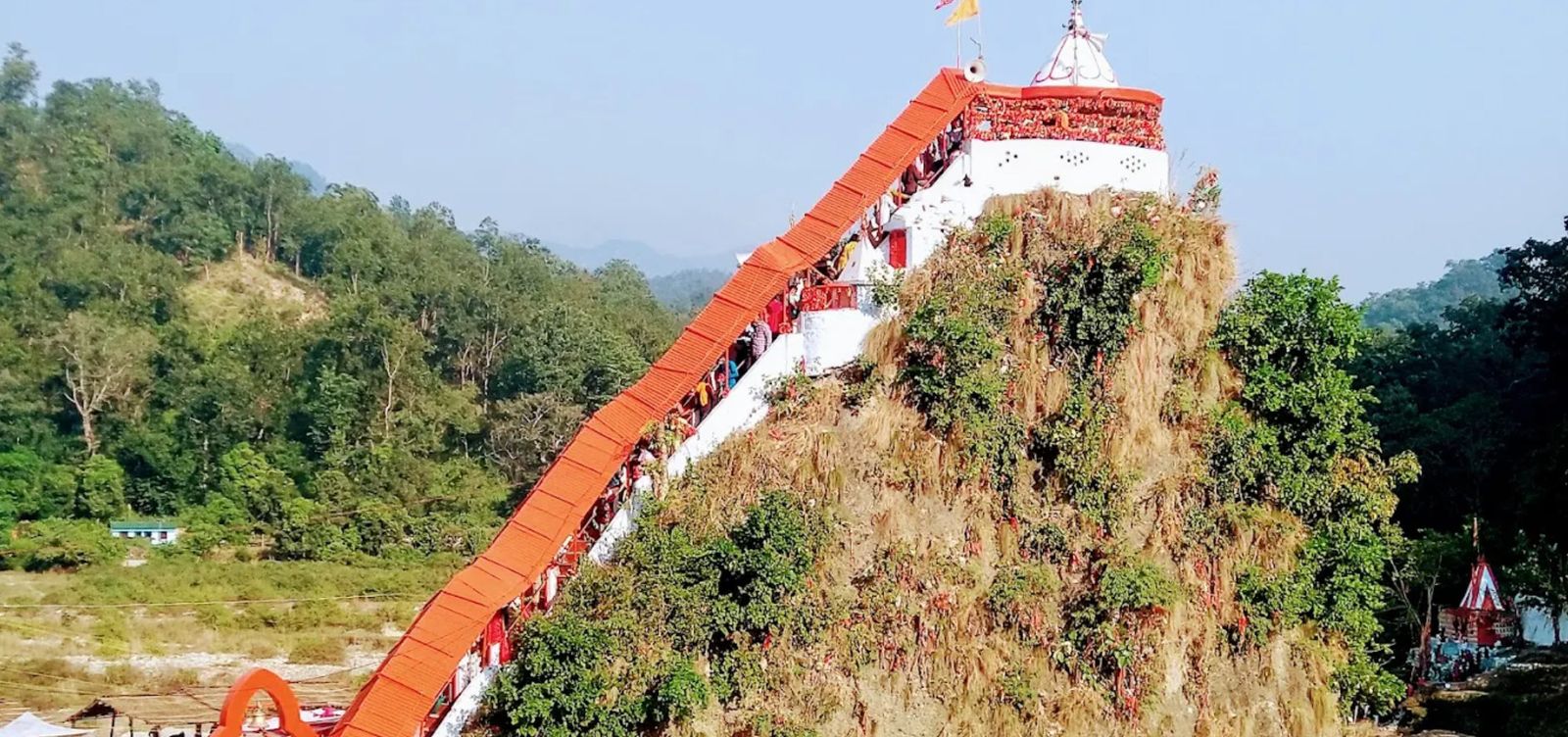
The Kosi River does something peculiar here. It splits, surges, and then parts around a single hulking boulder that rises some twenty metres from the riverbed — and on top of that boulder sits a temple. Not beside it. Not near it. On it. The Garjia Temple, devoted to the goddess Garjia Devi, balances on this lone outcrop like something the river forgot to carry away. To reach it, you climb a steep stone staircase from the riverbank, ninety-odd steps that have been smoothed by decades of bare feet. By the time you reach the top, slightly winded, the view alone tells you why people kept coming back to rebuild this place.
Most travellers passing through Jim Corbett National Park come for tigers. Garjia is the detour worth making.
The Boulder That Refused to Move
Local legend says the boulder once floated down the Kosi during a great flood, with the deity Garjia riding atop it, commanding it to halt at this spot. The river obeyed. Villagers, witnessing this, built a shrine where the goddess had landed. It's the kind of story that sounds like a tall tale until you actually see the boulder — improbably round, isolated mid-river, with nothing else like it for miles in either direction. Geology has its own explanation, of course. But standing at the base of those stairs with the water rushing past your ankles, you understand why people went with the other version.
The temple itself is small. A modest white-and-orange structure with a saffron flag snapping in the wind. No grand architecture, no carved facade, no elaborate dome. That's the point.
Climbing Toward the Goddess
Leave your shoes at the bottom, near the cluster of vendors selling marigold garlands, coconuts, and red thread for offerings. The stone is cool underfoot in the morning, scorching by midday. Bells line the staircase, and pilgrims ring each one as they ascend — a steady metallic chorus that drifts down to the riverbank.
Halfway up, you'll pass smaller shrines tucked into recesses of the rock: Lord Shiva, Saraswati, Batuk Bhairav, Lord Ganesha. Each one painted in primary colours, each tended with fresh flowers. The climb is short but steep enough to make older pilgrims pause. Don't rush it. The pauses are where the temple reveals itself in fragments — the river widening below, the forested ridges of Corbett rising on either side, the distant whistle of a kingfisher.
At the top, the platform is narrow. Maybe fifteen people can stand there comfortably. The main shrine houses an idol of Garjia Devi, draped in red cloth, garlanded with marigolds, lit by oil lamps that flicker even when there's no wind.
When the River Roars
The Kosi changes character with the seasons, and so does the experience of visiting Garjia.
In winter, from November to February, the river runs low and clear. You can wade across to the base of the boulder, and the water rarely climbs above your knees. This is when most visitors come — pilgrims and tourists alike — and the riverbank takes on the air of a small fair, with chai stalls, fried snack vendors, and the occasional sadhu offering blessings for a coin.
Then the monsoon arrives. Between July and September, the Kosi swells into something genuinely fierce. The temple becomes an island in the truest sense, sometimes inaccessible for days. Locals say this is when Garjia Devi is at her most powerful — and most temperamental. Photographs from this season show the boulder half-submerged, water churning white around its base, the temple flag the only thing visible above the foam.
Spring brings the festival of Kartik Purnima in November, when thousands of pilgrims arrive over a single weekend. If you want the temple to yourself, this is not the time.
What to Do When You're Not Praying
Garjia sits roughly fourteen kilometres from Ramnagar, the gateway town to Corbett. Most travellers fold the temple into a larger Corbett itinerary — a morning safari, then a late-afternoon stop here as the light softens and the river turns gold.
The riverbank itself is worth lingering on. Bring something to sit on. The stones are smooth and warm by mid-morning, and the water is shallow enough in the dry season to wade in without worry. Children splash. Sadhus meditate. Photographers crouch with their tripods. There's a quiet, unhurried rhythm to the place that's harder to find inside the national park proper.
If you have time, walk a short distance upstream. The crowds thin quickly, and you'll find pools where the water runs almost still, framed by the kind of sal forest that Corbett is named for.
Getting There Without Fuss
Ramnagar is the nearest town with a railway station, well-connected to Delhi by overnight trains. From Ramnagar, the temple is a forty-minute drive through forest and farmland, and most hotels in the Corbett area arrange transport. Taxis from Ramnagar will charge you a reasonable round-trip fare, including waiting time. Auto-rickshaws will go too, though the ride is bumpier.
If you're driving yourself, the temple has a paved parking area just off the main road. From there, it's a five-minute walk to the riverbank, where you'll find the staircase.
Entry is free. There's no ticket counter, no formal hours posted, but in practice the temple is accessible from sunrise to sunset. Photography is allowed on the staircase and around the boulder, but not inside the main shrine. A small donation to the temple is customary, not required.
A Few Practical Notes
Dress modestly — shoulders and knees covered. Carry a bottle of water; the climb is short but the heat in summer can be unforgiving. Leather goods, including belts and wallets, are sometimes discouraged inside the shrine, though enforcement is loose. Mobile signal is patchy, which feels appropriate.
Avoid visiting during peak monsoon if you're not comfortable around fast-moving water. The boulder is safe, but the approach can be treacherous when the river is high, and access is occasionally closed entirely.
The best light is the hour before sunset. The temple catches the last rays full on its western face, and the river below turns the colour of weak tea. If you can time your visit then, do.
Why It Stays With You
Garjia is not a grand temple. There are larger, older, more architecturally ambitious shrines all over Uttarakhand. What Garjia has is its setting — that improbable boulder, that insistent river, that small white structure refusing to be washed away by centuries of floods. It rewards patience and quiet attention. Come at dawn, climb slowly, sit on the platform for a while. Listen to the bells, the water, the kingfishers. Then come back down. You'll remember this one.