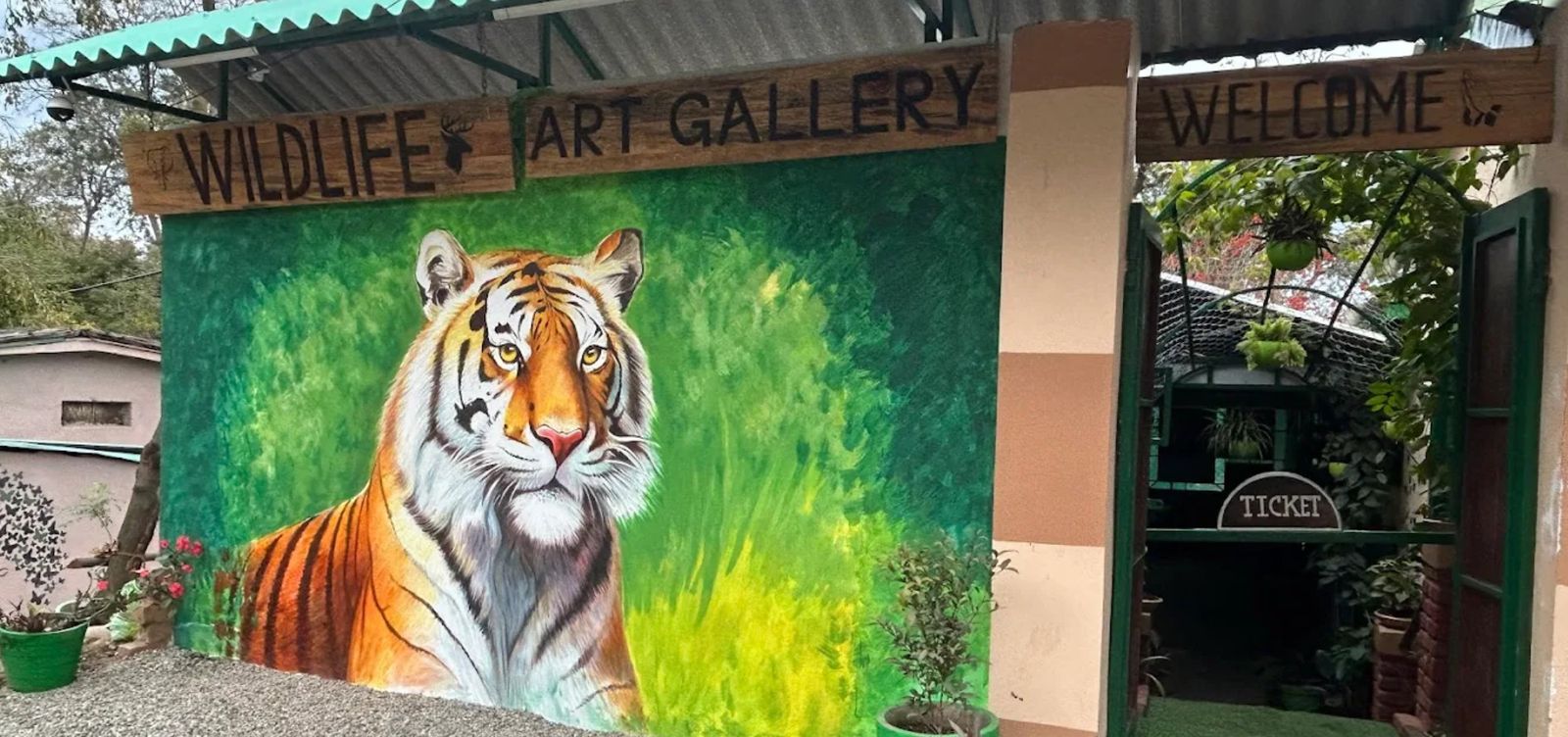
Inside Jim Corbett National Park, past the gates that funnel jeeps toward tiger country, sits a low building most visitors walk past on their way to something louder. The Wildlife Art Gallery doesn't roar. It doesn't need to. While everyone else is craning their necks for stripes in the sal forest, this small museum holds the second-best thing — and arguably, on a slow safari day, the better thing. Paintings, photographs, sketches, and field notes that together tell you what the Corbett landscape actually is, beyond the checklist of charismatic mammals. Forty-five minutes here, and you'll leave understanding what you're about to see — or what you just saw — with far more depth than your guide's running commentary gave you.
A Quiet Room in a Loud Forest
The gallery occupies a modest structure near the Dhangarhi Museum complex, close to the park's northern boundary. The architecture makes no fuss — whitewashed walls, tiled floors cool underfoot, ceiling fans turning slowly. After the diesel rattle of the safari queue outside, the hush inside feels deliberate, almost monastic.
What's on the walls is a curated record of the park's biodiversity rendered through human eyes. Watercolours of barking deer mid-bound. Ink studies of the Ramganga river system. Oil paintings of tigers that capture the animal's deliberateness — the slow shoulder roll, the gold-on-gold of fur against grass — in ways no camera can. There's a quiet authority to the work. These aren't tourist souvenirs. They're documents.
Why the Brushwork Matters Here
Here's the counterintuitive thing: a painting of a tiger can teach you more about tigers than a photograph. A photo freezes a half-second. A painting compresses hours of watching into a single image, distilled by an artist who has actually sat in a hide and learned how the animal moves.
The gallery leans into this. Several works come from naturalist-artists who spent seasons in Corbett and the surrounding reserves, and you can feel that patience in the brushwork. The tilt of an elephant's ear. The way a crested serpent eagle hunches before flight. The specific dust-and-honey light that falls through sal trees in late afternoon. Once you've seen these paintings, you start spotting these details on safari. The gallery trains your eye.
What's on the Walls
The collection rotates and expands, but the bones of it cover the predictable cast — tiger, leopard, elephant, gharial, mahseer — alongside species most visitors never think about. Hornbills. Otters. The rust-coloured flicker of a giant squirrel high in a tree. A section is usually devoted to the park's birdlife, which Corbett has in extraordinary variety, and which gets shamefully overlooked by visitors fixated on big cats.
Photography occupies a meaningful chunk of the space too. Black-and-white prints from earlier decades sit alongside contemporary colour work, and the contrast is instructive. You see how documentation of this forest has evolved, and how much hasn't changed at all.
The Ghost of Jim Corbett
You can't visit anything in this park without bumping into the man it's named for, and the gallery handles his presence well — there, but not overbearing. Some panels reference his writings, his transformation from hunter to conservationist, his understanding that the forest was worth more standing than dead.
The materials here connect the artistic record to a longer tradition of naturalist observation in these hills. Corbett himself was a sharp observer, and the gallery treats its visual archive as a continuation of that lineage. A small framing choice, but it elevates the place from decoration to something closer to scholarship.
Reading the Forest Through Pictures
One room toward the back deals with ecology rather than individual species. Maps showing the park's terai grasslands, riverine belts, and hill forests. Diagrams of how a tiger's range overlaps with prey corridors. Cross-sections of the Ramganga's floodplain.
This is where the gallery earns its keep for serious visitors. The big cat sightings are wonderful, but Corbett is a working ecosystem — one of India's oldest protected landscapes — and understanding it as a system rather than a series of photo opportunities transforms the entire safari experience. Spend twenty minutes with these displays and your next jeep ride becomes a different kind of trip.
Practical Notes
Getting In
The gallery sits within the Dhangarhi gate complex on the park's northern edge, accessible from the Ramnagar–Ranikhet road. Most safari operators include it as a brief stop before or after a Dhikala-zone drive, though you can visit independently too. There's a modest entry fee, well below the price of anything else you'll pay inside the park.
When to Come
The gallery is open through standard daytime hours, year-round. The park itself closes its core zones during monsoon — roughly mid-June through mid-November — but the gallery typically remains accessible even then. If anything, monsoon is the smart time to come. The crowds thin out, the rooms sit nearly empty, and you can take your time with the work instead of shuffling past it behind a tour group.
What to Bring
A notebook is more useful than a camera. Photography rules vary, and in any case, the paintings reproduce poorly on phone screens — flat, washed out, drained of the patience that went into them. Better to sit with them, jot down what catches your eye, and let the impressions feed into the safari that follows.
Pair It With Dhangarhi Museum
The adjacent Dhangarhi Museum covers the park's history, taxidermied specimens, and conservation timeline. Together with the gallery, the two sites form a single sensible stop. Budget ninety minutes for both. You'll arrive at your safari with context most other visitors lack — and you'll understand why, when a tiger finally does cross the track in front of your jeep, you're seeing something so much larger than a tiger.
The Last Thing You Take Home
Most people leave Corbett with a phone full of slightly blurry tiger photos. A few leave with something better — an actual feel for the place. The Wildlife Art Gallery is the shortcut to that deeper takeaway. It's small, it's quiet, it asks nothing of you, and it gives back more than its size suggests. Skip it and you've seen a park. Spend an hour inside and you've understood one. On a trip where every other stop is engineered for spectacle, this one rewards stillness. Which, when you think about it, is exactly how you should be watching the forest anyway.