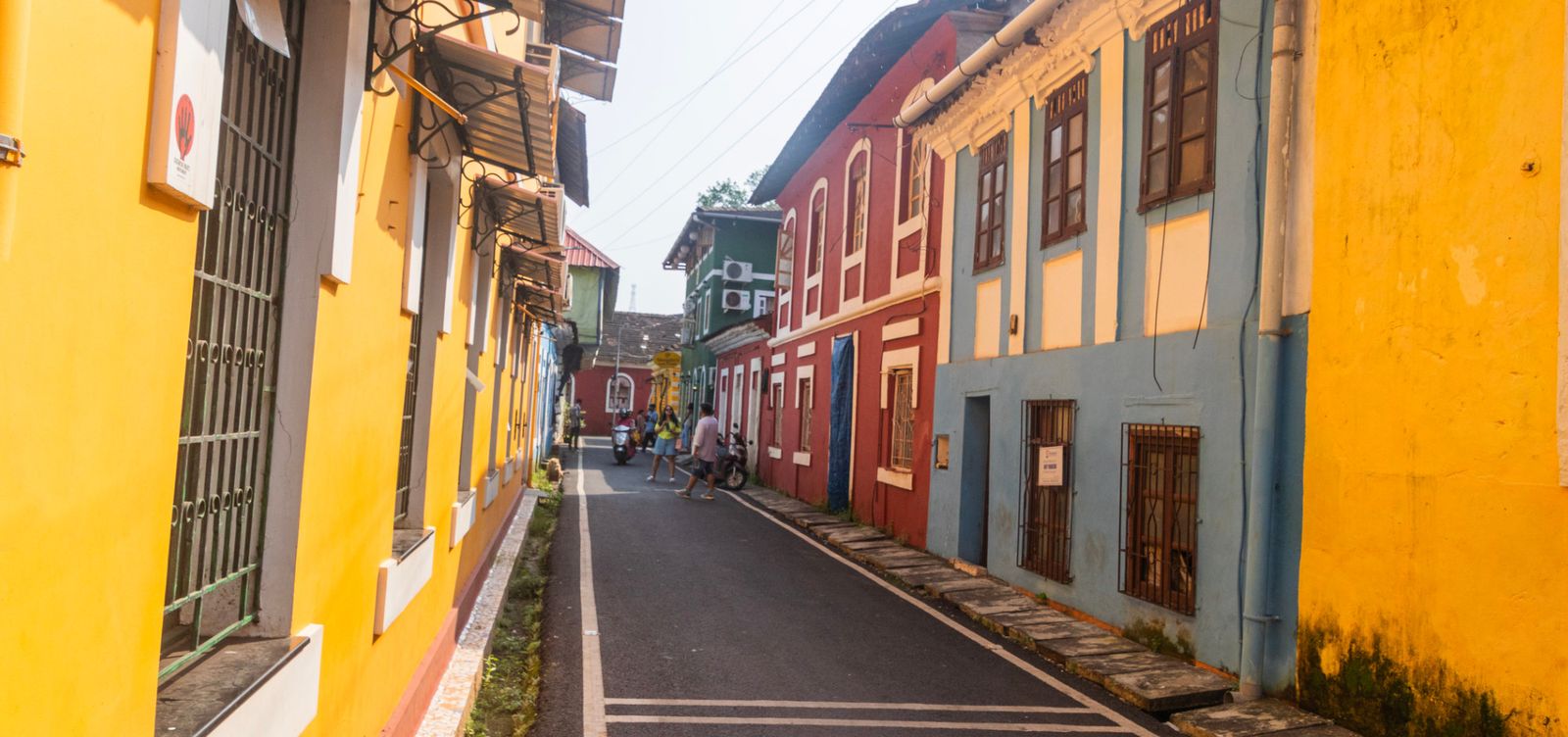
The paint is peeling, and that's precisely the point. In Fontainhas, the narrow lanes of Panaji's old Latin Quarter wear their decay like a badge of authenticity — ochre walls fading to salmon, azulejo tiles cracked but still clinging to doorframes, wooden shutters warped by four centuries of monsoons. This is not a restored heritage district polished for Instagram. It's a living neighborhood where elderly women still hang laundry from wrought-iron balconies and the faint sound of fado music occasionally escapes an open window. Fontainhas occupies a slim strip of land between Altinho Hill and the Ourem Creek, barely a few streets wide, yet it contains more genuine character per square metre than the rest of Goa's tourist circuit combined. Walking here feels like stepping into a Portuguese town that fell asleep in 1961 and only half woke up.
A Colony That Outlasted Its Colonizers
Portugal held Goa for 451 years — longer than the British held any part of India. When Indian troops marched in during Operation Vijay in December 1961, the colonial era ended overnight. But in Fontainhas, the transition was more of a slow dissolve than a hard cut. Families who had adopted Portuguese names, Catholic traditions, and Mediterranean cooking styles didn't suddenly reinvent themselves. They stayed.
The quarter traces its origins to the late 18th century, when a wealthy Brazilian landowner developed the area along the banks of what was then a much wider creek. Houses followed Portuguese architectural conventions — tiled roofs, internal courtyards, exterior walls painted in bold colours mandated by colonial law. That law required homeowners to repaint after every monsoon season, which explains the kaleidoscopic streetscape that survives today. Some residents still honour the tradition. Others have let the rain do its work, and those unpainted facades — mottled, water-streaked, reverting to bare laterite — are arguably more beautiful.
The Colour Code Nobody Follows Anymore
Here's the counterintuitive thing about Fontainhas: that famous palette — those deep blues, lime greens, burnt yellows, and terracotta reds — was never an artistic statement. It was bureaucratic compliance. Portuguese law forbade white-painted houses, reserving white exclusively for churches. Homeowners chose bright colours not out of creative impulse but because they had to pick something other than white.
What began as regulation became identity. Today, no one enforces the rule, yet the colours persist. Walk down Rua de Natal or 31st January Road and you'll pass walls in shades that don't exist in any hardware store catalogue — colours achieved through layers of limewash applied over decades, each coat bleeding into the one beneath it. A photographer could spend a full day on a single street and never exhaust the compositions.
Doors That Tell Stories
Pay attention to the doorways. In Fontainhas, they reveal more about a house's history than any plaque could. Older residences feature carved wooden doors with heavy iron knockers shaped as hands or lion heads. Some still bear Portuguese house names — Casa de Moeda, Villa Nova — etched into stone lintels above the frame. The wealthier homes have oyster-shell windows, a construction technique unique to coastal Goa: translucent shells fitted into wooden lattice frames back when glass was a luxury most families couldn't afford.
Many of these houses now operate as heritage guesthouses or small galleries. The Panjim Inn and Panjim Pousada, both converted residences on 31st January Road, let you sleep in rooms with original tile floors and four-poster beds that creak with personality. Staying overnight changes the experience entirely — the quarter empties after sunset, and the silence along the creek becomes almost theatrical.
What a Walk Through the Quarter Actually Feels Like
Fontainhas rewards slow movement. Start at the foot of Altinho Hill near the Maruti Temple, which sits slightly above the quarter and gives you a compressed view of the rooftops below — a tight jigsaw of terracotta tiles and satellite dishes, Old Goa and new India in a single frame. From there, descend into the grid of lanes. The streets are barely wide enough for a single car, and most traffic moves on foot or on two-wheelers that squeeze past with practiced precision.
Within minutes, you'll reach the Chapel of St. Sebastian, a small white church at the end of a narrow lane. Inside hangs a crucifix that originally stood in the Palace of the Inquisition in Old Goa — a chilling artifact from a dark chapter. The Christ figure has open eyes rather than the traditional closed ones, because the crucifix was designed to intimidate prisoners awaiting trial. It's a startling object in an otherwise tranquil space, the kind of detail that shifts your understanding of a whole neighbourhood.
Continue toward the creek side, and the residential character softens into commercial life. Small bakeries sell bebinca, Goa's layered coconut pudding that demands extraordinary patience — each of its seven to sixteen layers must be individually browned under a flame. A single bebinca can take hours. The result is dense, buttery, and entirely unlike any other Indian dessert.
Art and the Afternoon Hours
Several galleries have established themselves in Fontainhas without overwhelming its residential grain. The Gallery Gitanjali and Menezes Braganza Institute display contemporary Goan art alongside colonial-period pieces. These aren't shops pushing mass-produced prints. The work tends toward the introspective — artists grappling with Goa's layered identity, the tension between Portuguese nostalgia and Indian modernity. You sense this ambivalence everywhere in Fontainhas, but nowhere more clearly than on these gallery walls.
Afternoons here carry a particular stillness. Between 1 p.m. and 4 p.m., the quarter retreats behind closed shutters during the heat. This siesta culture — another Portuguese inheritance — means the best hours for exploration are early morning and late afternoon. Arrive at 7 a.m. and you'll have the lanes to yourself, light raking low across the painted facades, shadows sharp against plaster. By 10 a.m., the walking tours have started and the magic has thinned.
Getting There and Getting Oriented
Fontainhas sits in the heart of Panaji, Goa's state capital, on the south bank of the Mandovi River. From Dabolim Airport, a taxi takes roughly 45 minutes depending on traffic. Local buses from Kadamba Bus Stand drop you within walking distance, and motorcycle taxis — the distinctively Goan "pilots" — navigate the narrow approach roads faster than any car.
No entry fee exists for the quarter itself, though individual galleries and heritage homes may charge small amounts. Wear shoes with grip; the laterite stone paths turn slick during monsoon months between June and September. Ironically, the monsoon is also when Fontainhas looks its most dramatic — rain-darkened walls deepen in colour, and the creek rises to meet the lower roads. If you don't mind getting wet, June is the month to come.
Guided heritage walks operate most mornings, typically lasting ninety minutes to two hours. They're worthwhile not for the route — you could easily walk it yourself — but for the stories. Local guides know which house belonged to the last Portuguese governor's physician, which balcony was added illegally in the 1940s, which family still makes feni in a backyard copper pot. Without those stories, you're looking at pretty walls. With them, every doorway opens twice.
The Quarter That Refuses to Be a Museum
Fontainhas could easily become a preserved heritage zone — roped off, curated, frozen in amber. So far, it hasn't. Children still play cricket in the lanes. Neighbours argue across balconies. A man in a threadbare undershirt reads the Navhind Times on his front step while a cat sleeps on the warm bonnet of a parked scooter.
This is what separates Fontainhas from a dozen restored colonial quarters across Asia. It's not performing its history for you. It's simply continuing to live, paint flaking and all, in the only way it knows how.