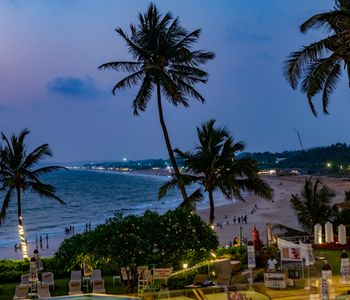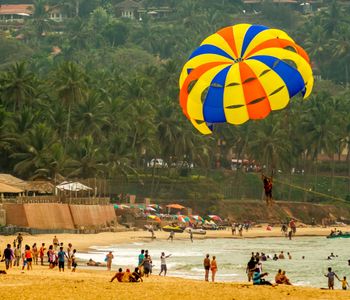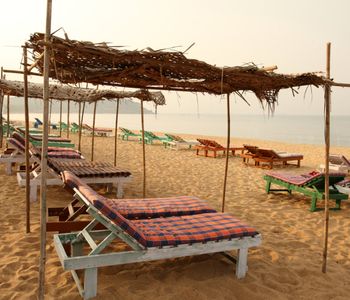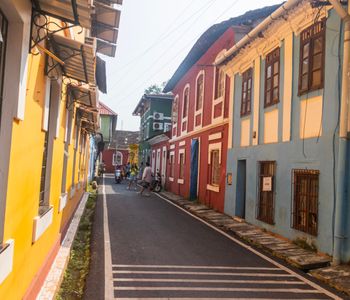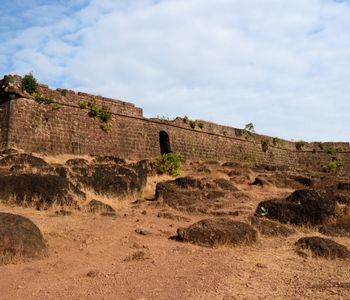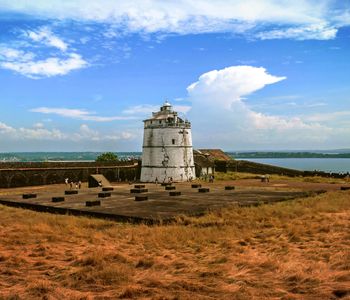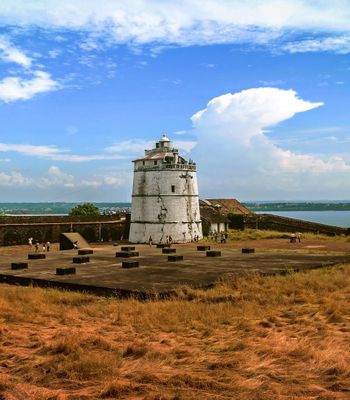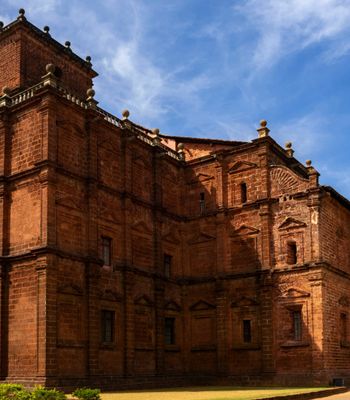
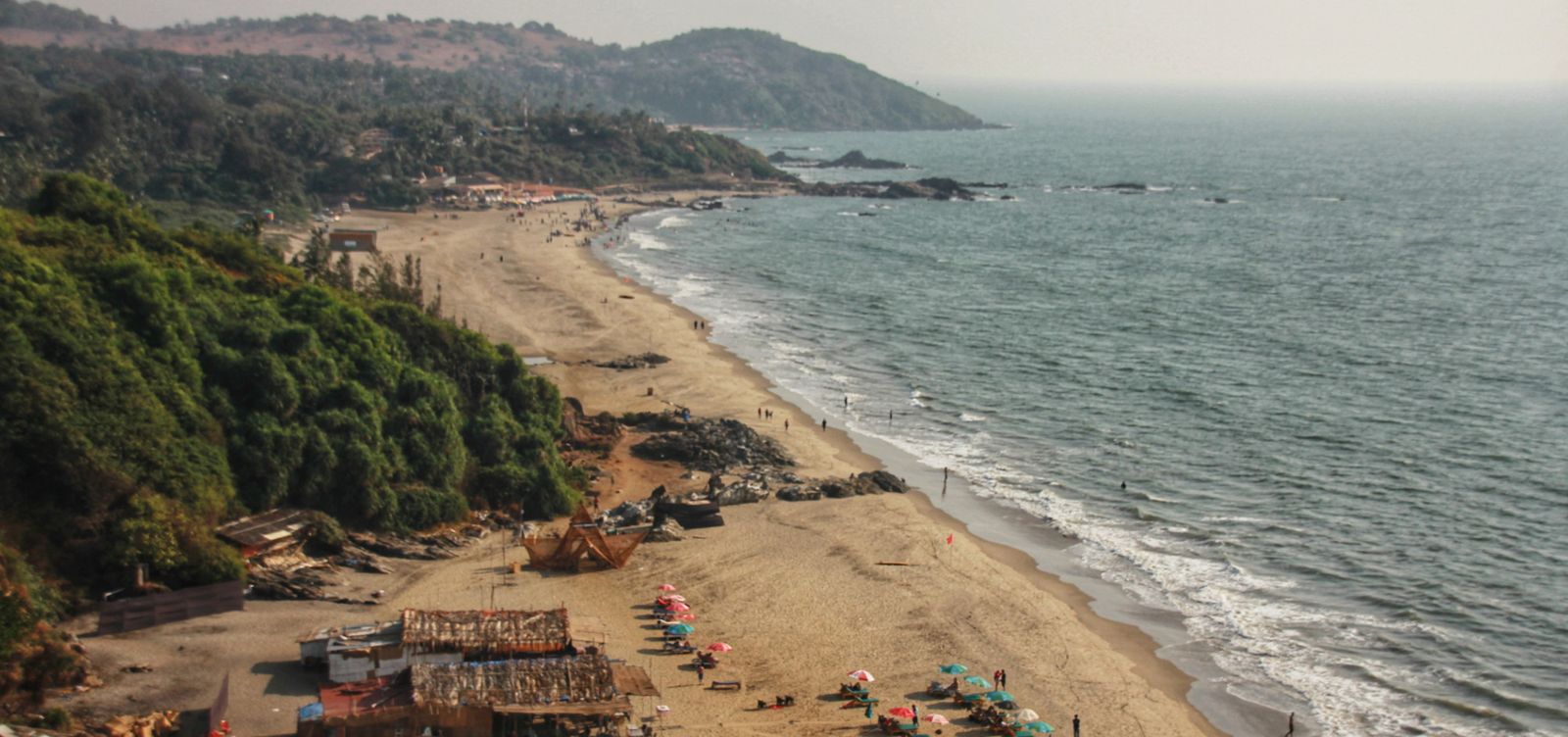
The sand at Anjuna isn't the powdery white stuff you find on postcards. It's coarse, dark in places, and interrupted by laterite rock formations that jut from the shoreline like the bones of some ancient geological argument. This is precisely the point. Anjuna Beach has never traded in perfection — it deals in character, and it has more per square metre than any manicured resort strip in South Goa could dream of.
Since the 1960s, when backpackers and hippies from Europe and North America drifted south along the overland trail through Afghanistan and Nepal, Anjuna became their terminus. Many never left. The residue of that era — the trance music, the flea market, the easy tolerance for eccentricity — still saturates this stretch of North Goa's coastline, though the cast of characters has shifted considerably. Understanding Anjuna means grasping that it was never built for tourists. Drifters found it first, and the place has been negotiating between those two identities ever since.
A Shoreline That Refuses to Behave
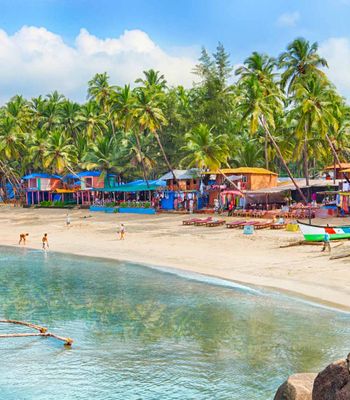
Walk the beach from south to north and you'll cover roughly two kilometres of uneven terrain. The southern end opens wider, where fishing boats with painted hulls rest on the sand between morning hauls. Closer to the centre, volcanic rock pools appear at low tide — small crabs and anemones trapped in shallow basins warmed by the afternoon sun. You can sit on these rocks, feet dangling in tepid saltwater, and watch the Arabian Sea do what it does best: shift colour from grey-green to deep indigo as the day matures.
The northern stretch is rougher, less hospitable to sunbathers, and far more interesting for it. Cliffs of red laterite rise above the waterline, and during monsoon months from June through September, the waves attack them with genuine force. Even in peak season, between November and February, the surf here carries an unpredictable edge. Swimming is possible but demands attention. The undertow has opinions of its own.
Wednesday's Main Event
Every Wednesday, Anjuna's flea market sprawls across an open ground near the southern end of the beach. It started in the 1970s as a place where long-staying travellers sold their belongings to fund another month. Now it's a dense, unruly bazaar — Kashmiri shawl sellers beside Rajasthani jewellery vendors, Tibetan refugees with singing bowls, Goan women hawking spices in small plastic bags.
Haggling isn't optional here. It's the grammar of every transaction. Start at roughly half the quoted price and work from there. Quality varies wildly: you'll find exquisite hand-embroidered textiles shoulder to shoulder with cheap screen-printed nonsense. The trick is patience, and a willingness to walk away. Vendors respect it. The market runs from mid-morning until sunset, but arrive before noon if you want space to move and think. By three o'clock, the lanes between stalls compress into a slow-moving crush.
What makes the flea market worth your time isn't any single purchase. It's the totality — chai brewing on portable stoves, the overlapping scents of sandalwood incense and fried fish, a Russian tourist arguing over the price of a drum while a cow ambles past both of them without interest. That cow, incidentally, is the only party in the negotiation who seems entirely at ease.
After Dark, the Beach Changes Its Mind
Anjuna's nightlife built its name on full-moon parties and open-air trance sessions that ran from midnight until the following afternoon. Those legendary gatherings have been curtailed by noise regulations and a 10 p.m. music curfew enforced with varying enthusiasm by local authorities. The spirit, though, hasn't entirely evaporated.
Curlies Beach Shack, perched on the rocks at the southern end, remains the gravitational centre. On weekends, DJs play until the legal limit, and the crowd — a genuinely international mix — spills across the rocks with drinks in hand. Lilliput Cafe, further north, offers a mellower alternative: fairy-lit terrace, acoustic sets, conversations that don't require shouting. The shack culture along Anjuna is democratic in the best sense. A wooden chair, a Kingfisher beer, the sound of waves beneath conversation. No dress code. No reservations. No pretension.
The Ghosts of Goa Trance
You can't discuss Anjuna honestly without acknowledging its role in birthing an entire genre of electronic music. In the late 1980s and early 1990s, DJs like Goa Gil held outdoor parties on the beach that fused psychedelic rock sensibilities with electronic beats, creating what became known globally as Goa trance. The genre migrated to clubs in London, Berlin, and Tel Aviv, but its origin was here — on laterite cliffs under coconut palms, speakers powered by diesel generators.
Today, that scene is largely nostalgic. The real underground parties, if they happen at all, occur at undisclosed locations outside the village. What remains on the beach is a commercialised echo. But sit at any shack on a Saturday night and you'll hear those spiralling, hypnotic basslines leaking from someone's speaker. The DNA persists, even when the body has moved on.
Fuelling the Day
Breakfast at Anjuna deserves its own section because the beach shacks do it remarkably well. Most open by eight o'clock and serve fresh fruit plates, eggs prepared a dozen ways, and strong South Indian filter coffee that arrives in a steel tumbler — the kind of coffee that feels like it's arguing with you, and winning. For something more local, seek out poee bread, a soft, slightly sweet Goan roll baked in traditional wood-fired ovens, paired with a fiery pork vindaloo from a nearby family-run kitchen. The Portuguese influence on Goan cuisine shows up everywhere, from the tang of vinegar to the prominence of coconut in curries and desserts.
For lunch, the grilled kingfish at most shacks comes straight from the morning catch. Ask for it with rechado masala, a Goan red spice paste that turns simple grilled fish into something you'll think about for months. Wash it down with feni, the local spirit distilled from cashew fruit. The first sip will make you wince. The second starts to make sense. By the third, you'll understand why people never left.
Getting There and Getting Settled
Anjuna sits roughly 21 kilometres from Panaji, Goa's capital, and about 50 kilometres from Dabolim Airport. From the airport, a pre-paid taxi takes approximately 90 minutes depending on traffic and the driver's relationship with speed limits. The Konkan Railway stops at Thivim station, roughly 20 kilometres away, where auto rickshaws and taxis wait in reliable numbers.
Within Anjuna, renting a scooter is the most practical way to navigate the narrow roads connecting the beach to the market, restaurants, and neighbouring villages like Vagator and Chapora. Expect to pay around 300 to 400 rupees per day for a decent Honda Activa. Wear a helmet — the Goa traffic police have grown enthusiastic about fines, and the roads after dark are poorly lit and shared with wandering livestock that won't yield for your headlight.
Accommodation ranges from spartan guesthouses charging under a thousand rupees per night to boutique properties with pools and ocean views at considerably higher rates. The sweet spot, financially and atmospherically, tends to be the family-run guesthouses set back one or two lanes from the beach. They're simple, clean enough, and the owners generally know the area with a depth no guidebook can replicate.
The Beach That Stayed Interesting
Anjuna will never win a competition for Goa's most beautiful beach. Palolem has the crescent perfection. Agonda, the serene emptiness. Benaulim, the quiet dignity. What Anjuna offers instead is texture — the layered accumulation of decades of stories, sounds, and small rebellions against the ordinary. The landscape and the people who've inhabited it are inseparable here, the rocks and the raves and the flea market and the fishing boats existing in a strange, productive tension.
Come expecting a pristine tropical escape and you'll be disappointed. Come curious, and Anjuna will hold your attention long after the tan fades. Most beaches want to be beautiful. This one would rather be remembered.