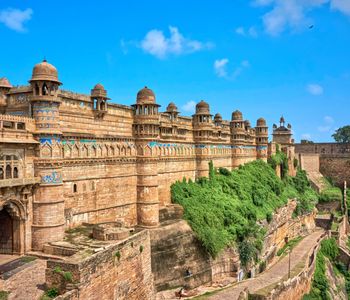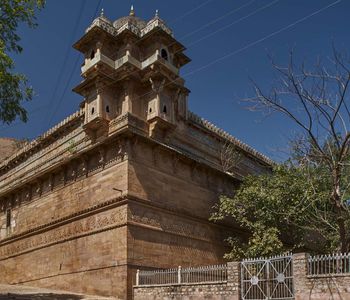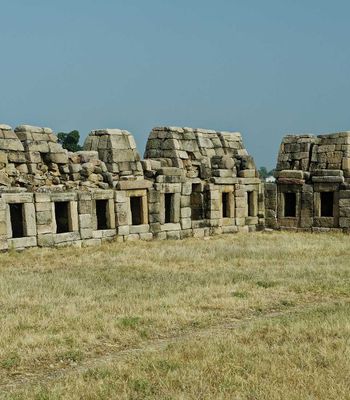
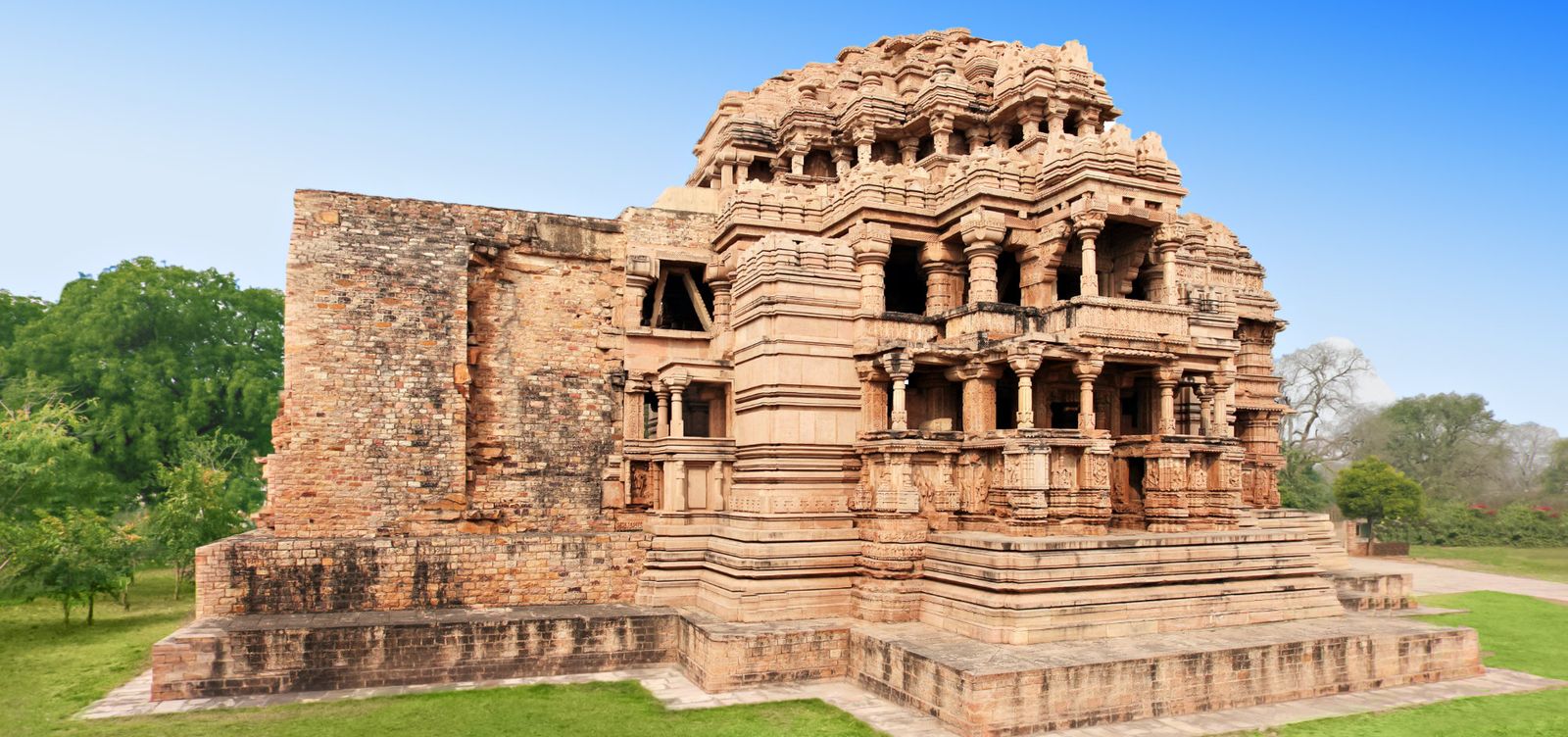
The name is a red herring. "Sas Bahu" translates loosely to "mother-in-law and daughter-in-law," and the popular legend has it that these twin temples were built by a queen and her son's wife, each one determined to outshine the other in devotion. A good story. Almost certainly fiction. The name most likely descends from "Sahasrabahu" — the thousand-armed Lord Vishnu, to whom the larger temple is dedicated. Centuries of local pronunciation wore the word down, and the rivalry tale rushed in to fill the silence. None of it matters much once you're standing before these two 11th-century sandstone structures on the eastern slope of Gwalior Fort. The real story is carved into the walls, and it's far stranger and more beautiful than any domestic squabble.
Built around 1093 CE under the Kachchhapaghata dynasty, the Sas Bahu temples are among Central India's finest expressions of Nagara-style architecture. The larger temple — Sas — rises with an almost aggressive confidence. The smaller Bahu echoes it in miniature, like a whispered response to a shout. Together they form an open-air anthology of Hindu sculptural art, and they give far more to the patient visitor than to the one who frames a shot and walks on.
Stone That Speaks in Layers
The larger temple's exterior is relentless. Every surface — pillar, lintel, ceiling panel — carries carvings so densely layered they seem to jostle for your eye. Scenes from the Ramayana run alongside geometric floral patterns and celestial dancers frozen in postures that suggest a sculptor who understood the mechanics of the human body with clinical precision. The closer you get, the more the intricacy resolves. It doesn't blur. It sharpens.
What stops most people mid-stride is the ceiling of the main mandapa. Look up and you'll find a circular lotus medallion carved from a single sandstone block, its petals radiating outward, folding into what appears to be three full dimensions. The engineering alone — achieving that depth in ceiling relief without the stone crumbling under its own mass — points to a mathematical intelligence the Kachchhapaghata builders never committed to paper but clearly held in their hands.
The smaller Bahu temple can't match its sibling's scale. It doesn't try. Instead, it trades volume for delicacy. Panels depicting Vishnu's ten avatars line the exterior walls with a narrative clarity that reads almost sequentially, like a visual chronicle you follow panel by panel. The sculptors allowed themselves more negative space here, and the figures breathe in a way the crowded surfaces of the larger temple don't permit.
A Dynasty's Forgotten Signature
The Kachchhapaghata rulers who commissioned these temples don't occupy the same mental real estate as the Mughals or the Rajputs. Their kingdom was modest, their reign comparatively short. Yet these temples betray ambitions wildly out of proportion to their political footprint. The larger temple originally rose from a raised platform with an open portico supported by pillars arranged in a cruciform plan — a layout that anticipated architectural innovations other, far more powerful dynasties would adopt decades later.
An inscription at the site credits King Mahipala with the construction, dedicating the temple to Padmanabha, a form of Vishnu. This matters because the temple's iconography doesn't stay neatly Vaishnavite. Shaivite elements appear too, including a Shiva Nataraja panel on the exterior. Whether this mixing reflected political hedging or genuine theological fluidity, the result is a space that resists belonging to a single doctrine.
Time and invasion stripped both temples of their original shikhara towers. The larger temple's superstructure is gone entirely, leaving the mandapa open to the sky. Here's the counterintuitive thing: the damage has its own austere power. Sunlight now falls directly onto carvings that were designed for shadow, exposing tool marks and surface textures the original architects never intended anyone to see. You're looking at the private skin of the stone.
The Fort Above and the Climb Below
The temples sit within the sprawling Gwalior Fort complex, so reaching them means either driving up the fort's winding road or climbing the eastern approach. Take the eastern path. It's steeper, but by the time you've passed the massive Jain rock-cut sculptures carved directly into the cliff face — towering Tirthankaras standing in silent meditation, some reaching nearly 17 metres — your sense of proportion has already been permanently adjusted. The temples, when they appear, feel like the destination your eyes have been recalibrating toward.
From the temple platform, Gwalior spreads below in a haze of low rooftops and the faint drone of traffic. The view doesn't deliver a postcard. It delivers a military education. You understand instantly why every dynasty from the Tomars to the British fought to hold this fort.
What Most Guides Won't Mention
Arrive before 9 a.m. and you get two things no later visitor does. First, the sandstone glows a warm amber in early light — by midday it's a flat, washed-out beige, and the carvings lose half their depth. Second, solitude. Tour groups from Gwalior's hotels roll in after ten, and by noon the platform bakes under unbroken sun with no shade to speak of.
Bring a flashlight, or at least use your phone's torch. Several interior carvings on the mandapa pillars sit in recessed panels where ambient light simply doesn't arrive. Without directed light, you'll walk straight past figures of apsaras, musicians, and mythological scenes that most people never register. The temple hoards its best details in its darkest corners.
The temples fall under the Archaeological Survey of India, so the grounds are reasonably maintained. Entry to the Gwalior Fort complex is ticketed — 75 rupees for domestic visitors, 600 rupees for international visitors as of recent years. Verify current pricing before you go. There's no separate charge for the Sas Bahu temples once you're inside the fort.
Getting There Without the Hassle
Gwalior sits on major rail and road routes between Delhi, Agra, and Bhopal. The Shatabdi Express delivers you from Delhi to Gwalior Junction in roughly three to four hours. From the station, an auto rickshaw to the fort's base takes about twenty minutes, traffic depending. If you're coming from Agra, it's approximately 120 kilometres along National Highway 44 — a straightforward drive.
Inside the fort complex, the temples are a short walk from the main vehicle drop-off near the Gujari Mahal. Wear proper shoes. The stone paths are uneven, and the platform steps turn slick during the monsoon months between July and September. October through February is the window that makes the climb and the lingering worthwhile — the air is cooler, the light better, and you won't feel rushed off the platform by the heat.
Worth the Detour
The Sas Bahu temples don't compete with Khajuraho's fame or Hampi's sprawl. They don't need to. What they offer is something harder to find — a place where 11th-century sculptors poured extraordinary skill into a commission for a minor dynasty, and where the result has outlasted the kingdom that paid for it by nearly a thousand years. Stand beneath that lotus ceiling in the early morning, trace the curve of a carved dancer's arm with your eye, and you'll grasp something about permanence. It has nothing to do with power. Everything to do with craft. These temples are the proof.