Two chandeliers hang in the Durbar Hall of Jai Vilas Palace, each weighing three and a half tonnes. Before they were hoisted into place in the 1870s, the story goes that ten elephants were marched onto the roof to test whether the structure could bear the weight. It held. The chandeliers still hang there today, dripping with crystal, throwing fractured light across a room that stretches over a hundred feet long. This single detail tells you everything about Jai Vilas Palace — a building conceived with the confidence of someone who believed that more was never quite enough.
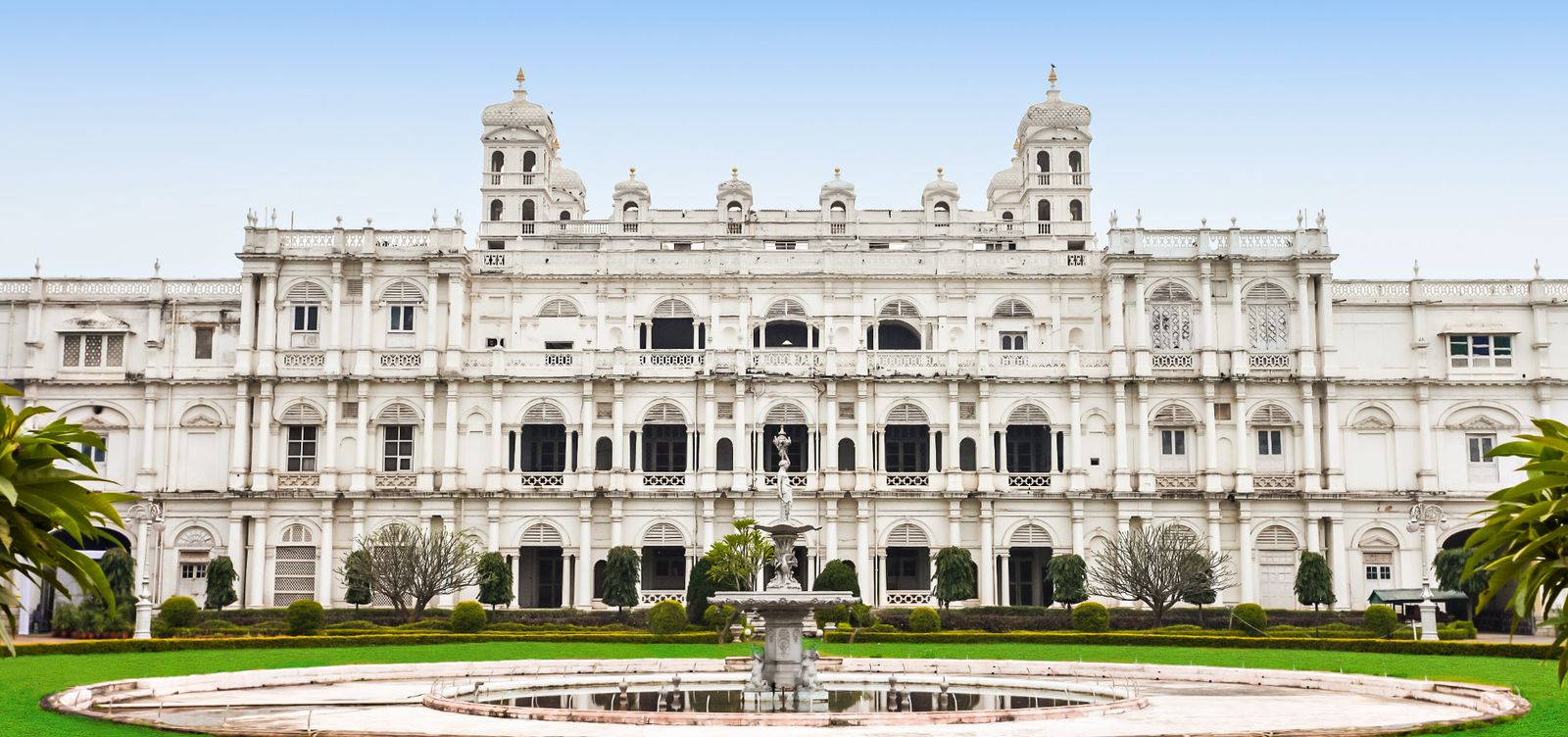
Built by Maharaja Jayajirao Scindia in 1874, the palace sits in the heart of Gwalior, a city already thick with forts and tombs. Yet Jai Vilas doesn't compete with its neighbors. It ignores them entirely, looking toward Europe for its architectural vocabulary while remaining unmistakably, defiantly Indian in its excess.
Where Europe Met the Scindias
The architect was Sir Michael Filose, a British officer handed an unusual brief: build something that would impress the Prince of Wales during his 1875 visit to India. Filose responded by borrowing from three European traditions at once. The facade draws on Italian Tuscan architecture, the interior channels French Rococo, and certain structural elements nod toward Corinthian design. The result should feel incoherent. Strangely, it doesn't.
Walk through the main entrance and the scale announces itself immediately. The white exterior gives way to gilded interiors, room after room lined with ornamental plasterwork, heavy drapery, and furniture imported from France and Italy. Gold leaf covers surfaces with an almost reckless generosity. You get the sense that Jayajirao Scindia wasn't decorating a home — he was prosecuting an argument about his dynasty's place in the world.
Here's the counterintuitive thing: for all its European aspiration, the palace feels most alive in its Indian details. The carved jali screens, the arrangement of courtyards, the way certain rooms open to catch cross-breezes — these reveal a builder who understood his climate and his culture far better than any imported blueprint could.
The Museum That Lives Inside
Thirty-five of the palace's rooms now operate as the Jiwaji Rao Scindia Museum, while the Scindia family continues to occupy the remaining sections. This arrangement gives the place a peculiar energy — you're walking through someone's ancestral home, except the ancestors had a silver train set that ran on miniature tracks across the dining table, delivering after-dinner whisky and cigars to guests.
That train set is real, and it's the exhibit people can't stop talking about. Made of silver, it chugged along rails embedded in the banquet table, stopping at each guest's seat. If you didn't pick up your drink quickly enough, the train moved on. There's something wonderfully absurd about it — hospitality mechanized and miniaturized, a maharaja's notion of entertainment that still makes people pause and grin a century later.
Beyond the train, the museum holds an extensive collection of Persian rugs, Mughal swords, royal photographs, and palanquins. One room displays European oil paintings that Jayajirao acquired during his travels. Another houses ornate cradles used for Scindia infants. The sheer variety of objects mirrors the palace itself — eclectic, ambitious, occasionally overwhelming, but never dull.
The Durbar Hall and Its Impossible Weight
Return to those chandeliers, because the Durbar Hall deserves its own moment. The room was designed for royal audiences and state functions, and every surface conspires to make you feel small. The carpet alone, reportedly woven by inmates of Gwalior's central jail, covers the entire floor in a single enormous piece. Gilt-framed mirrors line the walls, multiplying the chandeliers into an infinity of reflected light.
Stand beneath one of those fixtures and look directly up. The crystals hang in tiers, dense as frozen rain, and the ironwork that supports them vanishes into the ceiling's painted panels. The elephant test may be apocryphal — historians debate it — but the fact that the story persists tells you something about how this room affects people. It demands a legend to match its scale.
What strikes you most, though, is the silence. Despite tour groups shuffling through, the Durbar Hall absorbs sound. Heavy carpets and draped walls create a hush that feels almost devotional — a strange quality for a room built to showcase political power.
The Fort Above, the Palace Below
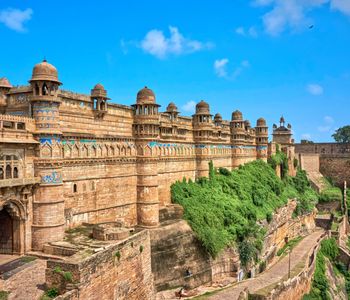
Jai Vilas sits below Gwalior Fort, which looms on a sandstone bluff above the city. The contrast is instructive. The fort is ancient, martial, and weathered — shaped by centuries of siege and succession. The palace, by comparison, is youthful and vain, barely 150 years old, more concerned with beauty than defense. Visiting both in a single day gives you a compressed history of Indian power: from walled fortresses to palatial statements.
The old city surrounds the palace grounds, and the streets leading to the main gate are loud with traffic, food stalls, and the persistent honking that defines Indian urban life. Inside the compound walls, manicured lawns and gravel pathways impose a sudden order. That transition — from chaos to control — is itself part of the experience.
Getting There and Getting In
Gwalior sits roughly 320 kilometers south of Delhi, connected by rail and a domestic airport. Trains from Delhi take between three and four hours on the Shatabdi Express, making a day trip feasible if somewhat rushed. From Gwalior's railway station, the palace is a short auto rickshaw ride away — no more than fifteen minutes through the city center.
The museum charges 100 rupees for Indian nationals and 400 rupees for international visitors. A separate photography fee applies, and it's worth paying given the interiors. The palace opens at 10 a.m. and closes by 5:30 p.m., with the last entry typically around 4:30 p.m. It remains closed on Mondays and certain national holidays.
Allow yourself at least ninety minutes inside the museum. Rushed visitors tend to photograph the chandeliers and the silver train, then leave. Linger instead in the smaller rooms, where personal artifacts — handwritten letters, family portraits, hunting trophies — reveal the Scindias not as abstract royalty but as people with habits and vanities and a taste for the dramatic.
A Monument to Ambition, Unashamed
Jai Vilas Palace doesn't apologize for what it is. In an era when many Indian palaces have been converted into heritage hotels or left to crumble, this one remains split between a living family home and a public museum — a negotiation between past grandeur and present reality. The silver train still sits on its tracks. The chandeliers still hang. Gwalior carries on around the compound walls, indifferent and alive. Spend an afternoon with the Scindias' ambitions, and you'll leave understanding something specific about what power looked like when it had no reason to be modest.