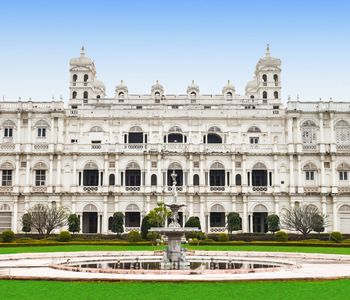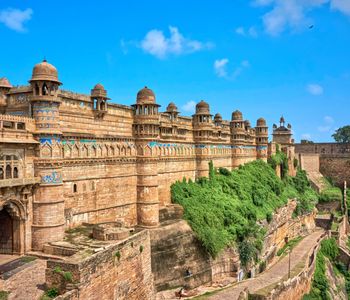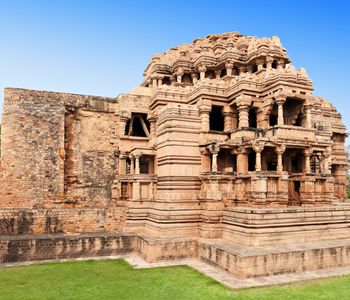
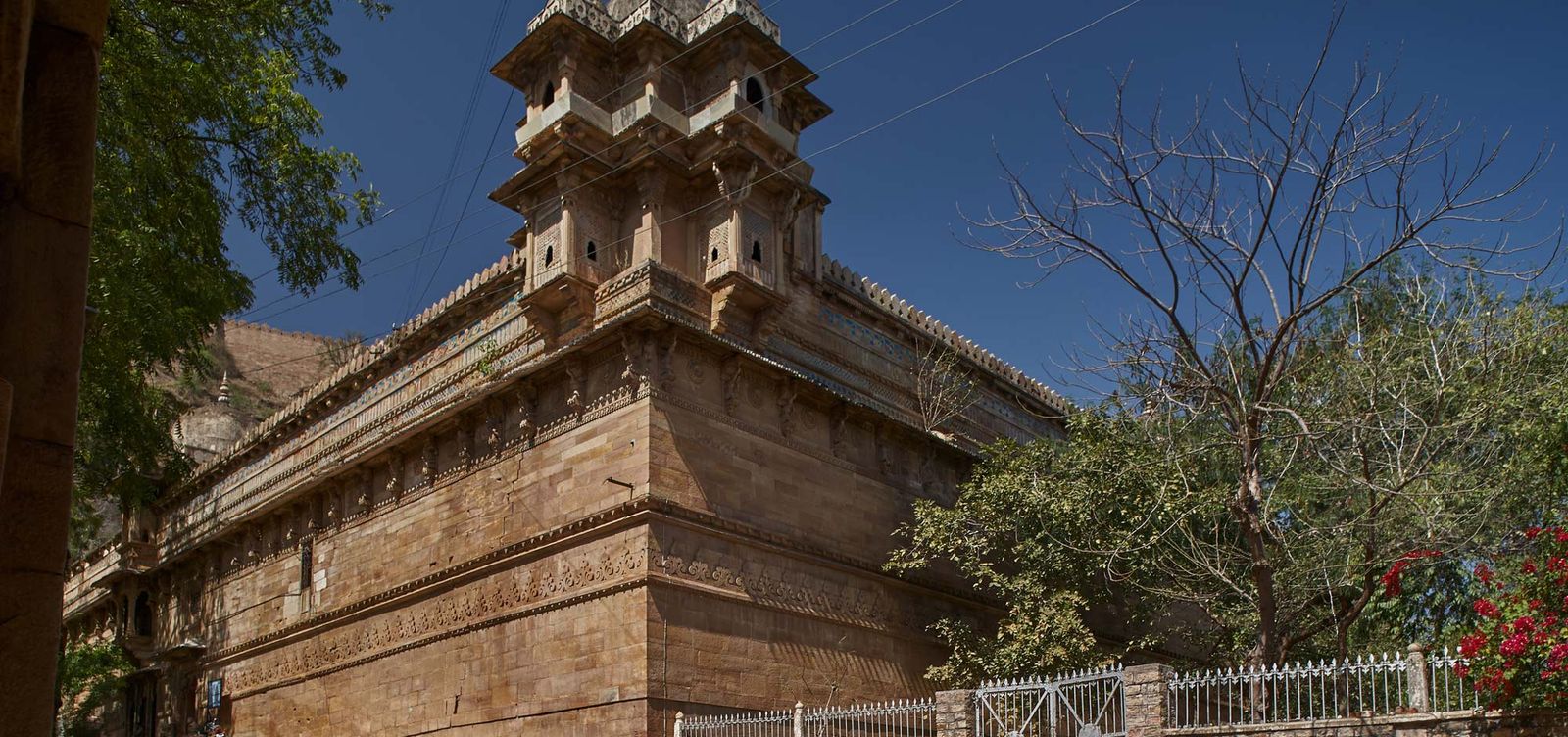
The Gujari Mahal sits at the eastern base of Gwalior Fort, a 15th-century palace built not for governance or defense, but for love. Raja Man Singh Tomar constructed it for his queen Mrignayani, a Gujar princess who agreed to marry him on one condition — a continuous supply of water from the River Rai. The palace got its water channel. The queen got her palace. And centuries later, the building got a second life as one of central India's most important archaeological museums. What strikes you first isn't the collection inside but the building itself — a sandstone structure with heavy, rounded bastions that looks more like a small fortress than a romantic gesture. Love, apparently, looked different in the 15th century.
When a Love Story Becomes a Museum
Man Singh Tomar ruled Gwalior in the late 1400s, and his attachment to Mrignayani became the stuff of regional legend. She was a commoner, a Gujar woman he reportedly encountered near a river. The palace he raised for her was grand by the standards of its era — thick walls, arched corridors, open courtyards angled to catch the breeze rolling off the fort hill above.
By 1922, when the Archaeological Survey of India converted the Gujari Mahal into a museum, the romance had long faded from the walls. What remained was the architecture — heavy, practical, beautiful in its bluntness. The conversion preserved much of the original structure while repurposing its chambers into gallery spaces. You're still walking through Mrignayani's palace. The proportions remind you of that with every doorway.
Sculptures That Speak Louder Than Labels
The collection spans roughly 1,500 years of artistic production from the Gwalior-Chambal region. Most of it is stone sculpture, and the quality is genuinely arresting. A miniature Shiva Nataraja from the 10th century commands one room, its movement carved so precisely into sandstone that the figure appears to twist as you shift your angle. Stand still. Then move a half-step. Different dance.
Hindu, Jain, and Buddhist sculptures fill the galleries in roughly chronological order. The Jain figures from the Teli Ka Mandir period possess a stillness that contrasts sharply with the dynamic Hindu carvings nearby — a tension that plays out across the room like a silent argument between two theologies of the body. One gallery houses Yakshi figures, female nature spirits rendered with a fluidity that makes the stone look soft, almost yielding. These aren't objects that reward a glance. They demand you slow down.
The Saalbhanjika sculpture — a woman grasping a tree branch — is perhaps the single most photographed object here. For good reason. The carving achieves something unusual: it captures weight and weightlessness simultaneously, the figure both grounded and reaching upward. You'll find reproductions in art history textbooks, but the original's surface texture, the chisel marks still faintly visible after centuries, changes your understanding entirely. Photographs flatten what the stone still holds.
Beyond the Stone
The museum doesn't confine itself to sculpture. Coins, copper plates, inscriptions, terracotta pieces, and painted manuscripts fill the smaller rooms. A collection of miniature paintings from the Tomara period offers a rare visual record of courtly life in pre-Mughal central India — figures seated on low platforms, musicians mid-note, the palette heavy on ochre, deep green, and vermillion. The colors have held remarkably well, as though they simply refused to leave.
One room contains weapons recovered from the Gwalior Fort complex and surrounding excavations. Swords, daggers, and shields sit in glass cases that feel slightly outdated in their presentation, but the objects themselves carry a different kind of authority. A curved dagger with an ivory handle, attributed to the Mughal period, catches window light in a way that makes you forget the dusty case surrounding it. You stop thinking "artifact" and start thinking "weapon."
Here's the counterintuitive thing about the Gujari Mahal: it's a better museum because it's a worse building. The thick walls and deep chambers keep the interior cool even in Gwalior's savage summers, when temperatures push past 45 degrees Celsius. Low ceilings and narrow doorways force intimate encounters with the objects — you can't breeze through at gallery-trot speed. The architecture won't let you. What failed as ventilation for a queen succeeds brilliantly as climate control for sandstone carvings.
The Courtyard Nobody Lingers In
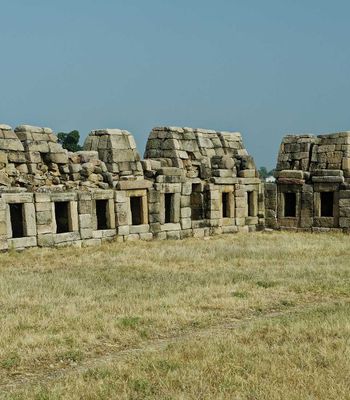
Step outside into the central courtyard and you'll find stone fragments and architectural pieces arranged in open air — lintels, pillar capitals, carved panels too large for the indoor galleries. Pigeons own the upper walls. Afternoon light falls across inscribed tablets leaning against the courtyard perimeter, some dating to the Gupta period, their edges softened by centuries of rain and indifference.
This outdoor section doesn't get the attention it deserves. Most people hurry through to the next indoor gallery. Don't. Some of the finest carved panels sit here, weathering slowly, their details still sharp enough to study at arm's length. A frieze depicting court musicians, likely from the 11th century, runs along one wall at knee height — precisely where most people walk right past it without a downward glance. Kneel. It's worth the dust on your trousers.
The Practical Particulars
The Gujari Mahal sits on Gwalior Fort Road, directly below the fort's eastern face. From Gwalior Junction railway station, an auto rickshaw covers the roughly three-kilometer distance in about fifteen minutes, depending on traffic. If you're visiting the fort — and you should be — the museum makes a natural starting point at the base before you ascend.
Entry fees are modest. Indian nationals pay 20 rupees, while foreign visitors pay 250 rupees. The museum opens at 10 a.m. and closes at 5 p.m. daily, except Mondays. Photography rules have shifted over the years, so ask at the entrance before pulling out your camera. The staff is generally accommodating.
Plan about ninety minutes for a thorough visit. The galleries aren't enormous, but the density of the collection rewards patience. Mornings tend to be quieter, and the courtyard light is better before noon. Carry water — there's no cafeteria inside, though vendors outside the gate sell snacks and cold drinks.
October through February is the sensible window for visiting Gwalior. The summer heat is genuinely punishing, and while the palace walls offer some relief, the walk from the road to the entrance under a May sun will test your commitment to archaeology in ways no exam ever could.
A Building That Found Its Purpose
The Gujari Mahal could have crumbled into footnote status — another romantic ruin in a country that has more of them than it knows what to do with. Instead, it found a purpose that suits it better than its original one. As a museum, it houses a collection that traces central India's artistic evolution with more honesty than any guidebook summary can manage. The palace Man Singh built for love now serves something more durable: a region's memory, carved in stone, arranged in quiet rooms, waiting for anyone willing to look closely enough.