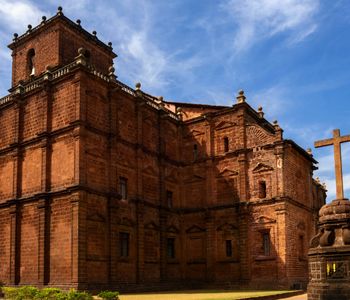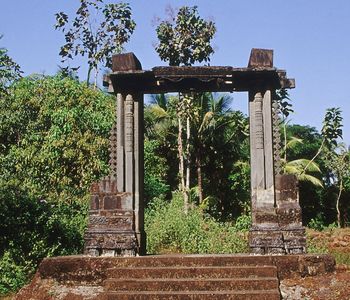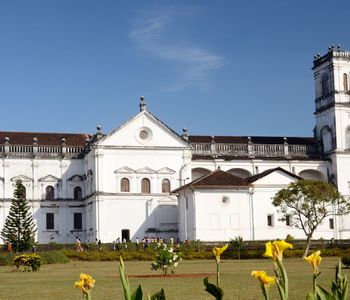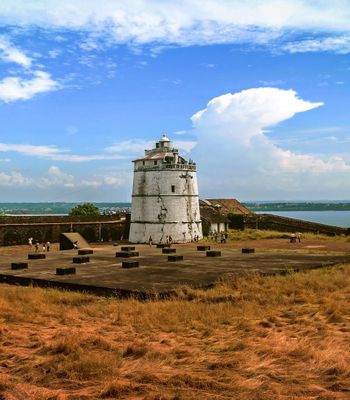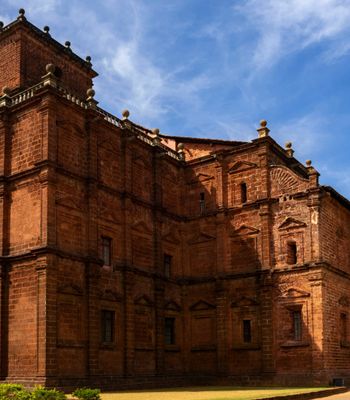
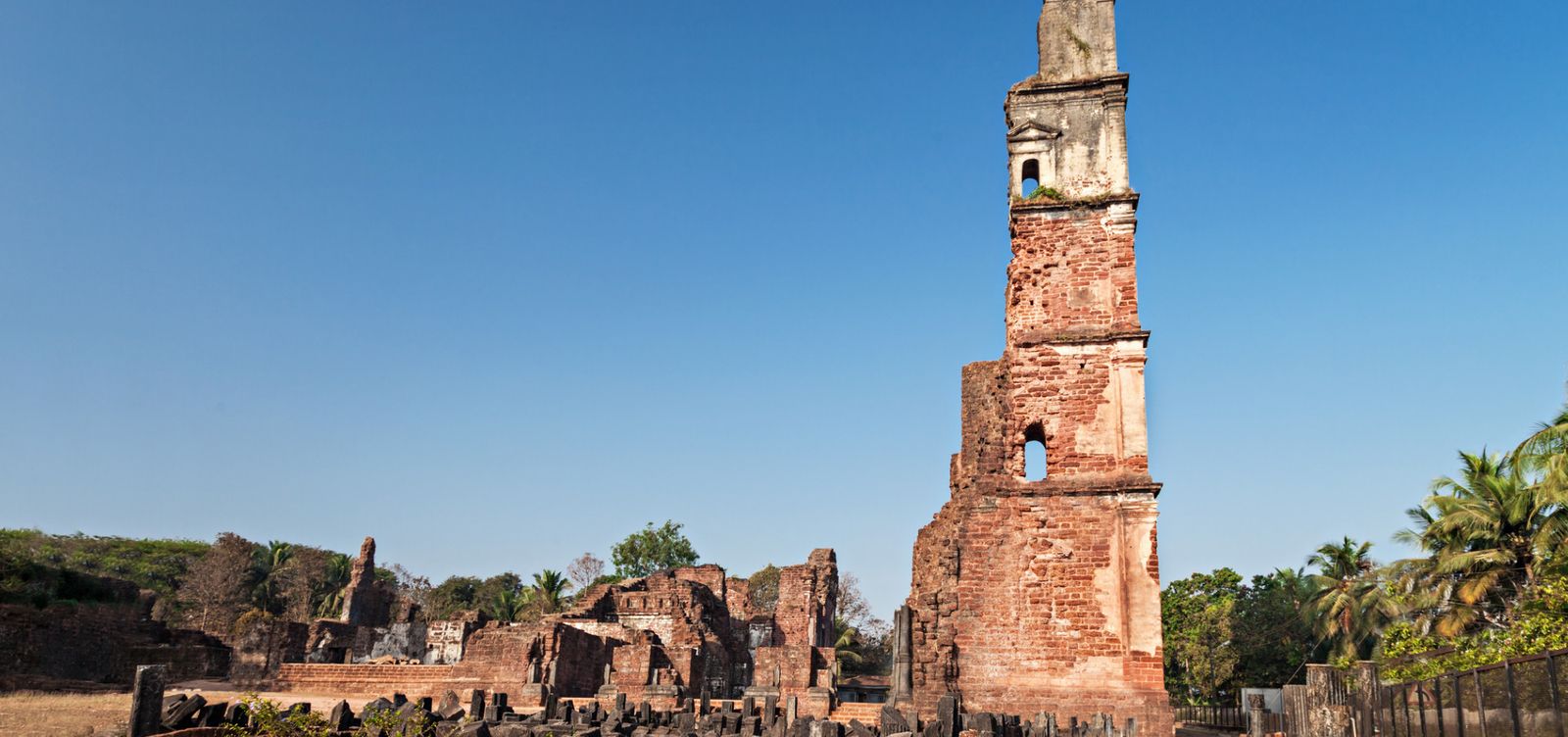
Most ruins fade quietly. St Augustine Tower refuses. Rising over 46 feet above the laterite plateau of Old Goa, this solitary facade is all that's left of what was once the largest church in a city that, during the sixteenth and seventeenth centuries, had the nerve to rival Lisbon itself. The tower doesn't inspire the kind of hushed reverence you feel inside a cathedral. It inspires something more like defiance. The vault collapsed. The nave fell. The monastery crumbled to nothing. And yet this single wall of laterite and plaster held on — leaning slightly, weathered to the color of dried tobacco, as if daring the monsoons to finish what they started.
To visit St Augustine Tower is to encounter Portuguese colonial Goa at its most honest: not the gilded altars and polished floors of Se Cathedral down the road, but the slow, unglamorous truth of empire decaying in tropical heat. That distinction alone is worth your afternoon.
A Church That Outgrew Its Welcome
Augustinian friars laid the foundation of the Church of St Augustine in 1572. By 1602, it was complete — a massive structure with a vaulted interior, four altars, a convent, and what historical records describe as one of the finest church facades in Portuguese Asia. The bell tower alone originally stood nearly 200 feet, tall enough to be visible from the Mandovi River. That wasn't vanity. It was a deliberate signal to ships approaching the colonial capital: you have arrived.
For roughly two centuries, the church hummed along as a center of Augustinian religious life. Then the Portuguese government, through a series of policies suppressing religious orders during the 1830s, expelled the friars from Goa. Without its caretakers, the church began to die — not dramatically, but with the quiet inevitability of a body abandoned by its immune system. The vault collapsed in 1842. The front facade followed in 1931. By the mid-twentieth century, only the tower's belfry section remained upright, surrounded by heaped laterite rubble and creeping vegetation.
Here's what's counterintuitive: the tower survived not because it was the strongest part of the building, but because it was the least ambitious. While the nave and vault attempted grand spans in a climate that punishes ambition — monsoon rains, root infiltration, termite damage working in relentless concert — the tower was simply a thick, vertical stack of laterite blocks. Its modesty saved it.
What the Rubble Tells You
Approach from the main road and the first thing you register is the scale of the debris field. Massive laterite blocks, some the size of small cars, lie scattered across the hillside in arrangements that still hint at the original footprint. Walk among them and your mind starts rebuilding — the transept here, an altar base there. Moss and ferns have colonized every crevice, and during monsoon season the entire ruin takes on a deep green patina that photographs beautifully but smells distinctly of wet stone and decomposing leaves.
The tower itself retains traces of plasterwork on its inner face. Look closely and you can make out the outlines of arched window openings, now empty, that once held wooden frames. At the base of the ruins, the Archaeological Survey of India has excavated and partially exposed the old floor level, revealing the sheer thickness of the original walls — some measuring over five feet across. You press your hand against one and feel the density of it, the impossible weight of a building that still fell.
One of the tower's four original bells was transferred to the Church of Our Lady of the Immaculate Conception in Panaji, where it still hangs today. Another found its way to Se Cathedral nearby. If you visit those churches before coming here, you'll have the genuinely strange experience of hearing bells that once rang from this now-silent ruin. The sound carries on. The building doesn't.
The Solitude You Didn't Know You Wanted
Most visitors to Old Goa cluster around the Basilica of Bom Jesus and Se Cathedral, both UNESCO World Heritage sites and fully intact. St Augustine Tower sits on a small hill just a few hundred meters south, yet it receives a fraction of the foot traffic. On a weekday morning, you might have the entire site to yourself — just you, the laterite, and crows arguing in the surrounding palms.
That solitude changes the experience entirely. At the basilica, you're a tourist managing other tourists. Here, you're an observer in a genuinely abandoned space. The ASI maintains the site and has installed informational placards, but the intervention is minimal. No gift shop. No audio guide. No queue. You walk in, look up at the tower's remaining wall, and sit with the fact that an entire religious complex — convent, library, church — vanished within a few generations. The absence is the exhibit.
Getting There Without the Headache
Old Goa lies about ten kilometers east of Panaji, the state capital. From Panaji's Kadamba bus stand, frequent local buses make the trip in under thirty minutes. If you're staying in the beach towns of North Goa — Calangute, Baga, Anjuna — a taxi or ride-share will take roughly forty-five minutes depending on traffic, which in Goa means depending on whether a cow has decided to nap in the road.
The tower sits on a gentle hill behind the Church of St Augustine ruins, accessible via a laterite pathway. Wear shoes with decent grip, particularly during the monsoon months from June through September when the stones turn slick and treacherous. The ASI charges a nominal entry fee — typically around 25 rupees for Indian nationals and 300 rupees for international visitors, though it's worth confirming current rates before your visit.
There's no dedicated parking lot, but vehicles can pull over along the road below the hill. The walk up takes about five minutes at a leisurely pace. Because the site is fully open-air with no shade structures, carry water and consider visiting before 10 a.m. or after 3 p.m. Between March and May, the Goan sun doesn't warm you so much as punish you.
Pairing It With the Neighborhood
Old Goa rewards a full morning on foot. After the tower, descend the hill and cross toward Se Cathedral, the largest church in Asia when it was completed in 1619. From there, the Basilica of Bom Jesus is a two-minute walk — its interior holds the remains of St Francis Xavier in an ornate silver casket. The Archaeological Museum, housed in the former Convent of St Francis of Assisi, offers a cool interior and a collection of portraits depicting every Portuguese viceroy who governed from Goa. Some look triumphant. Most look exhausted.
For food, skip the overpriced stalls near the basilica. Head back toward Panaji instead and stop at one of the small restaurants along the NH 748, where a plate of fish curry rice — Goa's honest, daily staple, the dal and rice of the coast — costs a fraction of tourist-zone prices. The curry arrives thin and sharp with kokum, the rice still steaming. That's lunch.
A Ruin Worth Your Respect
St Augustine Tower won't dazzle you the way a restored monument does. It won't hand you a tidy narrative about glory and devotion. What it offers is rarer: an unvarnished record of how quickly grandeur unravels when no one's left to maintain it. Stand at its base, look up at the remaining wall with its patches of old plaster still clinging on, and you'll understand something about colonial Goa that the polished churches down the hill can never quite convey. Some places teach you history. This one teaches you what happens after history moves on.