Inside a laterite-walled basilica in Old Goa, the mortal remains of St. Francis Xavier have been lying in a silver casket for over four centuries. The body, by most accounts, has resisted the full indignities of decomposition — a fact that has drawn pilgrims, skeptics, and the merely curious in roughly equal measure since the seventeenth century. The Basilica de Bom Jesus, which translates to "Basilica of Good Jesus," is the only church in Old Goa that hasn't been plastered on the outside, and this absence gives it a raw, weathered authority that its whitewashed neighbors lack. Dark laterite blocks stand exposed to the tropical air, absorbing heat and age with equal patience. Walk through its doors, and the temperature drops. The light dims. Something shifts.
Stone Without a Mask
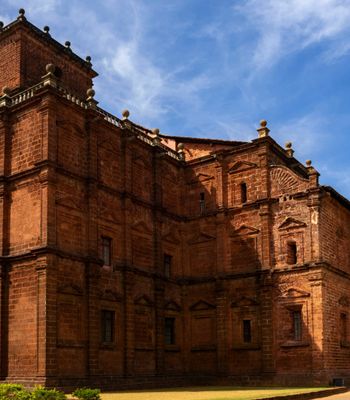
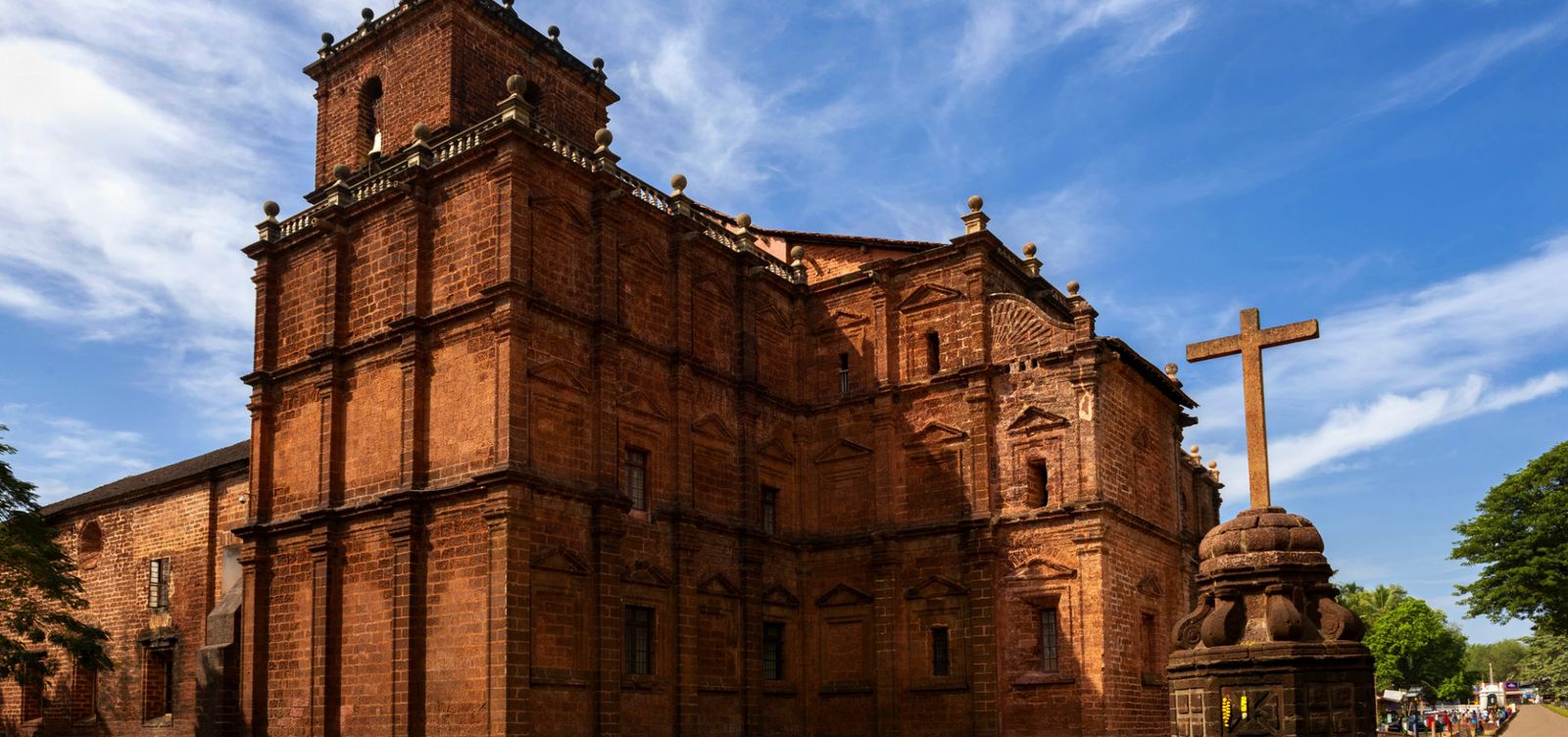
The basilica's unplastered exterior wasn't a deliberate aesthetic decision — it's the aftermath of a misguided 1950 renovation that stripped away the original lime plaster. What you're looking at is the building's skeleton: blocks of reddish-brown laterite stacked since 1605, when the church was consecrated after a decade of construction. The Jesuits who commissioned it wanted grandeur. They got it, though not in the way Rome might have expected.
Forget soaring Gothic verticality. The facade blends Renaissance restraint with Baroque ornamentation — three doorways punctuating the ground level, Corinthian columns framing the central window above. The letters "IHS," the Christogram of the Jesuit order, sit carved in basalt near the top. At the very peak, a simple cross. Nothing excessive. Nothing accidental.
Inside, the nave stretches roughly 55 metres, its gilded main altarpiece dedicated to the infant Jesus. Gold leaf catches whatever light filters through narrow windows, casting the interior in a warm amber tone that feels almost subterranean. Wooden carvings crowd every surface of the reredos — cherubs, saints, columns twisting into spirals — with a density and obsessiveness that rewards a second and third look. You don't glance at this altarpiece. You read it.
A Saint in a Silver Box
The basilica's true gravitational center lies in the right transept. Here, elevated on a marble pedestal designed by the seventeenth-century Florentine sculptor Giovanni Battista Foggini, sits the silver casket containing St. Francis Xavier's remains. The casket arrived from Florence in 1698, a gift that took a decade to complete. Its panels depict scenes from the saint's life: baptizing converts, surviving shipwrecks, performing miracles that may or may not have happened.
Xavier died in 1552 on Shangchuan Island off the coast of China, and his body took a circuitous route to Goa — first buried in quicklime on the island, then exhumed months later and transported to Malacca, finally brought to Goa in 1554. The Jesuits reported the body was remarkably intact. Over subsequent centuries, pieces were removed. A toe bitten off by a devotee in 1554. The right forearm sent to Rome in 1615. What remains is considerably less than the original, but the basilica doesn't advertise this.
Once every ten years, the body is displayed to the public in a ceremony called the Exposition. The last one drew hundreds of thousands over several weeks. Between expositions, the casket stays closed. You stand before it, read the plaques, study the silver reliefs, and fill in the rest with faith or imagination — whichever you brought with you.
Where Empires Built Their Altars
Old Goa was, for a brief and ferocious period, the Rome of the East. At its peak in the sixteenth century, the Portuguese colonial capital rivaled Lisbon in population and ambition. Churches and convents rose by the dozen. The Basilica de Bom Jesus was the Jesuits' flagship — a declaration of permanence in a land they intended to convert and keep.
That permanence proved fragile. Cholera, malaria, and a silting river drove the Portuguese to abandon Old Goa by the eighteenth century. A city that once held 200,000 residents became a ghost town of churches. Most survive today as part of a UNESCO World Heritage designation granted in 1986. The basilica stands among them, but it stands differently — less restored, more honest about its age.
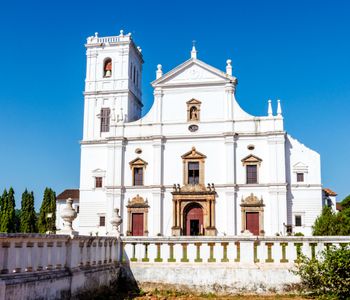
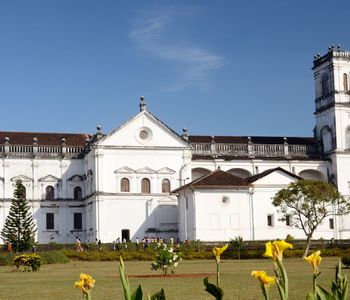
Here's the counterintuitive thing: it's precisely this roughness that makes the building moving. The polished, whitewashed Se Cathedral across the square looks preserved — almost embalmed. The Basilica de Bom Jesus wears its four centuries on its skin. Moss creeps along the laterite. Rain has stained certain blocks almost black. It looks like a building that has survived something. Which, of course, it has.
What the Art Gallery Upstairs Won't Tell You
On the upper level, a small gallery houses a collection of paintings and wooden sculptures — most of them devotional, some genuinely accomplished. A large canvas depicting the life of St. Francis Xavier dominates one wall, its colors still vivid, its composition busy in the way colonial religious art tends to be. Most people pass through quickly, pulled back downstairs toward the casket. This is a mistake.
Spend ten minutes in this gallery, and you begin to see the real story of the building: Portuguese Baroque ambition colliding with Indian artisanship. Go back down and look at the carved wooden pulpit in the main nave with fresh eyes, and the fusion becomes unmistakable — European forms executed with a tropical fluidity, a warmth in the woodwork that Lisbon alone could never have produced. The basilica is a hybrid. Its beauty lives in that tension.
Getting There and Getting In
Old Goa sits about ten kilometres east of Panaji, the state capital. Local buses run frequently between the two, and the ride takes roughly twenty minutes depending on traffic. Auto rickshaws and taxis are plentiful, though agree on a fare before climbing in — meters are decorative in this part of India.
Entry to the basilica is free. It opens daily at 9 a.m. and closes around 6:30 p.m., with a brief afternoon closure on Sundays for Mass. Weekday mornings are the quietest. By mid-afternoon, tour groups fill the nave, and the contemplative silence that makes the space so effective gives way to phone cameras and the murmur of guided commentary. Cover your shoulders and knees — this remains an active place of worship.
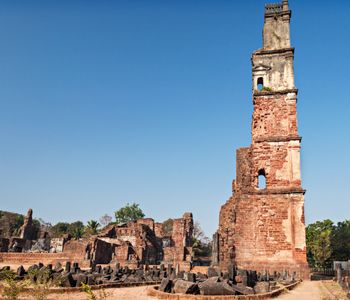
The surrounding complex justifies a full morning. Se Cathedral, the Church of St. Francis of Assisi with its archaeological museum, and the ruins of the Church of St. Augustine are all within walking distance. Bring water. Old Goa's humidity is relentless, and shade between the monuments is intermittent at best.
A Final Impression
The Basilica de Bom Jesus doesn't seduce you the way India's more flamboyant monuments do. It earns your attention slowly — through the weight of its unadorned walls, the obsessive detail of its gilded altar, and the strange quiet that gathers around a silver casket holding what's left of a sixteenth-century Jesuit. This is a building that understands the difference between spectacle and presence. It chose presence. After four hundred years, the choice still holds.