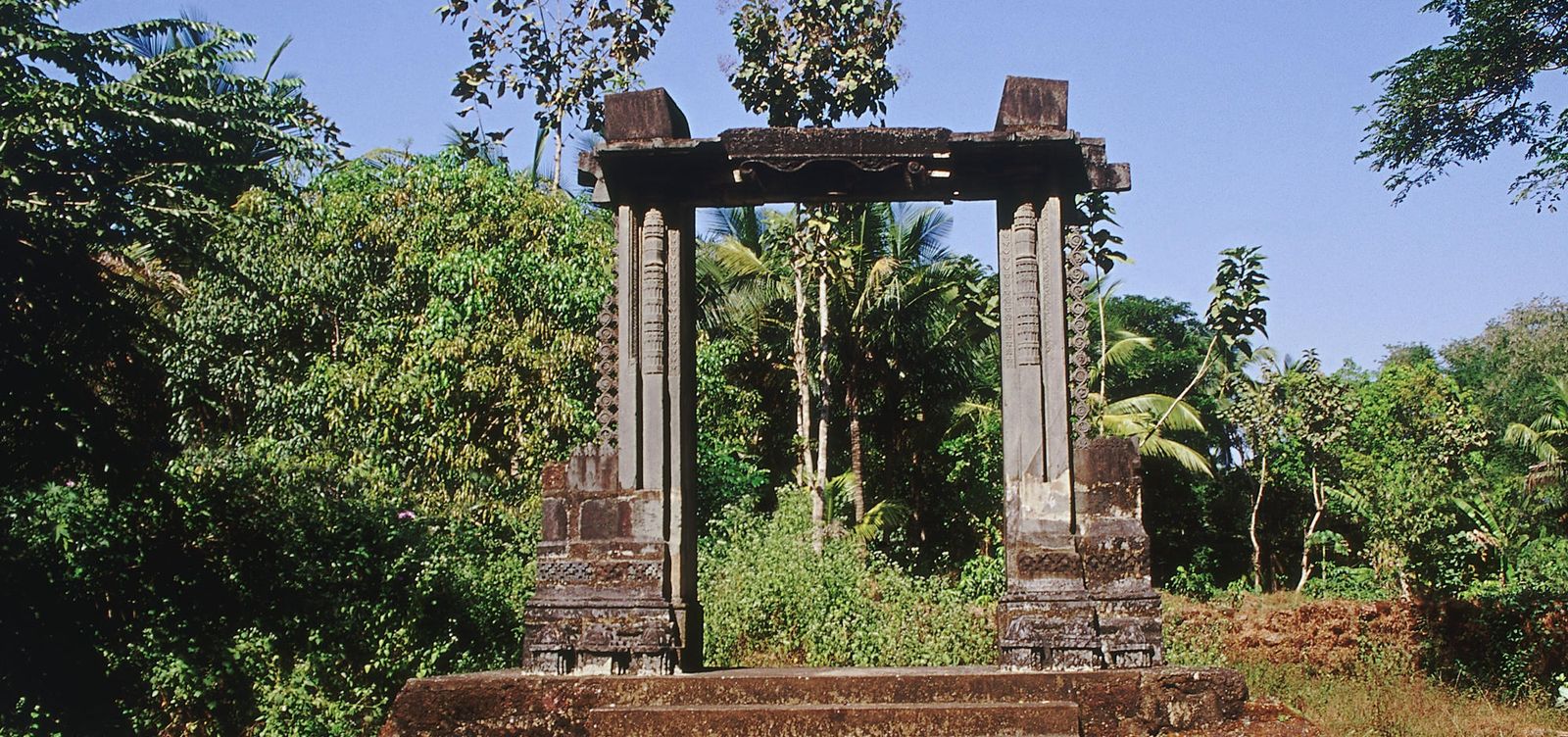
Most gateways lead somewhere. The Adil Shah Palace Gateway in Old Goa leads to an absence — a grand Sultanate palace that no longer exists, dismantled and repurposed centuries ago by Portuguese colonizers who found the structure more useful as building material than as a monument. What remains is the gateway itself, a solitary arch of laterite stone standing in the tropical heat, framing nothing but sky and the ghosts of a Muslim dynasty that once controlled this sliver of the Konkan coast. It's a strange and affecting sight. The doorway is more eloquent than any palace could be, precisely because it stands alone — a reminder that power is temporary, but good masonry endures.
The Sultan's Mark on Goan Soil
Before the Portuguese arrived with cannons and crucifixes in 1510, Old Goa was the secondary capital of the Adil Shahi dynasty of Bijapur. Sultan Yusuf Adil Shah raised his palace here in the late fifteenth century, choosing ground near the Mandovi River for the strategic advantage and the breezes that came off the water. The palace served as a seat of governance, a hall for receiving dignitaries, and a declaration — in laterite and mortar — that Bijapur's reach extended to the western coast.
When Afonso de Albuquerque seized Goa, he didn't demolish the place. The Portuguese were pragmatists; they recognized the building's utility and converted it into a viceregal residence. For decades, Portuguese governors administered their Indian empire from within walls built by the very dynasty they had displaced. Eventually the structure was cannibalized — its stones redistributed into churches, convents, and colonial offices that now define Old Goa's UNESCO-listed landscape.
The gateway is all that survived this slow architectural consumption. It stands as the oldest secular structure in Old Goa, a fact that startles most visitors who assume every stone here was laid by the Portuguese.
Reading the Stone
Don't expect grandeur on the scale of Bijapur's Ibrahim Rouza or the Gol Gumbaz. This is a modest thing — a pointed arch of dark laterite, roughly fifteen feet high, wearing the patina that tropical humidity and five centuries of monsoons inevitably produce. Laterite, the rust-colored stone native to this coast, gives the gateway a somber mass that sandstone could never achieve. It looks less built than risen from the red earth itself.
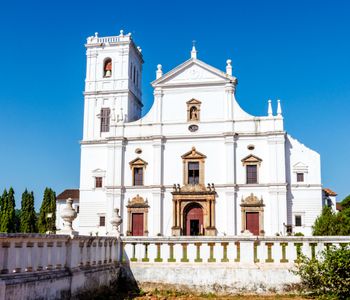
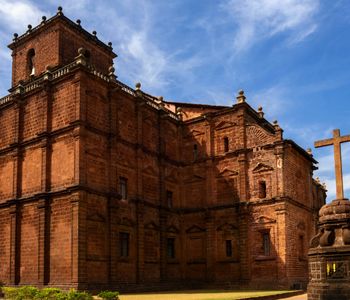
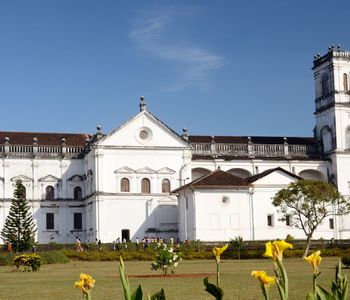
Study the archway's profile. The pointed Islamic arch form is unmistakable, a design vocabulary utterly foreign to the Baroque curves of the surrounding Portuguese churches. That contrast is the gateway's real force. Standing beside the Basilica of Bom Jesus or the Se Cathedral, this single arch insists on a different history — one that predates the colonial narrative by decades.
Little ornamental carving survives. What remains is structural honesty: thick walls, a functional arch dimensioned to admit elephants and palanquins, and a bluntness that speaks of military architecture rather than courtly decoration. The gateway wasn't designed to charm. It was designed to announce authority.
Where the Palace Once Breathed
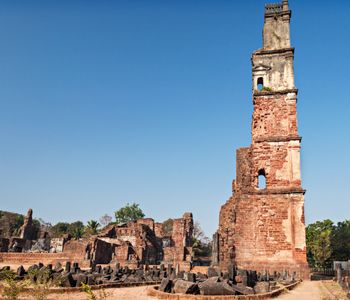
The surrounding grounds now belong to a quiet compound that includes the Church of St. Cajetan and other religious structures. Walk the area and you'll notice how the terrain tilts gently toward the Mandovi River — the same gradient that would have given the sultan's palace its commanding sightline over approaching ships and trade vessels. A few scattered laterite remnants hint at the palace's former footprint, though nothing has been labeled or excavated with any real ambition.
Here's the counterintuitive thing about this site: the emptiness is the experience. Old Goa is dense with ornate churches competing for your attention — gilded altars, painted ceilings, reliquaries containing actual body parts. The Adil Shah Gateway offers none of that. It offers silence and subtraction. You stand before a doorway into a vanished room, and your mind does the reconstruction that archaeologists never bothered to complete.
Afternoon light filters through the arch at a low angle, throwing a shadow that stretches across the compound like a sundial. Bring a camera, but don't rush the shot. The gateway photographs best when you let the emptiness around it fill the frame.
Fitting It Into an Old Goa Day
The gateway sits within easy walking distance of Old Goa's major churches, all clustered in a compact area roughly a kilometer long. Most travelers walk past it without pausing, their attention already seized by the Basilica of Bom Jesus and its preserved remains of St. Francis Xavier. That's a mistake — or at minimum, a missed shift in perspective. Ten minutes here before entering the churches changes how you read everything else. Suddenly the Portuguese monuments reveal themselves as what they partly are: replacements, built atop and often from the materials of an earlier civilization.
Old Goa lies about ten kilometers east of Panaji, the state capital. Regular buses connect the two, and the ride takes roughly twenty minutes depending on traffic. Auto rickshaws and taxis are easy enough to find at the Panaji bus stand, though agree on the fare before you climb in. If you're arriving from farther afield — South Goa's beaches, say — hire a taxi for the half-day and fold the churches and the gateway into a single loop.
There's no entry fee for the gateway and no ticketed hours. It stands in open air, accessible whenever you choose to walk past. Early morning, before the tour buses pull in around ten o'clock, gives you the compound largely to yourself. The heat is also gentler before noon, particularly between March and May when Goa's pre-monsoon temperatures climb past 35 degrees Celsius and the laterite radiates stored warmth like a kiln wall.
What the Guides Won't Mention
Official signage amounts to a small ASI plaque and little else. Hired guides in Old Goa tend to anchor their narratives in the Portuguese period, because that's what the churches demand and what most tourists expect. If you want the Adil Shahi context, you'll need to bring your own knowledge or specifically request a guide versed in pre-colonial Goan history. A few of the better-informed guides at the Basilica can speak to the Bijapur connection if you press them, but don't count on it.
The compound has no dedicated food stalls, though vendors selling water and snacks line the main road near the churches. For a proper meal, head back toward Panaji or try one of the small restaurants along the NH748 highway between the two towns — Goan fish curry and rice, served without ceremony, at prices that haven't yet caught up with the tourist economy.
A Threshold Worth Crossing
The Adil Shah Palace Gateway won't consume your afternoon. It doesn't need to. Five minutes of quiet attention at this laterite arch communicates something that Old Goa's grand churches, for all their splendor, tend to obscure: Goa's history didn't begin with the Portuguese, and the most honest monuments are sometimes the ones left standing after everything else has been carried away. Walk through the arch. Feel the weight of its pointed vault overhead. Then turn and look back through it, framing the colonial skyline beyond. That single view holds the entire complicated story of this place.