The floor is made of tombstones. That's what stops you first when you step into the Church of St Francis of Assisi — not the gilded altarpiece, not the Portuguese Baroque excess, but the fact that you're standing on the dead. Carved granite slabs bear coats of arms and inscriptions worn smooth by four centuries of footsteps, each one marking the grave of a colonial-era nobleman or clergyman who chose this nave as their final address. Most people walk right over them without a second thought. But these stones tell you everything about what this place once was: not merely a house of worship but a declaration of imperial permanence, pressed into the very ground.
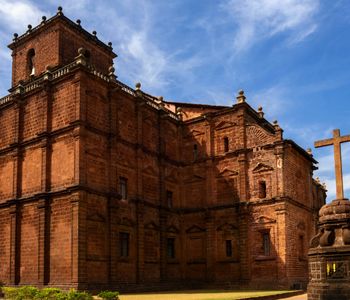
The church stands in Old Goa, roughly ten kilometers from the modern state capital of Panaji, part of a complex of religious monuments that together form a UNESCO World Heritage site. Its neighbors — the Basilica of Bom Jesus, Sé Cathedral — pull the crowds and the camera phones. St Francis of Assisi operates with less fanfare. That's precisely what makes it worth your time.
A Building That Changed Its Mind
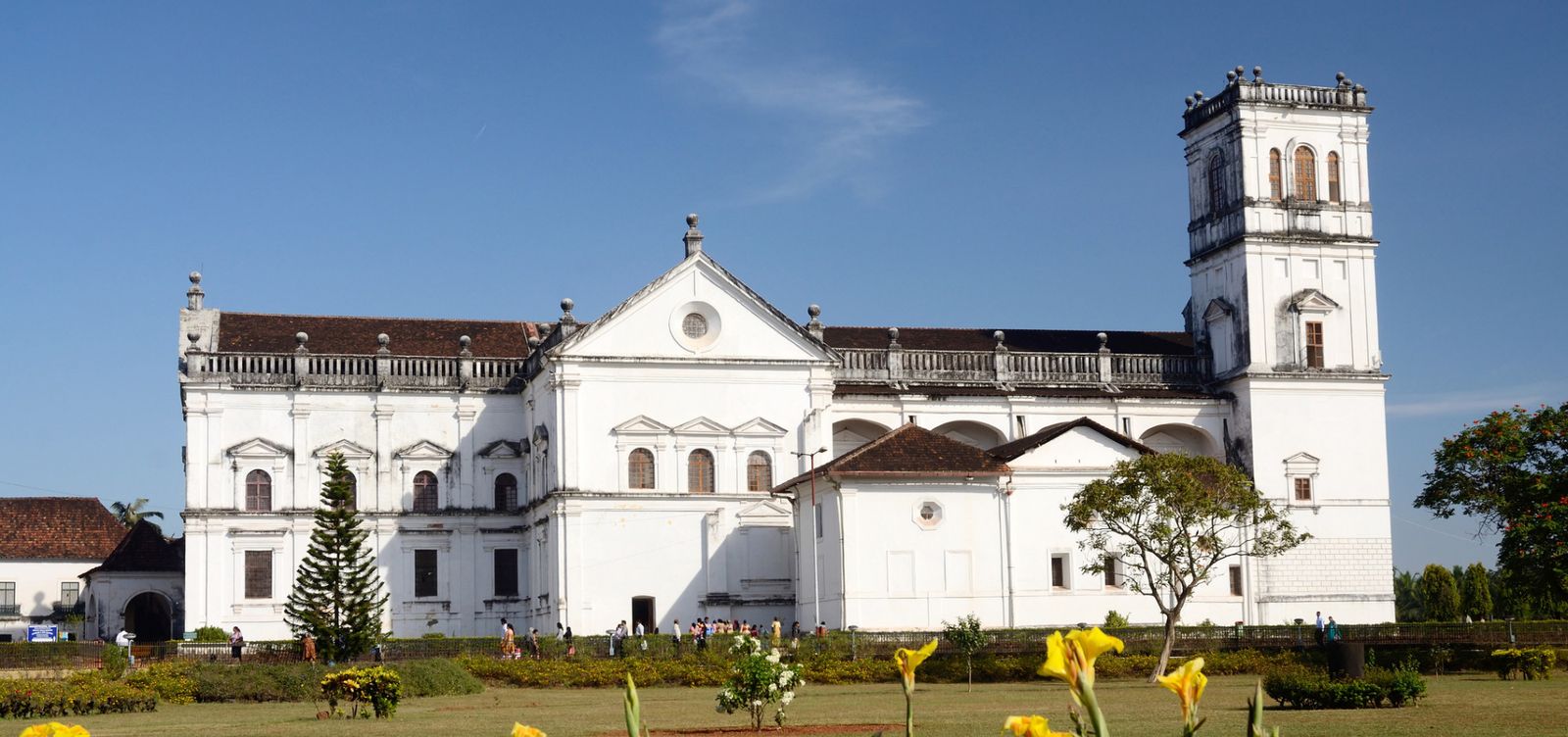
The church you see today is not the church that was originally built here. Eight Franciscan friars arrived from Portugal and erected an earlier structure in 1521, but by 1661 it had been substantially rebuilt in the Mannerist and Baroque styles that Portugal was then exporting to its colonies with missionary zeal. The original chapel was modest. Its replacement was anything but.
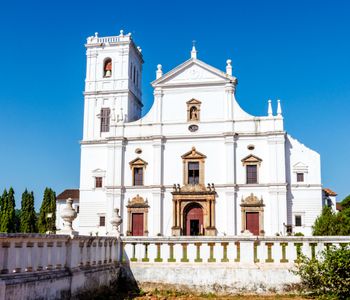
Stand outside and study the facade. The lower tier is Tuscan in its orderly columns, restrained, almost disciplined. Then your eye climbs and the upper section erupts — Corinthian scrolls, pilasters, a central niche that frames the entrance like a statement of intent. This tension between austerity and grandeur runs through the entire building, as if two architectural philosophies argued for decades and neither conceded.
Inside, the nave stretches into a single hall without aisles, a feature borrowed from Franciscan convention. The order's emphasis on simplicity, however, ends decisively at the reredos. The main altarpiece is a towering carved-wood construction sheathed in gold leaf, depicting scenes from the life of St Francis. Cherubs crowd every available surface. Floral motifs spiral between panels. The gilding is so dense that in late afternoon, when sunlight enters through the western windows at a low angle, the entire sanctuary seems to ignite from within.
Where the Dead Tell Stories
Those tombstone floors deserve more than a passing glance. Many inscriptions are in Portuguese, and while time has eaten away parts of the text, you can still trace dates stretching from the seventeenth to the nineteenth century. Some stones carry elaborate heraldic crests. Others are plain — markers for lesser-known figures of colonial Goa's religious establishment.
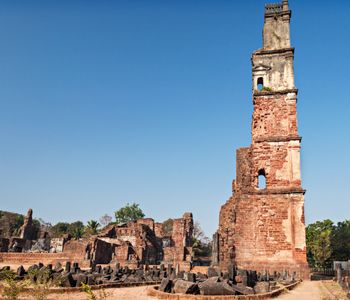
What makes these graves remarkable isn't their individual stories but their collective weight. Old Goa was once called the "Rome of the East," a city of perhaps 200,000 people at its sixteenth-century peak — larger than Lisbon at the time. Epidemics of cholera and malaria hollowed it out over the following centuries, and by the 1800s, the Portuguese had moved their capital downstream. The grand churches survived because they were built from laterite stone and because the religious orders refused to abandon them. Walking over these graves, you feel the entire trajectory of a colonial apparatus that built extravagantly and then watched its city die around it.
The Museum Nobody Expects
Attached to the church is the Archaeological Museum, housed in the old Franciscan convent. This is one of the better small museums in Goa, and almost nobody walks in with any real intention. That's a mistake.
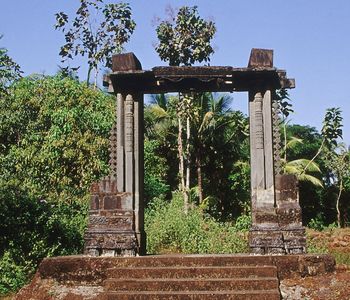
The collection includes portraits of Portuguese governors and viceroys arranged chronologically — a parade of stern faces in starched collars spanning centuries of colonial rule. More arresting are the carved wooden panels, Hindu temple fragments, and hero stones that predate Portuguese Goa entirely. These objects remind you, forcefully, that before the crosses and cathedrals, this land had its own sacred architecture. The Portuguese didn't build on empty ground. They built on what they demolished.
One room holds a collection of Sati stones and pre-Portuguese inscriptions that feel almost defiant in this context — remnants of a civilization the colonial project tried to overwrite. Thirty minutes in this museum reshapes your understanding of the church next door. You begin to see the lavish Baroque interior not simply as devotion but as conquest made decorative.
Painting a Ceiling, Claiming a World
Before you leave, look up. The wooden ceiling carries painted panels depicting floral motifs and scenes from the life of St Francis, executed in a style that blends European technique with something looser, warmer — likely the hand of local Goan artists trained in Portuguese workshops. The paint has darkened with age, but the compositions keep their energy. Vines twist between biblical scenes. Birds appear where you don't expect them.
Here's the counterintuitive thing about these panels: they represent a collaboration that neither side would have described as equal, yet the result is something neither European nor Indian alone could have produced. It's a detail that rewards patience — easy to miss if you're staring straight ahead at the altar, impossible to forget once you've noticed it.
Getting There and Getting In
Old Goa sits along the Mandovi River. From Panaji, you can reach it by bus, taxi, or auto rickshaw in about twenty minutes. Buses run frequently from the Kadamba Bus Stand and cost next to nothing. From the beach areas of North or South Goa, expect a taxi ride of thirty to fifty minutes depending on traffic — which in Goa operates on its own elastic sense of time.
Entry to the church itself is free. The Archaeological Museum charges a nominal fee — around 25 rupees for Indian nationals and somewhat more for foreign visitors, though rates shift periodically. Both the church and museum are generally open from 9 a.m. to 5 p.m., with a possible midday break for the museum. Photography is typically permitted inside the church but restricted in the museum galleries.
Arrive early. Before 9:30 a.m., you can have the nave almost to yourself — the tour buses don't start disgorging their groups at the Basilica of Bom Jesus across the road until after that. The humidity in Old Goa builds fast after mid-morning, and the laterite walls trap warmth like an oven. Dress light. Carry water.
A Monument to Contradictions
The Church of St Francis of Assisi doesn't inspire the awe of Sé Cathedral or draw the pilgrim traffic of Bom Jesus with its relic of St Francis Xavier. It operates at a quieter register. But that quietness is what makes it honest. Here, the beauty of Baroque craftsmanship coexists with the uncomfortable evidence of colonial erasure, and the building doesn't try to resolve that tension. You walk across graves, you admire gold leaf, and you step into a museum that shows you what was destroyed to make all of this possible.
Few churches anywhere offer that kind of clarity. Visit it not for comfort, but for understanding.