Most people arrive in Goa chasing coastline. They come for the sand, the shacks, the sunburn. So it's strange, almost disorienting, to find yourself twenty-two kilometers inland from Panaji, standing before a temple that has nothing to do with any of that. Shree Mangesh Temple sits in the village of Priol in Ponda taluka, and the first thing that strikes you isn't the architecture or the history — it's the quiet. After the relentless honking of coastal Goa's tourist corridor, the silence here feels almost physical, broken only by the rhythmic clang of a brass bell from somewhere inside the complex.
This is Goa's most important Hindu temple, and it operates on an entirely different frequency from the state's beach-facing reputation. If you want to understand Goa beyond the party, you start here.
A God That Moved
Shree Mangesh Temple is dedicated to Lord Manguesh, a form of Shiva worshipped almost exclusively in Goa. The deity's origins trace to a local legend: Shiva, disguised as a tiger, frightened Parvati so badly that she cried out "trahi mam girisha" — save me, lord of the mountains. That phrase, compressed and worn smooth by centuries of retelling, eventually became "Manguesh."
The temple hasn't always stood in Priol. During the Portuguese Inquisition in the sixteenth century, Hindus along the coastal talukas faced forced conversions and the systematic destruction of their sacred spaces. Rather than surrender their deity, devotees smuggled the Manguesh linga inland to its current location in Ponda, where Portuguese control was weaker. That act of defiance — carrying a god through jungle to save it from colonial erasure — gives this temple a gravity that no amount of ornamental grandeur could replicate.
The Deepstambha and the Dome
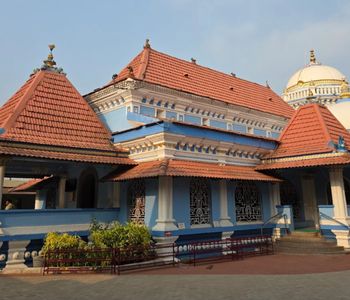
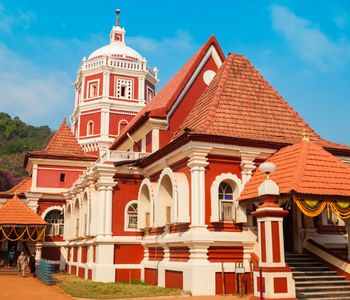
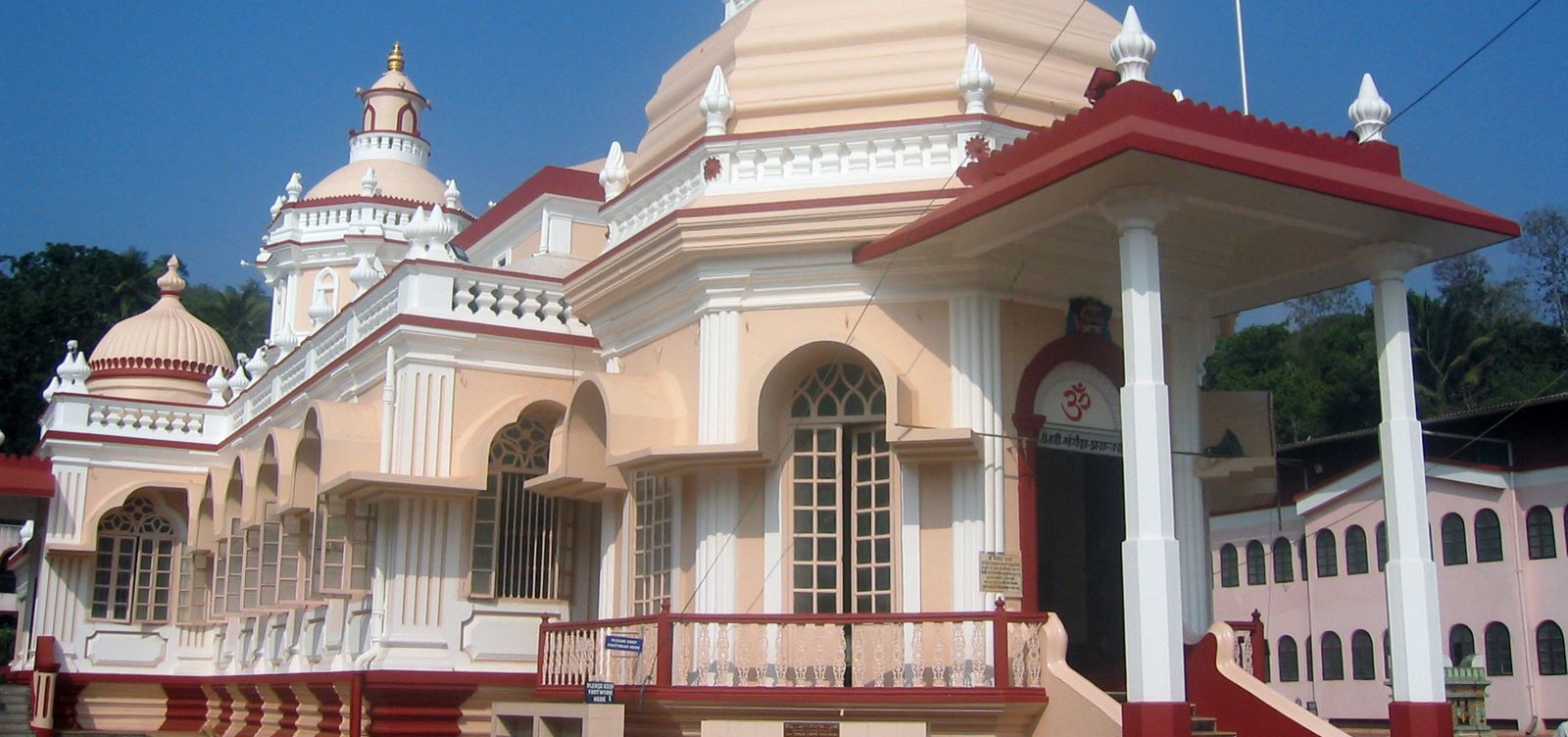
Architecturally, Shree Mangesh confounds expectations. This isn't a purely Dravidian or Nagara structure. Centuries of Portuguese presence left their fingerprints even on Hindu sacred spaces, and the result is a temple with a distinctly Goan identity — a white-plastered exterior topped by an octagonal tower that looks, frankly, more like a church bell tower than anything you'd find in Tamil Nadu or Rajasthan.
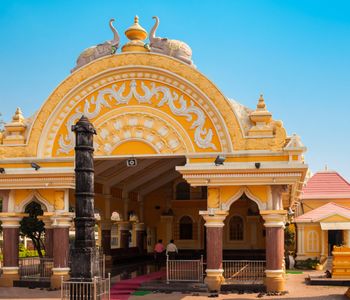
The deepstambha commands the courtyard. This seven-story lamp tower, built from laterite stone and painted white, holds dozens of oil lamps that are lit during festivals. At dusk, when every lamp is burning, the tower throws a warm amber glow across the entire complex. It's an image that belongs to Goa alone — you won't see its equivalent in Varanasi or Madurai.
Inside, the sanctum houses the Shiva linga on a silver pedestal. The sabha mandapa, the assembly hall, features carved wooden pillars and a polished floor that catches the soft light filtering in from high windows. There's no overwhelming scale here. The proportions are human, intimate. You don't crane your neck. You simply stand, breathe in the sandalwood-scented air, and feel the temperature drop a few degrees as stone walls hold the heat at bay.
Ritual as Routine
Shree Mangesh isn't a museum piece. On any given morning you'll encounter families performing puja, priests chanting in the inner sanctum, and the sharp scent of camphor competing with incense. The earliest aarti begins before dawn. The final one closes out the evening. Between these poles, worship hums along without interruption.
What catches you off guard is the tank. The temple's sacred water tank — a kalyani — sits to one side of the complex, surrounded by laterite steps that descend to green-tinged water. Few people linger here, which makes it the right place to sit and watch the temple's rhythms unfold without feeling like you're in anyone's way. Pigeons roost along the upper steps. A coconut seller works the far corner. The ordinariness of it is the point.
During the annual Jatra festival, that ordinariness evaporates. Typically held in the month of Magha on the Hindu calendar, the Jatra transforms the complex with processions, music, and a ceremonial chariot pulled through the surrounding streets. If you happen to be in Goa during this period, the energy at Shree Mangesh eclipses anything happening on the coast.
Getting There Without the Headache
Priol is roughly a forty-minute drive from Panaji and about an hour from Calangute or Candolim, depending on traffic. Hiring a scooter or motorcycle gives you flexibility and lets you combine a temple visit with other Hindu sites scattered across Ponda taluka — Shanta Durga and Mahalasa temples are both within a short ride.
Auto rickshaws from Ponda town reach the temple in about ten minutes. If you're relying on public buses, services from Panaji's Kadamba Bus Stand run regularly to Ponda, from which you can catch a local ride. The temple has a parking area that accommodates cars and two-wheelers, though it fills quickly on festival days.
Entry is free. Remove your shoes before entering — a storage area sits near the main entrance. Dress modestly; shoulders and knees should be covered. Photography is generally permitted in the courtyard and around the deepstambha, but keep cameras away from the inner sanctum during active worship.
When the Light Is Right
Early morning delivers the best experience. The temple is cooler, the crowds thinner, and the morning aarti carries a focused intensity that afternoon hours can't match. Arrive by seven and you'll share the courtyard mostly with devotees rather than tour groups.
Late afternoon has its own pull. Western light hits the whitewashed walls and turns them gold, and the transition into evening — when the deepstambha lamps begin to flicker — creates a shift in atmosphere that feels almost theatrical. Between October and March, the weather cooperates fully. Goa's summer heat and monsoon rains make the remaining months less comfortable for extended temple visits, though the monsoon does lend the surrounding landscape a ferocious green intensity that has its own rewards.
More Than Its Walls
Here's the counterintuitive thing about Shree Mangesh: it's most powerful not as a spectacle, but as a correction. It tells a story that most of Goa's marketing would prefer to skip — one about survival, adaptation, and a religious identity that endured despite centuries of colonial pressure. The architecture holds that tension in its bones, blending Hindu sacred geometry with European decorative instincts in a way that could only have happened here, in this particular strip of the Konkan coast. You leave not with the adrenaline of a beach day or the buzz of a nightclub, but with something quieter and more durable: the understanding that Goa's deepest history lives not on the shore, but inland, in laterite stone and lamplight.