
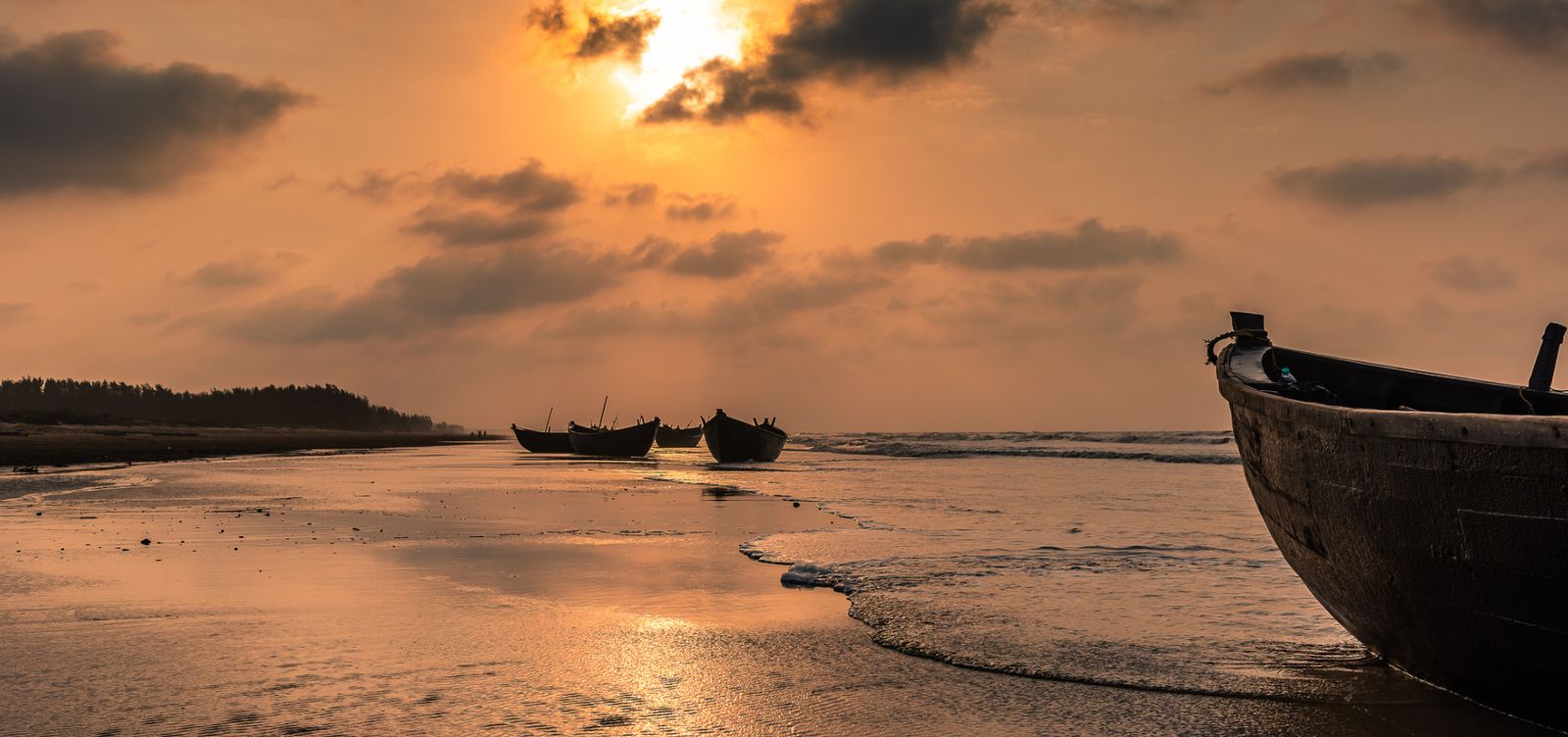
The first thing you notice about Digha isn't the sea. It's the flatness. The beach extends so far toward the waterline that the Bay of Bengal seems to be retreating from you, pulling back across hundreds of meters of hard, wet sand that reflects the sky like a dull mirror. This isn't the turquoise postcard coast of Goa or Kerala. Digha's ocean is grey-green, sometimes brown, and it arrives in low, wide waves that barely crest before dissolving into foam across that impossibly broad shore. And yet, something about this place keeps drawing people back — millions of them, every year — from Kolkata, from across Bengal, from Jharkhand and Bihar, arriving in buses that deposit them at the edge of town like offerings to the tide.
Digha sits at the southern tip of West Bengal's Purba Medinipur district, roughly 185 kilometers southwest of Kolkata. The drive takes about four hours if traffic cooperates, which it rarely does near the Kolaghat bottleneck. A more dignified option is the Tamralipta Express from Howrah, which drops you at Digha station after a journey through some of Bengal's most unremarkable flatlands — paddy fields, brick kilns, the occasional goat staring philosophically at the tracks.
A Beach That Refuses to Follow the Script
What makes Digha unusual, and occasionally maddening, is its tidal personality. At low tide, you can walk nearly a kilometer toward the water and still be ankle-deep. The beach floor is compact enough for motorcycles, and locals exploit this without hesitation — you'll spot vendors on bicycles hauling baskets of jhalmuri and sliced cucumber right across the sand. At high tide, that same expanse disappears entirely, and the waves shove up surprisingly close to the concrete promenade that lines the main stretch of Old Digha.
The sand isn't golden. It's a muted taupe, firm underfoot, scattered with small shells and the occasional red crab scuttling sideways toward its burrow. Children dig pointless, magnificent holes. Families cluster under rented umbrellas. Couples walk at the waterline where the wind flings salt spray into their faces. There's no pretension here, not even the ghost of it. Digha is a democratic beach — crowded, loud, deeply Bengali in its bones. The soundtrack layers crashing surf over Bollywood music from nearby stalls, all of it punctuated by the persistent, nasal call of the chanachur seller.
Old Digha, New Digha, and the Restless Gap Between
Old Digha is where the chaos thickens. Hotels stack so close together along the beachfront road that their balconies nearly touch, like neighbors leaning in for gossip. Restaurants serve fried fish — pomfret, mostly, along with the local favorite, bhekti — alongside plates of rice and dal that arrive fast and hot. Skip the hotel dining rooms. The fish fry stalls along the main road are where the real eating happens. Find the ones where locals queue three-deep, where the pomfret gets dipped in a mustard-spiked batter and fried until the skin crackles audibly when you break it open.
New Digha, a few kilometers east, was built to relieve the pressure. It's quieter, wider, with a long promenade and marginally cleaner stretches of sand. The trade-off is fewer places to eat and a certain municipal sterility — the kind of planned seafront that functions perfectly well without ever acquiring a pulse. Still, if you want to hear the waves without competing with loudspeakers, New Digha earns its keep.
Between the two, a marine aquarium and a science center sit along the connecting road. Neither will rearrange your understanding of the world, but the aquarium holds a decent collection of Bay of Bengal species, and it's a reasonable escape when the afternoon sun turns the beach into a griddle.
What Lies Beyond the Tideline
The real reward of Digha sits just outside it. Udaipur, about eight kilometers south along the coast toward Odisha, offers a quieter shore where casuarina groves lean permanently into the onshore wind, their trunks bent like old men walking uphill. The Chandaneswar Shiva Temple, barely across the Odisha border, pulls pilgrims during Shivaratri but remains mostly undisturbed the rest of the year — its stone courtyard cool and silent under ancient trees.
Shankarpur, roughly fourteen kilometers west, is a fishing village with its own brutal rhythm. Trawlers return each morning with the night's haul, and if you arrive early enough, you can watch the auction unfold directly on the sand — fishermen shouting prices while baskets of prawns, crabs, and silver-sided fish catch the first light. Buy directly if you're staying somewhere with a kitchen. The prawns, still twitching, cost a fraction of Kolkata prices.
Here's the thing most visitors never consider: Digha was never meant to be glamorous. It was one of independent India's first attempts at a planned seaside resort, championed in the 1920s by an English tourist and developed more seriously after independence. Its power lies not in beauty — the coast is too flat, too silty, too scoured by wind for conventional beauty — but in reach. For millions of Bengalis, Digha is the first sight of the sea, the first lungful of salt air. That carries a weight no amount of landscaping could replicate.
Come expecting a rough, honest, overcrowded beach town that smells of fried fish and ocean brine. Calibrate your expectations to the place itself, not to any brochure. Walk the wet sand at low tide when the light turns copper and the whole shore becomes a single dimming mirror. Eat the fish. Watch the trawlers drag in. Let Digha be exactly what it is — no more, and not a gram less.