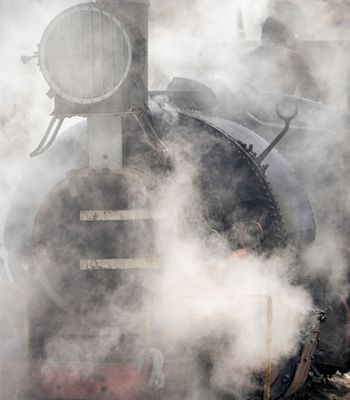
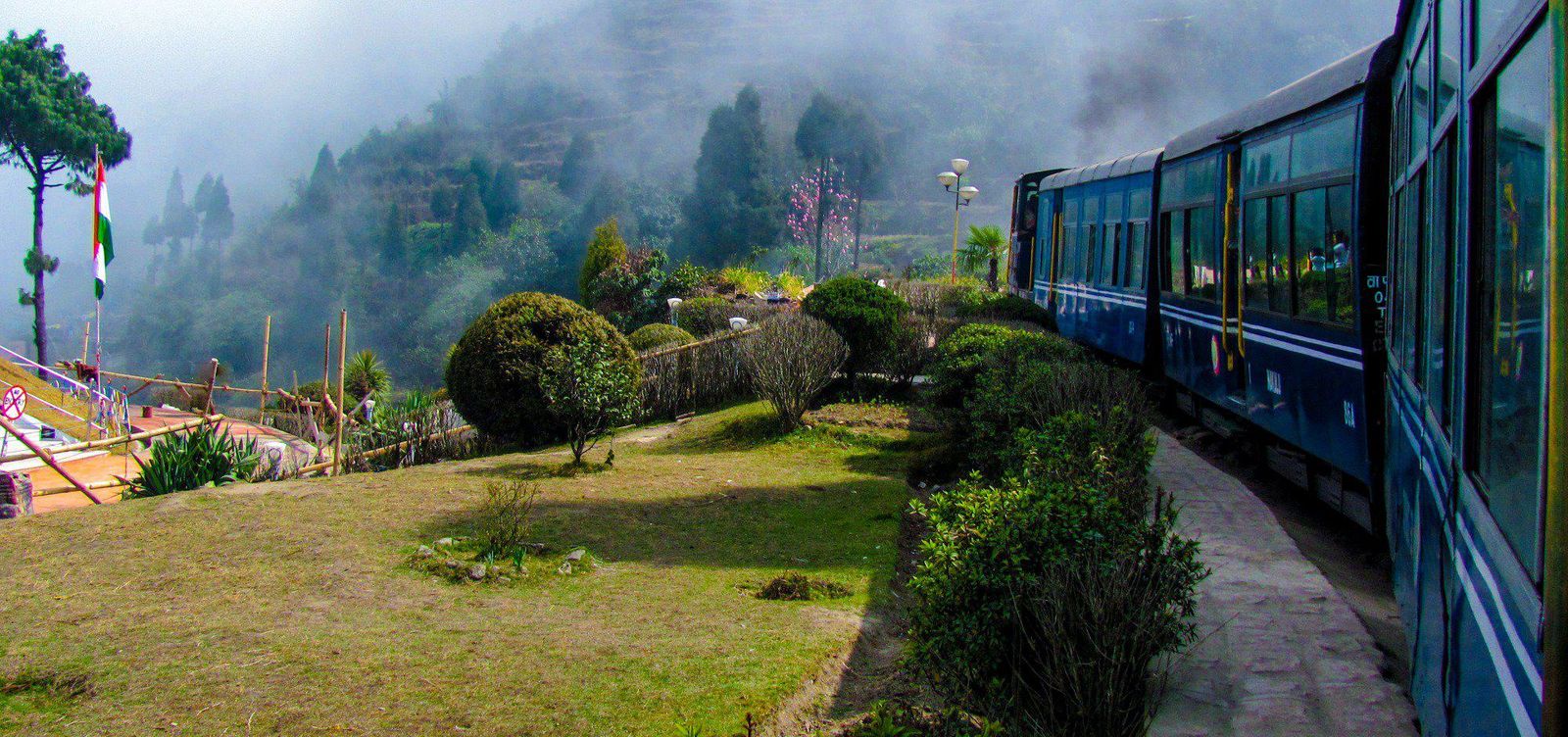
The first train to Darjeeling doesn't so much arrive as it announces itself — a small steam engine hauling toy-sized carriages up an impossibly steep grade, whistling around bends where the track loops back on itself and briefly runs alongside the road it just crossed. The Darjeeling Himalayan Railway has been doing this since 1881, and it still does it slowly. You'll overtake it on foot in places, and there's no shame in it. The journey up is the whole idea of this town.
Darjeeling sits high in the northern reaches of West Bengal, strung along a ridge at just over two thousand metres, where the plains of Bengal give way to the first serious folds of the Himalaya. The British came here in the 1830s, took the land from Sikkim, and turned a forested spur into a sanatorium and summer retreat. Then they planted tea. The tea changed everything.
The Mountain That Runs the Show
Wake before dawn and go to Tiger Hill with everyone else. Yes, it's crowded — busloads arrive in the dark, and you'll jostle for a spot with strangers clutching paper cups of tea. But when the sun finally clears the horizon and lights up Kanchenjunga, the third-highest mountain on earth, going pink and then gold above the clouds, the crowd goes quiet. Even the touts stop talking.
Kanchenjunga hangs over the town like a rumour made solid, close enough to feel and far enough to stay unreal. The locals treat it as sacred, and after a few days you understand why. It sets the mood for everything — appearing at first light, vanishing behind cloud by mid-morning, keeping its own counsel. You learn to look up whenever the sky clears, because you never know how long it will last.
The Leaf That Built the Town
The tea gardens begin the moment the town runs out. Row upon row of clipped bushes contour the hillsides, tended by women who move through them with baskets strapped to their foreheads, plucking two leaves and a bud with a speed that looks careless and isn't. This is where Darjeeling tea comes from — the muscatel, faintly floral leaf that fetches absurd prices in London and Tokyo.
Visit an estate like Happy Valley, one of the oldest, and walk the factory floor where the leaves wither, roll, and oxidise on ancient machinery that clatters through the harvest months. The first flush of spring is the prized one, pale in the cup and so light it barely stains the water. Buy some at the source. The stuff sold at the estate bears little resemblance to what most of us drink from a supermarket box, and once you've tasted it fresh, the difference is hard to unlearn.
A Square at the Top of the Climb
Darjeeling has no flat ground to speak of. The town climbs and drops along its ridge, and getting anywhere means either up or down, usually more than you'd like. The heart of it is Chowrasta, a flat open square near the top where the streets finally relent — a rare level space where people gather, gossip, and let their children chase pigeons.
From here the Mall stretches out, lined with old bookshops, tea sellers, and cafés that have been pouring the same strong brew for decades. Glenary's, a colonial-era bakery, still turns out cakes and pastries in a wood-panelled room with a view down the valley. Order a pot and a slice of the fruit cake, dense and dark and studded with peel, and take the window seat if you can get it.
Wander the lanes below the Mall and Darjeeling shows its other face — a mix of Nepali, Tibetan, Bengali, and Lepcha life packed into a tangle of shops and homes. Prayer flags stretch between rooftops. Momo steam rises from doorway kitchens. The town feels less Indian than borderland, which is exactly what it is, sitting where Nepal, Sikkim, Bhutan, and Bengal all press close.
Where the Mountaineers Trained
Darjeeling has a serious claim on the history of Himalayan climbing. Tenzing Norgay stood atop Everest with Edmund Hillary in 1953. He made his home here afterwards, and helped run the Himalayan Mountaineering Institute, which still trains climbers on The Ridge above town. The small museum attached to it holds gear and photographs from the great expeditions, and Tenzing's memorial sits nearby.
Through the same gate you reach the Padmaja Naidu Himalayan Zoological Park, one of the few places you can see red pandas and snow leopards being bred in captivity. It's set into the forested slope, cold and misty, and the animals here belong to this altitude in a way zoo animals rarely do. Give it an hour or two on either side of the mountaineering museum.
Into the Ridges Beyond
The walking around Darjeeling rewards the effort. Trails thread out from the town into the surrounding hills, past tea gardens and pine forest and villages where the shops open late and close early. The gentlest of these is the Batasia Loop, where the toy train spirals around a War Memorial garden below the town. The better walks take you further.
Head toward Sandakphu, on the Nepal border, and the ridge opens onto a horizon crowded with the highest mountains on earth — Kanchenjunga near at hand, and Everest visible far off to the west, small and unmistakable. It's a multi-day walk and not for the unfit. But even a day spent hiking the lower ridges gives you the essential Darjeeling experience: cloud drifting through cedar, tea slopes falling away below, and the mountains appearing and vanishing as the weather decides.
When to Climb the Hill
Darjeeling has real seasons, and timing matters. Spring, from March to May, brings the first tea flush and the clearest mountain views, though the town fills with visitors escaping the plains. Then the monsoon arrives. From June through September the cloud swallows everything, the rain doesn't let up, and the landslides can be serious enough to close the roads for days.
Autumn is the sweet spot. After the rains clear in October, the air turns crisp and the skies open, and Kanchenjunga stands out sharp against the blue for days at a time. Winter is cold and quiet, sometimes touched with frost, and the crowds thin to almost nothing.
Come knowing that Darjeeling is not the tidy hill retreat the postcards suggest. The town is overbuilt, the traffic on the few motorable roads can be miserable, and the water and power both falter more than they should. None of that is hidden. You'll see it your first afternoon.
But climb to Chowrasta at dusk, when the day-trippers have gone and the lamps flicker on along the Mall, and the whole ridge settles into something quieter. The mountain catches the last light. A vendor packs up his tea cart. Somewhere below, the toy train whistles one final time. Give the place three days and walk more than you drive. Darjeeling was built on a slope for a reason. It makes you earn the view — and then, when the cloud lifts, it hands you Kanchenjunga.