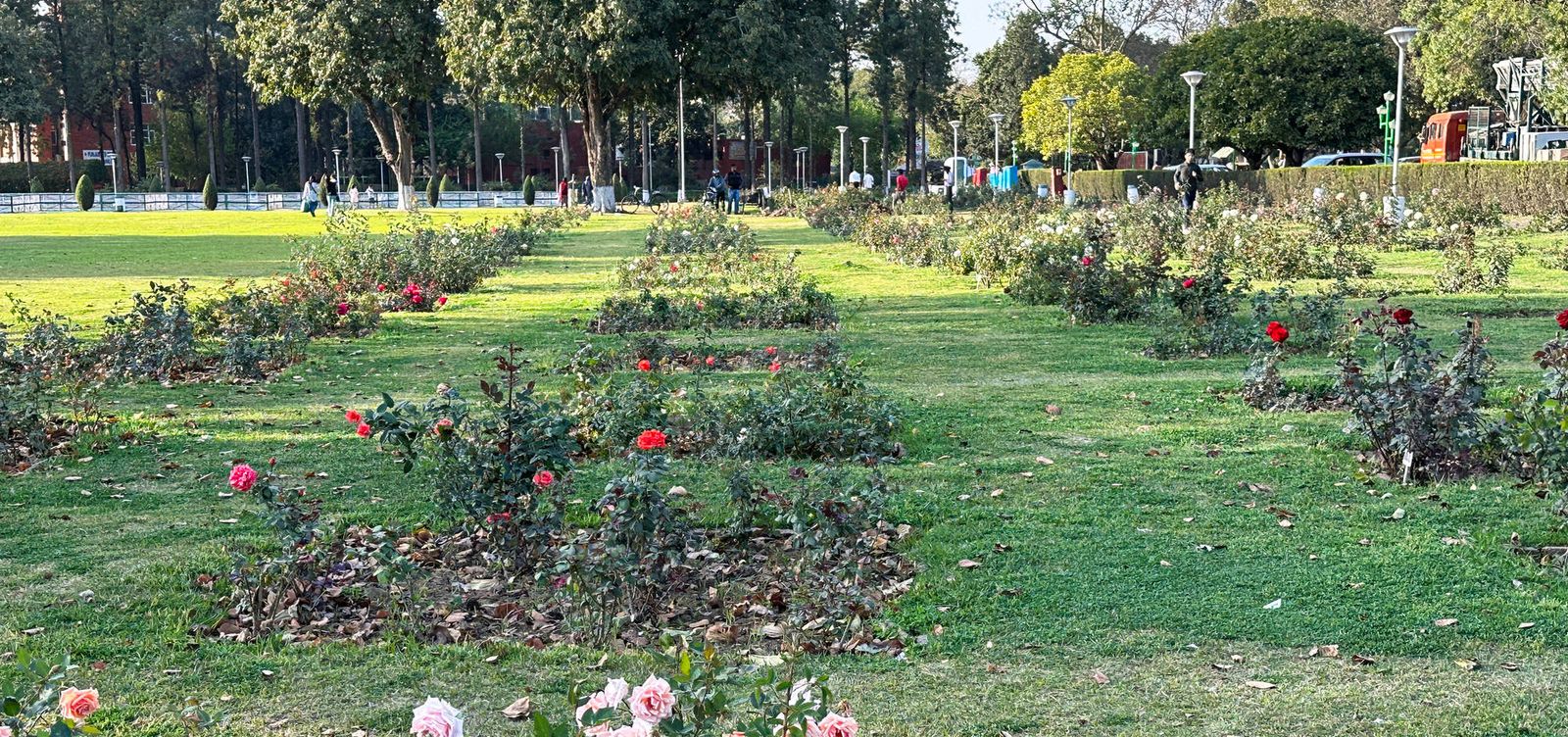
Thirty acres of roses sound excessive until you're standing in the middle of them, mid-February, when sixteen hundred varieties are blooming simultaneously and the air is so thick with fragrance that it almost registers as taste. The Zakir Hussain Rose Garden doesn't just display flowers — it stages them, in terraced layers that climb a gentle slope in Sector 16, each tier revealing a new palette of color that shifts from crimson to apricot to a white so pale it barely exists.
This is Asia's largest rose garden, a claim that feels abstract until you try to walk it end to end and realize your legs are tired before you've covered half the ground. The garden was designed in 1967 under the direction of Dr. M.S. Randhawa, a botanist and administrator who understood that Chandigarh — Le Corbusier's great modernist experiment — needed softness to balance all that concrete geometry. He was right. The Rose Garden is the city's exhale.
Geometry in Bloom
Chandigarh is a city built on grids, and even its garden follows a certain logic. The terraces descend in orderly rows, each bed labeled with cultivar names that read like a wine list: Papa Meilland, Double Delight, Montezuma, Queen Elizabeth. The organization is meticulous — hybrid teas here, floribundas there, miniatures gathered in their own modest corner like quiet guests at a loud party.
Yet the place never feels clinical. Bougainvillea and jasmine creep along the periphery, breaking the rose monoculture with splashes of violet and white. Old timber trees — some likely older than the garden itself — throw generous shade over stone benches where couples sit with their knees touching, saying nothing. A medicinal plant section in one corner often goes ignored by visitors racing toward the roses, but it rewards the curious with neem, ashwagandha, and tulsi planted in neat rows, each labeled with its common uses.
When the City Shows Up
Early mornings belong to the walkers. By six o'clock, retirees in white sneakers have already completed their first lap around the perimeter path, moving with the determined pace of people who've been doing this for decades. Yoga groups claim patches of lawn near the fountains. A man with a transistor radio sits cross-legged beneath a Kigelia tree, its sausage-shaped fruit hanging absurdly overhead, and listens to the morning news at a volume that suggests he considers it civic duty.
By mid-morning, the garden changes hands. Families arrive with thermoses and aluminum tiffins. School groups in matching uniforms move in loud, chaotic clusters, their teachers shouting instructions that dissolve into the noise. Photographers — professional and amateur — crouch between rose beds, angling for that perfect bloom against a blurred green background. The light at this hour turns golden and forgiving, which explains why so many engagement shoots happen here between October and March.
The annual Rose Festival, typically held in February or early March, transforms the garden into a fairground. Flower competitions, cultural performances, and food stalls take over, drawing crowds thick enough to make the pathways feel like Delhi Metro at rush hour. If you want the roses without the spectacle, come a week before or after. The blooms don't check the calendar.
What the Roses Won't Tell You
Here's the thing that caught me off guard: the Rose Garden is at its most interesting when you stop looking at roses. The peripheral sections — the medicinal herbs, the small stands of bamboo, the seasonal beds planted with marigolds and chrysanthemums — reveal a garden that's actually trying to be an ecosystem rather than a showroom. Birds own this place as much as anyone. Spotted owlets roost in tree hollows. Rose-ringed parakeets streak overhead in green blurs, screeching as if personally offended by the serenity below. On a quiet weekday, you can hear woodpeckers working the bark of old trees near the garden's northern boundary.
The landscaping, maintained with evident pride, carries that slightly weathered quality common to Indian public gardens — a cracked bench here, a fountain running at half-pressure there. This isn't neglect. It's the honest texture of a place that's been loved hard by millions of visitors over five decades. The wear is part of the character.
Finding Your Hours
The garden opens at six in the morning and closes by ten at night, with a nominal entry fee that barely registers. Sector 16 is well connected by Chandigarh's local buses and auto-rickshaws, and parking runs along the perimeter road. A morning here pairs well with a walk to the adjacent Leisure Valley, a long green corridor stretching through several sectors that offers a different kind of quiet — less manicured, more sprawling.
Come between late November and early March for peak bloom. The roses thin out through summer heat, and monsoon months turn the paths slick and steamy. But even off-season, the trees and medicinal beds hold their ground, and the walking paths remain among the most pleasant in a city that takes its public spaces seriously.
Chandigarh was designed to prove that a modern Indian city could be rational, ordered, humane. The Rose Garden makes a subtler argument — that within all that planning, there's still room for something as unruly and extravagant as sixteen hundred kinds of beauty, all blooming at once.