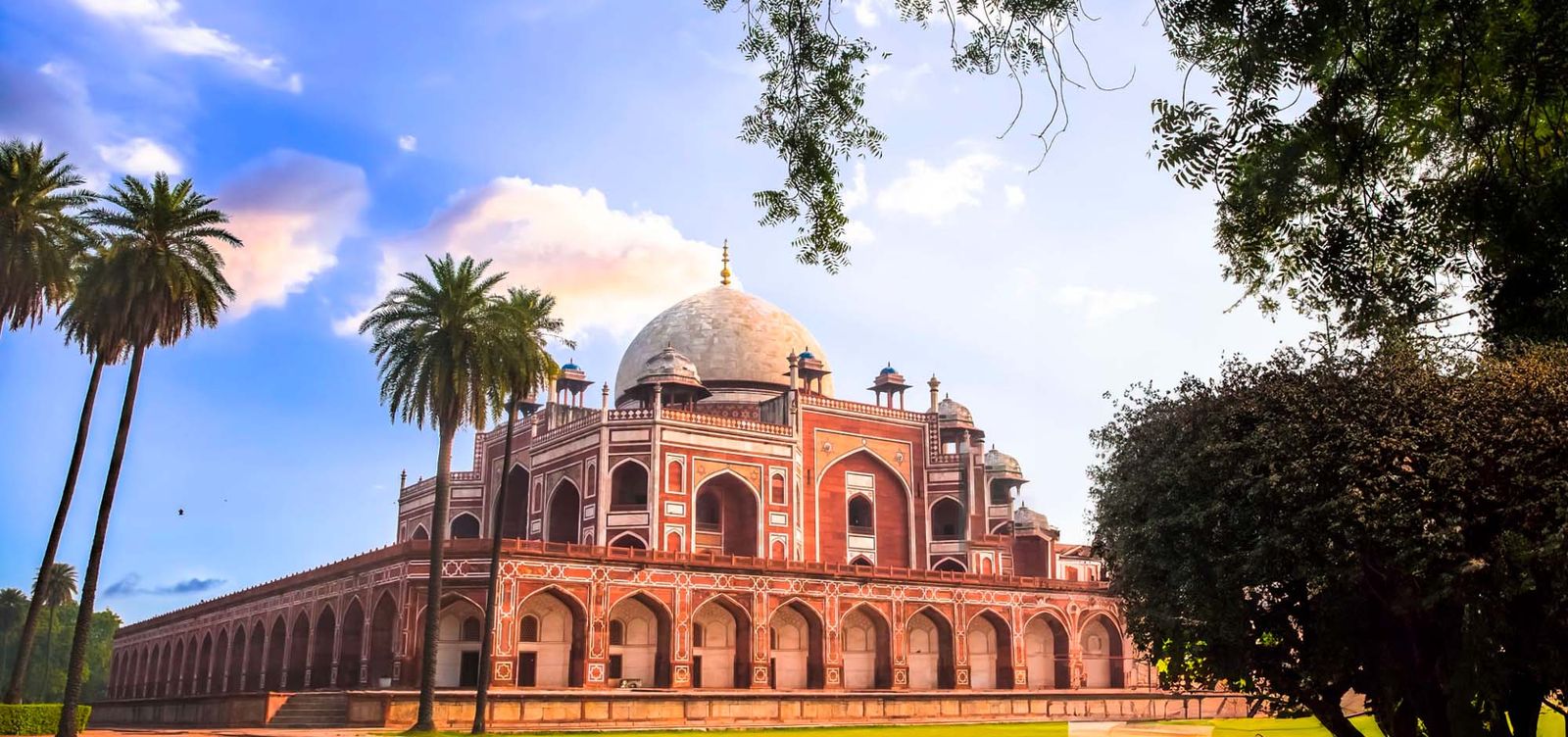
Thirty-four years before the first stone of the Taj Mahal was laid, a grieving widow commissioned a tomb in Delhi that would rewrite the rules of Mughal architecture. Humayun's Tomb, completed in 1572, stands in South Delhi as the prototype for nearly every grand Mughal monument that followed. The Taj gets the postcards. This one deserves the credit.
What strikes you first isn't the symmetry or the scale — it's the color. Red sandstone inlaid with white marble in clean geometric patterns holds the afternoon light in a way photographs consistently fail to capture. Walk through the main gate and the tomb doesn't reveal itself gradually. It simply appears, massive and whole, framed by a garden so deliberately designed that every sightline feels choreographed. This is a building meant to be approached on foot, slowly, with the full weight of anticipation doing its work.
A Wife's Monumental Grief
Humayun, the second Mughal emperor, lived one of the dynasty's more chaotic lives. He lost his empire to the Afghan ruler Sher Shah Suri, spent fifteen years in exile, recaptured Delhi, and then died in 1556 after falling down the stairs of his library. The irony is almost too sharp — a man who survived wars and exile, killed by architecture.
His senior wife, Bega Begum, oversaw the tomb's construction. She brought in Mirak Mirza Ghiyas, a Persian architect, to design a structure unlike anything India had seen. Persian garden traditions merged with Indian craftsmanship, producing the subcontinent's first garden-tomb on a monumental scale. Bega Begum reportedly camped near the construction site during the nine years it took to build. She's buried here too, though few people think to ask about her.
Where Persia Met the Plains of Delhi
The central dome rises approximately 42.5 metres from ground level. Its double-layered construction creates a bulbous silhouette that became the defining shape of Mughal architecture for centuries. Stand directly beneath it and look up — the interior dome sits noticeably lower than the exterior shell, an engineering trick that gives the building its proportional grace from outside while keeping the interior from feeling cavernous and cold.
Eight smaller chambers radiate outward from the central hall, each connected by corridors angled to allow cross-ventilation. Even during Delhi's most punishing summer weeks, air moves through these passages with purpose. The Mughals understood climate control centuries before anyone thought to name it.
Sandstone lattice screens — jalis — filter light into the interior chambers. In the early morning, they throw geometric patterns across Humayun's marble cenotaph, patterns that shift and dissolve as the sun tracks overhead. You won't see this at noon, when the light goes flat and harsh. Come before nine if you want to understand what the architect intended.
Gardens Built on Sacred Geometry
The charbagh layout divides the grounds into four main quadrants, each subdivided again into smaller sections. Water channels once ran along these divisions, meeting at a central platform beneath the tomb. Most of the channels are dry now, though restoration efforts have revived portions of them.
Here's what's counterintuitive: the gardens cover roughly 27 acres, which means the tomb itself occupies a surprisingly small fraction of the total complex. The Mughals didn't build a garden around a tomb — they built a tomb inside a garden. The distinction matters. Walking the grounds, you pass through groves of neem and palm, past secondary tombs and crumbling walls, and the main mausoleum keeps reappearing from different angles, each view slightly altered by whatever foliage happens to frame it.
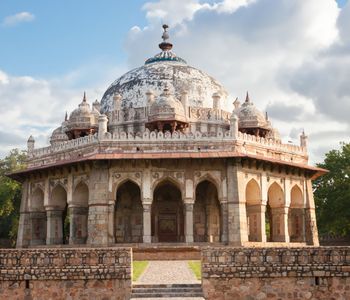
Among the secondary structures, seek out the Barber's Tomb near the main entrance and the Tomb of Isa Khan, which actually predates Humayun's Tomb by about two decades. Isa Khan's octagonal structure has its own small garden and a quiet, almost private atmosphere that the main monument simply can't offer during peak hours.
One Hundred and Fifty Graves, One Building
Humayun doesn't rest alone. The mausoleum contains over 150 Mughal graves, making it less a single tomb than a royal necropolis. Many belong to later Mughal rulers and their relatives, interred here over the following centuries as the dynasty's power dimmed and the resources for new monuments dried up.
In 1857, the last Mughal emperor, Bahadur Shah Zafar II, hid here during the Indian Rebellion against the British. Captain Hodson of the British forces captured him at this very site. The building that began as an expression of imperial love ended as the backdrop to an empire's final surrender. That kind of layered history doesn't announce itself with plaques. You have to carry it in with you.
Getting There Without the Headaches
The tomb sits near the Nizamuddin area of South Delhi, sandwiched between the busy Mathura Road and Nizamuddin Railway Station. Take the Delhi Metro's violet line to JLN Stadium station, and you're roughly a ten-minute auto rickshaw ride from the entrance. The Hazrat Nizamuddin station on the pink line puts you even closer.
Entry costs 600 rupees for foreign nationals and 35 rupees for Indian citizens. The complex opens at sunrise and closes at sunset daily. Weekday mornings remain the most peaceful window — by Sunday afternoon, the gardens fill with families and the selfie-stick density around the central platform rises sharply.
Budget at least ninety minutes for a proper visit, longer if you want to explore Isa Khan's tomb and the surrounding structures. The Nizamuddin Dargah, the shrine of the revered Sufi saint, lies within walking distance and pairs naturally with a trip here. On Thursday evenings, the sound of qawwali drifting from the dargah adds a dimension to this neighborhood that no monument alone can provide.
A Monument That Taught an Empire How to Grieve
Humayun's Tomb earned its UNESCO World Heritage designation in 1993, and the Aga Khan Trust for Culture has led extensive restoration work since 1997. Sandstone has been cleaned, gardens replanted, water channels repaired. The work is meticulous and ongoing, which means the complex looks closer to its original state now than it has in centuries.
Delhi has dozens of monuments competing for your time, and most people allocate their hours to the Red Fort or Qutub Minar first. That's a mistake of sequence. Come here before those places. Humayun's Tomb is where the architectural language of the Mughal Empire found its voice — the grammar of symmetry, garden, dome, and sandstone that would echo across the subcontinent for the next two hundred years. Stand in front of it, and you're looking at a rough draft that turned out to be a masterpiece in its own right.